Bager1968
Air Brakes are a type of flight control used to reduce air speed during landing. They differ from spoilers in that air brakes are designed to increase drag while making little change to lift, spoilers greatly reduce lift while making little change to drag.
They are on all modern fighters (and many other combat aircraft), although some have them in different places.
F-15 – Center fuselage upper side:
F-16 – beside exhaust both sides:
A-6 – wingtips (early models also had ones on aft fuselage sides which were later removed):
A-4 – aft fuselage sides: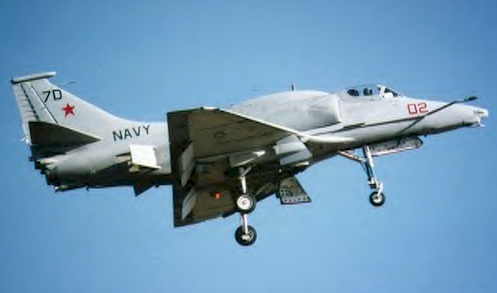
Bager1968A few points need to be brought out here.
1. There are already “primary jet trainer” aircraft in the US fleet… the USN/USMC have their T-45 Goshawks, and the USAF has replaced its T-37s with the T-6 (calling it a “jet-like trainer”), so the need is for the next step between those two and the fighters. T-45 also fills this for the USN/USMC, just the USAF needs something.
2. The USAF/USMC/USN have all said that they are not asking for a “trainer” version of either F-22 or F-35, so the new trainer needs to prepare new pilots to fly “all-up combat aircraft”, so something simple just won’t do… it needs to be a true LIFT aircraft.
3. The USAF has stated that “supersonic flight is NOT a requirement of this program”, so T-50 doesn’t get any special consideration for that feature.
4. The T-38 is limited to about 5g loads during aerial combat, which is insufficient for preparing pilots for the 9g capability of the Lockheed Martin F-22 and F-35 Lightning II. The new trainer needs to be rated for at least 7g.
To summarize the main & outside competitors:
The Korea Aerospace Industries/Lockheed Martin T-50 is a candidate.
In April 2010, Finmecannica chief executive Pier Francesco Guarguaglini said that Alenia would seek a US partner as a prime contractor to offer the M-346 to the USAF. For the T-X competition, the M-346 is renamed the T-100 integrated training system (ITS).
Meanwhile, BAE’s plan is still to offer the Hawk T2/128 through its US-based subsidiary BAE Systems Inc.
Meanwhile, Boeing has a relationship with Alenia to market the M-346 in some international markets, and has previously teamed with BAE Systems to build T-45 Goshawks for the US Navy. Therefore, they could either team up with one from the start, wait and team with either the M-346 or H-128 if one of those wins, or throw a monkey wrench into the whole competition (what else is new).
Boeing, in particular, wants the USAF to factor industrial base issues into the T-X competition. Industry sources last year confirmed to Flight International that Boeing may offer a “purpose-built” aircraft. With each off-the-shelf option relying heavily on foreign aircraft designers, Boeing may hope to sway the requirements to drive a clean-sheet design launched by a US manufacturer.
Northrop Grumman also has the ability to surprise the competition by producing an all-new, clean-sheet design. In addition to its long heritage in the trainer market, the company owns a major stake in Burt Rutan’s Scaled Composites.
Among several ambitious design projects over the years, Scaled designed and built a jet-powered replacement for the Fairchild A-10 ground-attack aircraft in the early 1990s called the agile response effective support aircraft.
Bager1968I’m not sure the 3rd San Giorgio will be sold… or even removed from service.
The San Giorgio and San Marco were laid down in 1985 and 1986 respectively while the slightly larger San Giusto was not ordered until 1991. The first two ships were launched in 1987 and commissioned in 1987 and 1988.
The San Giusto, launched in 1993 and finally commissioned in 1994, is some 300 tons heavier as a result of a longer island and increased accommodation. San Marco was funded by the Italian Ministry of Civil Protection and, although run by the Italian navy, is specially fitted for disaster relief operations.
San Guisto is normally operated as a training ship.
The first two were modified and refitted starting in 1999, to allow simultaneous operation of 4 helicopters (similar to San Guisto). The bow doors of the first two have been removed, and a closed bow fitted (San Guisto never had them).
It is likely that one of the three (likely San Marco) will simply be transferred completely to the Ministry of Civil Protection.
Bager1968Italy To Get New Amphibious Ships
The Italian navy has received the go-ahead to procure two 20,000-ton amphibious assault ships (LHDs), with the possibility of a third ship, configured with extensive aviation facilities (LHA).
The preliminary LHD project is funded and will take 12 months for completion. It will be followed by a project definition phase requiring eight months and leading to a contract. Delivery of the first ship comes within 30 months after that. If everything goes to plan, the first LHD arrives in late 2014.
LHDs will replace two 8,000-ton San Giorgio-class LPDs, commissioned in 1987 and 1988. The LHA will eventually replace the carrier Garibaldi, which is being dedicated to amphibious and helicopter roles now that the Cavour carrier is in service.
I expect that “LHA” will be a repeat Cavour, with minor modifications.
This will give Italy 2 ships that can operate F-35B (with a secondary amphib role), and two that concentrate on the troop/equipment landing role (with a secondary helo-support role).
In a pinch, the LHDs could operate ASW helos controlled by ASW escorts, and the LHAs could boost the amphib capacity if air support is supplied by allies.
Two different types of flexible, multi-role ships. Nice.
Bager1968The last thread for F-100 pics had lots posted by TangoIII… who removed them a couple of months later.
Hun pics
This one still has a bunch:
Questions about the Hun
Which has a link to an F-100 site:
http://www.f-100.org/
There are also numerous “F-100 vs Mig-19” and “Mig-19 vs F-100” threads that might have some pics… use the search function to find them.
And since Pioneer is still around, I have an aswer to his question from 2006:
Does anyone have any infomation on the carrier-based version of the F-100 Super Sabre proposed by North American to a US Navy Request for Proposal ??
http://tailspintopics.blogspot.com/2009/10/proposed-super-furies.html
In November 1953, North American tried to end run the F8U program with a Super Fury proposal, which was a carrier-based derivative of the J57-powered F-100B (stretched fuselage, wing flaps, etc.) being proposed to the Air Force. The F-100B was a redesign of the J57-powered F-100A that incorporated the latest supersonic flight technology and almost doubled the internal fuel capacity. The inlet was now swept back and incorporated variable geometry, with a horizontal ramp on the upper side used to establish and control the shock wave associated with supersonic flight. Unlike the F-100A, the fuselage was to be area ruled for improved transonic performance and lower supersonic drag. It had also been lengthened by almost four feet to increase its fineness ratio and add more fuel. The wing was basically the same in shape and area, but it was thinner and designed to hold fuel. Flaps were added and boundary layer control incorporated for slower takeoff and landing speeds. The main landing gear now featured dual wheels.
For the Super Fury proposal, in addition to adding the requisite tail hook, wing folding, catapult hooks, etc., other changes were made to the F-100B design to further improve the prospect of carrier suitability. When the flaps were lowered, the folding portion of the wings was repositioned to provide 15 degrees of anhedral to improve lateral stability and aileron control at low speeds. The fuselage speed brake was intended to be deployed on approach and would retract automatically on touchdown. Another innovation was a retractable gun sight to improve over the nose visibility.
North American chose to propose armament of three T-160 20 mm cannons. Dual rotating rocket launchers contained 44 two-inch folding fin rockets could be substituted for the guns. One feature from the F-100B design was an alternative forward fuselage that incorporated a radome housing a small search radar in place of the APG-30 ranging radar.
Although it had the same engine and equipment, the Super Fury was heavier than Crusader so it would also have cost somewhat more. Although shorter, only 22 could be spotted in the requisite deck space compared to 25 F8Us . The Super Fury proposal was also deficient in military power ceiling. However, it was projected to be slightly better than just supersonic on military power, faster than required on combat power, have considerably more range on internal fuel and external fuel, and otherwise meet or exceed the requirements.
The proposal’s most compelling feature was that a prototype of sorts was flying and first Super Fury production delivery was expected in early 1956 on that basis. As it turned out, the Air Force decided not to proceed with the F-100B (although it did seque into the F-107) and the Vought F8U Crusader was a success.
Links are to full-size versions of the illustrations:
The gray shadow is the F-100B:
http://2.bp.blogspot.com/_wI-DdPSXymk/SvS1PEq_l9I/AAAAAAAAAd4/1YcZKuJheA8/s1600/F-100A%2Bvs%2BF2J.jpg
Bager1968So easy for clumsy (or agenda-ized) editors to modify the footage so you appear to say something you didn’t actually say as well.
Like cutting a particular question and the wrong answer, to the remaining answer is attached to a different question.
But at least some of what you remember & want others to know about will be preserved, so by all means, please do participate… future generations will gain the benefit.
Bager1968Well, the UK can afford to give out £8billion per year in foreign aid.
You give £38 million a year to China… each year you will give about £1billion in aid to India, a nuclear-armed power and one of the fastest-growing economies in the world… a nation which launched an un-manned probe to the moon in 2008*, has formally established a manned space program of its own**, and which is building its own aircraft carriers and has bought one from Russia at nearly the cost of one CVF.
Now you tell me the UK can’t afford its own carriers?
Perhaps you wish to sub-contract the defense of the UK to India… after all, the UK is paying for much of India’s Navy.
* http://www.astrobio.net/pressrelease/3240/early-end-to-indias-moon-mission
Bager1968How do you think I felt in the winter of 1990-91, when a Sovremenny & a Udaloy made a port visit to San Diego, Ca?
The Soviet Union was still in existence, and here were two of its destroyers in the largest US Navy West Coast Port?
They were anchored just off the north-east corner of North Island… home of Naval Air Station North Island, and the piers for 3 USN supercarriers!
I had recently (mid-1989) left the USMC after 8 years, and while they were awesome to see close-up, my only other sightings of Soviet warships were on the videotapes from our F-14s & A-6s as they flew over them at sea*… in a very different context.
* I had served aboard one of those USN carriers from 1986-1987 while my squadron was attached to her air wing, and we made 2 trips to the Korean operating area & 1 trip to the northern Indian Ocean during that time.
Bager1968Look again.
F-100D: Wingspan 38 feet 9 inches, length 50 feet 0 inches, height 16 feet 2 3/4 inches
F-8E: wingspan 35 feet 8 inches, length 54 feet 6 inches, height 15 feet 9 inches
What you are seeing is due to aircraft being at different distances from the camera.
Bager1968Bager1968Think they could come over to England this fall & do that?
😀
>grabs jacket & exits<
Bager1968I hope you do not mean that case of Mistake identity when Minssionaries were killed???
The case where the plane with the missionaries were killed was in Peru, not Brazil… and the PAF aircraft was an A-37 jet, not a prop-driven Tucano.
Brazilian shoot-down: http://www.youtube.com/watch?v=gHDZqUa0m1s
Peruvian shoot-down: http://www.huffingtonpost.com/2010/02/04/video-of-missionaries-bei_n_449074.html
The Peruvian incident shows the importance of clear communication, as the CIA officers spoke little to no spanish, and the Peruvian AF officers spoke little to no english, relying on a third party to translate messages, thus the CIA couldn’t get the PAF to hold off for further verification until it was too late.
Bager1968Catapult strops on a A6. Never heard of that before.
The A-6A was designed for bridle-launch. The prototype, designated A2F-1, made its first flight on 19 April 1960.
The A-6A (the USN changed its designation scheme to match the USAF in the fall of 1962) entered squadron service in February 1963.
On 19 Dec 1962, an E-2 Hawkeye catapulted from the USS Enterprise in the first shipboard test of nose-tow gear designed to replace the catapult bridle. A second nose-tow launch was made by an A-6A.
Bager1968Well, its the Daily Mail, so ’tis to be expected…
Other drawings feature caricatures of Hitler, Winston Churchill and then American president Theodore Roosevelt,
Wrong President Roosevelt!
Theodore Roosevelt was the 26th President of the USA, from September 14, 1901 to March 4, 1909.
He lived from October 27, 1858 to January 6, 1919.
Franklin Delano Roosevelt (5th cousin of TR) was the 32nd President of the USA, from March 4, 1933 to April 12, 1945.
He lived from January 30, 1882 to April 12, 1945.
TR was also the brother of Elliot Roosevelt, father to Eleanor Roosevelt, wife of FDR (her fifth-cousin once removed).
Bager1968The F-100 was out of all USAF squadrons by 1972.
Several hundred F-100Ds (single seat ground attack) & a hundred F-100F (combat trainer & Wild Weasel I) served in the Air National Guard in various states, but all F-100D/Fs were gone from the ANG by 1979, replaced by F-4s, A-7s, & A-10s.
Denmark & Turkey retired their F-100s in 1982.
France retired the last of theirs in 1978.
Taiwan is nearly impossible to get public-sector info from, and Fight’s On: Airborne With the Aggressors (Tim Laming, 1996) {about aggressor & drone aircraft} claims that Taiwan might still be operating some of their F-100D/Fs at that date.
Don Chan on the Modern Military section has an extensive knowledge of Asian air forces… he should be able to provide a date for Taiwan’s retirement of their F-100s if anyone can.


 Sign In