 Bager1968
So much for the problem cited by Swerve:
2. There is no clear route. Most of any possible routes would be over foreign territory
http://www.ynetnews.com/articles/0,7340,L-3903864,00.html
Report: Saudis permit Israeli jets to pass over to Iran
London Times reports Saudis carry out defense missile tests aimed at allowing Israeli warplanes to pass through airspace on way to bomb nuclear facilities in Iran. ‘We will let them through and see nothing,’ says source
Ynet
Published: 06.12.10, 08:42 / Israel NewsSaudi Arabia has carried out tests of its missile defense systems aimed at allowing Israeli warplanes to pass over its territory on their way to strike nuclear facilities in Iran, defense sources in the Persian Gulf told the London Times Saturday.
Passing over Saudi Arabia would shorten the flight to the Islamic Republic. According to the report, the missile tests were carried out in order to ensure that Israeli planes will not be shot down while flying over the kingdom’s territory.
In 2009 the London Times reported that Mossad chief Meir Dagan held talks with Saudi Arabia on the subject, and even updated Prime Minister Benjamin Netanyahu on their outcome.
In the report, a diplomatic source was quoted by the paper as saying that “the Saudis hinted that they would agree to allow Israeli jets to pass through their airspace in order to carry out a mission with common Israeli and Saudi interests”.
In Saturday’s report a US defense source in the region was quoted as saying, “The Saudis have given their permission for the Israelis to pass over and they will look the other way.”
He added, “They have already done tests to make sure their own jets aren’t scrambled and no one gets shot down. This has all been done with the agreement of the State Department.”
Sources in Saudi Arabia also told the paper that senior officials in the kingdom had agreed among themselves to allow the planes’ passage. Despite the bad blood between the two states, fears Tehran will develop a nuclear weapon are shared.
“We all know this. We will let them through and see nothing,” one source told the paper.
Bager1968Looks like a Chinook with wings instead of rotors!
Bager1968so for this new fighter design SAAB thought FOD was a higher priority than dog-fighting?
Obviously not, since they actually went with a different design in the end 😉
According to articles describing the development of Gripen, the top-intake design was the best “statically stable” design they came up with… better than the canard-delta if natural aerodynamic stability was required.
However, the decision was made to make the aircraft “statically un-stable”, using full FBW & computerized flight controls. This allows a better aerodynamic performance, which allowed use of the higher-lift, greater payload canard-delta configuration.
Bager196818 FREMMs is a doubling of their current fleet of 6 Niteroi & 3 Type 22 (Greenhalgh) frigates, & a replacement with more capable ships.
Quite true, and a good plan.
10 OPVs is also a big increase in capacity.
Not really, they currently have 5 corvettes, one of which is new (2,350 tons full load), and 4 x 15-20 year old (1,970 tons full load).
They also have 15 OPVs, one of which is a new Franco-Brazilian design. Another of this type is under construction, and 4 more are planned.
http://en.wikipedia.org/wiki/List_of_ships_of_the_Brazilian_Navy
Bager1968Thanks for the links, pagen01, as the word “airbase”, without any further elucidation whatsoever as to which airbase, or what meaning of the term was intended, meant nothing to those outside your narrow geographical area.
And no, I hadn’t read the 3-page thread started weeks ago about it, as it looked (from the preview blurb that pops up from the title in the index page) like just another thread about a WW2 base.
Bager1968Or the NR-349… an advanced interceptor based on the A-5 Vigilante… it had intakes on both sides of the fuselage… both above & below the wings!
From vectorsite http://www.vectorsite.net/ava5.html :
North American proposed advanced versions of the Vigilante to the US Air Force an interceptors. One, known as the “Retaliator”, added a liquid-fuel rocket engine to the two J-79s, but the Air Force didn’t pursue the concept.
Later, in 1972, in response to an Air Force requirement for an advanced interceptor, North American proposed adding a third J-79 in the center bay and arming the “NR-349”, as the new aircraft was designated, with six AIM-54 Phoenix air-to-air missiles. The Air Force didn’t follow up on that concept, either.

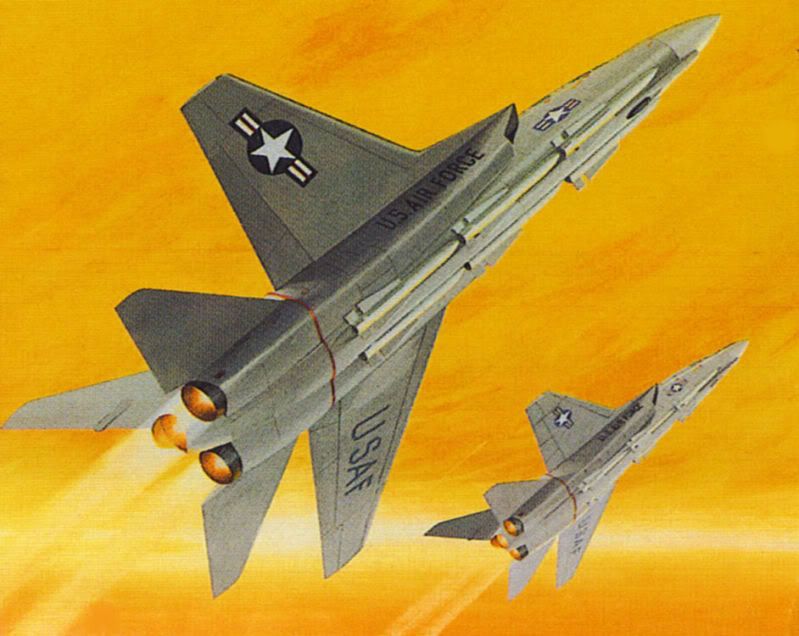
Note the bifuricated intakes on the upper surface feeding the third engine.
Bager1968Ah, but…

Bager1968I seem to remember something written by a defected NK Mig pilot to the effect that the NK pilots received combat training in China in Mig-9s/Yak-15/17s (he described straight wings & engine(s) under the forward fuselage).
Their early combat sorties were from Chinese airfields, as those in NK were damaged by USAF B-29 strikes.
In the first year or so of the war, most of the Mig-15s encountered by UN forces were piloted by Russians, with the NK pilots only starting to get them in 1951.
Bager1968A short barrel doesn’t mean an inaccurate weapon.
My father is a retired railroad police officer, and in the State of Utah that automatically made him a reserve Sheriff’s Deputy.
When he went to the police range for his annual qualification, he always got “regular” police officers miffed. With his Smith&Wesson .357 magnum with a 2 1/4″ barrel, he normally shot a perfect or near-perfect target (50′ range)… far better than most of the “real” officers.
Bager1968HASC Chair Skelton Wants Diesel-Electric Subs
The cruise-missile carrying, stealthy submarine may very well become the ship of the future, says Rep. Ike Skelton, the influential chair of the House Armed Services Committee. Determined to see the Navy battle fleet grow to 313 ships (today’s fleet is 286 ships), and mindful of shipbuilding costs, he thinks building larger numbers of smaller, perhaps even diesel-electric, submarines, instead of large capital ships, might be the answer.
Small, stealthy submarines have utility in both high-end, large scale wars and low-end, guerrilla conflicts, he said, speaking to reporters in Washington this morning.
“Numbers make a difference, presence makes a big difference… just an American ship in the area makes a big difference.” Skelton is so adamant about naval forward presence that he said just “put sails” on any ship and get it out there.
God, is he stoned?
If he expects “forward presence” from SSKs, we will need a lot of fully-equipped “forward bases” to allow those short-ranged things to have some semblance of a mission duration.
The advantage of a SSN is its nearly unlimited range/duration (food supplies & crew mental status are the main limiters), allowing them to make high-speed transits across the Atlantic/Pacific oceans!
Going to a shorter-ranged SSK, whose mission duration is strongly limited by fuel considerations, means that they cannot be based in the US… they will have to be based in foreign countries… with all the political complications that brings.
As far as “just “put sails” on any ship and get it out there”, I guess USS Constitution will be doing a cruise to the IO soon, then?
MORON!
Bager1968I think everyone is getting confused by the Southern Cross, it is normally depicted with 4 stars and not 5.
G.
Australian flag:
Here are what the stars are:
New Zealand flag:
Bager1968The first YAK jet fighter was the Yak-15.
The Yak-17 was a new design, but was very similar in appearance to the Yak-15.
Yak-15:

Bager1968What about a modern Bronco or Mohawk for COIN missions.
Mohawk isn’t very good for COIN.
Bronco idea isn’t a fantasy…
http://strikehold.wordpress.com/2009/10/14/ov-10-comeback-will-the-bronco-buck-again/
14/10/2009
Boeing has confirmed that it is going to offer a new, upgraded version of the Vietnam-era OV-10 Bronco for the USAF’s OA-X Light Strike aircraft programme.
Bager1968No German jet aircraft could have fought in the BOB, engine development boosts or not.
The Me-262 wasn’t even nearing flight tests during the BOB.
Its first test flight was April 18, 1941.
The He-280 was a bit earlier (first powered flight March 30, 1941), but still not flown during the BoB, as its first test flights (towed, unpowered) were conducted from September 22, 1940 on.
Improved funding would not have speeded their first flights much*, as the reduction in funding took place in February 1940, but it certainly would have speeded up the attainment of actual operational capability.
* the He-280 example shows that airframe design was a bit ahead of engine development, but the airframes weren’t ready by the BOB either.
Bager1968Apparently, you have signed in there, so it accepts a link request from your computer’s IP address.
For anyone who does not have an account there, it limits the link to the sign-in page.
This is actually common for sites that require registration before access is granted.
I suggest you download the pic/doc & put them up on a “no registration required to view” hosting site.


 Sign In







