 Bager1968
On the contrary, the “second fuselage” is vitally needed.
The extra-wide fuselage required for an effective COD aircraft (and “nice to have” for a tanker) reduces speed and range/endurance… which are needed for the ASW/AEW roles.
Thus, having a narrower fuselage for those variants and a wider one for the others makes good sense.
Bager1968All of the 90 KA-6Ds were converted from A-6As (12 of which had been converted to A-6Es before their “K” conversion).
The last A-6A left the assembly line in December 1970.
The first EA-6B (converted from an A-6A) flew in November 1970, and the first new-build EA-6B was started in January 1971 (only the first 5 “production” Prowlers and the 3 test articles were conversions).
The 170th & last EA-6B was delivered to the USN on 29 July 1991.
Therefore, the Prowlers averaged much younger than the tanker-Intruders, with the oldest EA-6B being younger than the youngest KA-6D, and the youngest being 20 years newer.
Bager1968It is fact. This issue was specifically investigated a number of years ago, and the movement records of all Japanese subs in service at that time were scrutinized, and it was shown that none were anywhere where they could possibly have been at (or gotten to) the battle site the evening of the battle or the next day or so.
Here are links to the full Parliamentary report of 199 (main page and section 5, which addresses the IJN sub point [5.39-5.69])
http://www.aph.gov.au/house/committee/jfadt/sydney/reportinx.htm
http://www.aph.gov.au/house/committee/jfadt/sydney/Sydch_5.htm
Apparently, there were not even IJN subs in the Indian Ocean at all, as they were being positioned for the attacks on Pearl Harbor, the US west coast, Indonesia, and the Philippines which took place 18 days later.
Bager1968And for just a little more (compared to the quoted price of one such refining plant), you can add currently-in-use stack scrubbers/purifiers which remove the CO2 from the exhaust and absorb it into a solid material, rendering the environmental issue technically* irrelevant.
Of course, those Greenies and their pet media and Congresscritters will ignore this and trumpet these plants as “The End Of The World”.
*As Greenies hate technology, they will not even know this, but it will still be political fodder… even though they will be spinning lies to support their cause.
99% of all pollution can be prevented with a little more technology actually being purchased & installed, but between bean-counters who refuse to spend on anything not required (by law or production necessity) and pollies/greenies who block such solutions because it will take away the “crisis issue” they get so much power from, we have the mess we are in now.
Bager1968$1.2 million? To an F119-P-100?
Sounds like the engine was damaged (as is normal when solid bits are ingested while running), but not even close to being rendered unrepairable.
As an example, here is a link to the Air Force Times article on the incident you cite in your original post:
http://www.airforcetimes.com/news/2007/11/airforce_f22_mishap_071105w/
Note that an earlier incident with a landing gear pin cost $6.8 million in damage to one F119 engine!
Bager1968All I have is a pic & info for the smaller Avro C-102.
Bager1968I’ve always maintained that his Rama quartet of books were the peak of his writing,
Rendezvous with Rama
Rama II
The Garden of Rama
Rama Revealed
as for the books he wrote with Gentry Lee I’d rather he hadn’t bothered.
Like the last 3 of the quartet you praise?
Bager1968I’ve always maintained that his Rama quartet of books were the peak of his writing,
Rendezvous with Rama
Rama II
The Garden of Rama
Rama Revealed
as for the books he wrote with Gentry Lee I’d rather he hadn’t bothered.
Like the last 3 of the quartet you praise?
Bager1968Here are links to the reports of the group that found both Sydney II and Kormoran:
The reports include sonar images and detailed descriptions of both what they found and how they found it.
The location (100 nm west of the coast of Western Australia) could actually be described as “extreme Eastern Indian Ocean”, not “South Pacific”.
Bager1968I refer you to the thread on this incident… which happened on November 2, 2007!!
http://forum.keypublishing.co.uk/showthread.php?t=75726&page=3
Here is the article stating the cause, with a link to an animation of the crash:
http://www.af.mil/news/story.asp?id=123081718
Bager1968A significant portion of that increase is directly due to the falling dollar vs the Euro… one of the hazards of buying foreign.
Bager1968The CL-321 would indeed be hard to up-engine… but the CL-291 much easier, with those pylon-mounted twin engine pods.
I notice the CL-291 seems to be an early version of what became the C-141?
The C-141 competition was issued in 1960… 5 years after Lockheed “won” the tanker competition.

Bager1968I’ve seen a drawing of the Lockheed proposal, looks like a smaller 135 or a Convair 880.
Ummm, no it doesn’t!
The Lockheed proposal (which won the competition) was a larger aircraft, with a higher fuel load capability, and with 4 x J75 engines (~50% more powerful than the KC-135’s original engines) in aft-mounted twin-engine pods blended into the underside of the wings.
The first version: CL-291-1: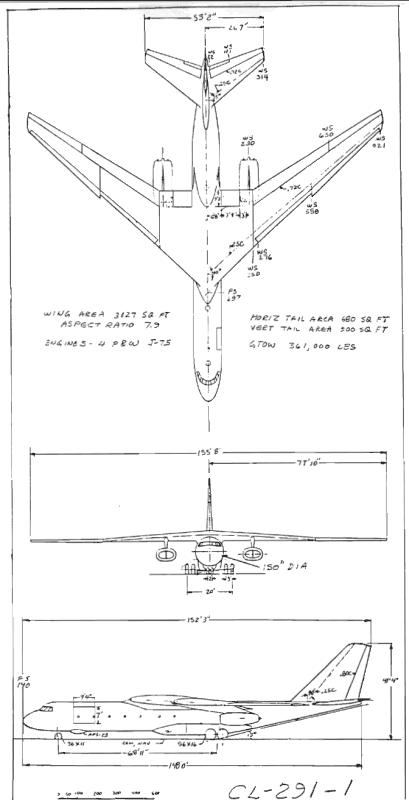
Final version: CL-321-11: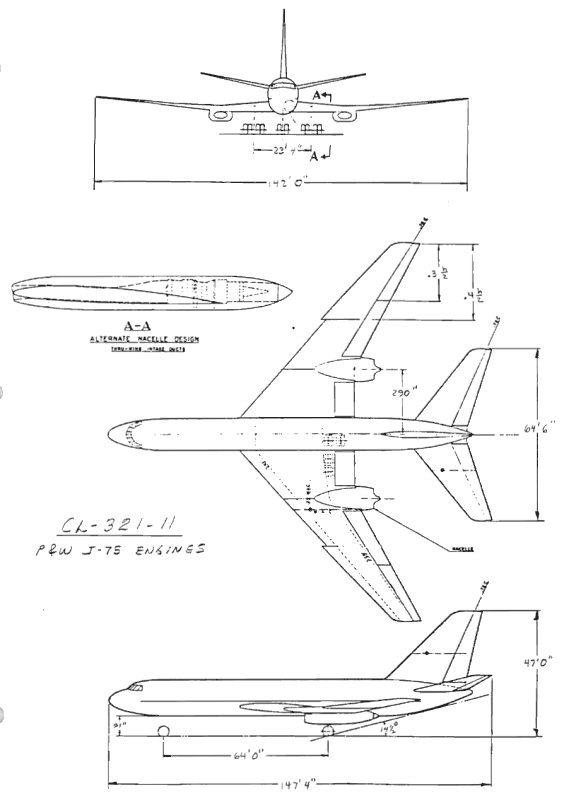
http://www.americanheritage.com/articles/magazine/it/2004/4/2004_4_10.shtml
(article on the history of aerial refueling)
“On March 26, 1952, Boeing’s president, Bill Allen sent a memo to his division heads, asking if they thought they could fly a prototype jet transport in just two years. Jim Barton in Boeing’s cost-accounting group said it would cost $13 to $15 million. On April 22 Boeing’s board of directors unanimously approved $15 million for Project X, or the Model 367-80, better known as the Dash-80. This project posed an enormous risk, for the military had not described the specific performance details that it wanted, and the $15 million investment represented more than twice Boeing’s profits from 1951. Although the plane had civilian uses as well, if the Dash-80 failed as a tanker, Boeing could fail too.
At SAC’s Requirements Conference in November 1953, General LeMay called for 200 jet tankers. The Air Force announced a design competition for a jet tanker on May 5, 1954, and invited Boeing, Convair, Douglas, Fairchild, Lock—heed, and Martin to participate. At that point Boeing’s leaders could only forge ahead with the Dash-80, which had its first successful flight test on July 15, and pray that it would win the competition.
On August 3, 1954, with the jet-tanker design competition still in progress, the Air Force decided to buy interim tankers. The Air Force Secretary, Harold E. Talbott, announced an order to buy 29 tankers from Boeing. Less than two weeks later the Air Force said it would buy 88 more Boeing tankers. It looked as if Boeing was set to win the competition, but it didn’t.
In February 1955 the Air Force announced that Lockheed had won the competition and at least one of its tankers would be funded for construction. In the very same announcement, however, Talbott said the Air Force would buy an additional 169 tankers from Boeing. Eventually it canceled Lockheed’s paper proposal.”
KC-135 engines: JT3s (civilian J57, 10,000 lb.s.t. [later 12,000-14,000 with water injection, then 17,000 lb.s.t. TF33 {turbofan J57} after 1960])
CL-291/321’s engines: J75 (15,000-17,000 lb.s.t.) (perhaps later the 21,000 lb.s.t. TF33 developments?).
KC-135:
Wingspan: 130 feet, 10 inches (39.88 meters)
Length: 136 feet, 3 inches (41.53 meters)
Height: 41 feet, 8 inches (12.7 meters)
CL-321-11:
Wingspan: 142 feet, 0 inches (43.28 meters)
Length: 147 feet, 4 inches (44.91 meters)
Height: 47 feet, 0 inches (14.33 meters)
Bager1968Lots of info can be found here:
HSK Kormoran Discovered
David Mearns – Search Director, The Finding Sydney Foundation
Wreck of HSK Kormoran Discovered
“The wreckage of the German Raider HSK Kormoran was found by the search team on board the SV Geosounder at 17:30 (AWDT) on March 12th, 2008 in the approximate position 26° 05′ 49.4″ S 111° 04′ 27.5” E. With Kormoran’s sinking position established, and the identity of its wreckage confirmed on the basis of high quality sonar imagery, the search for HMAS Sydney (II) has been localised to a most probable area and this search is currently ongoing.
Kormoran’s wreckage consists mainly of several pieces of hull amidst a large and dense field of debris, which is indicative of a ship that has suffered a catastrophic explosion. Following the initial discovery of the wreckage field using the 6 kilometre swathe of the SM30 sonar, a series of higher resolution sonar images were made that revealed additional information to confirm the identity of the wreck and its condition, as summarised below:
*
The wreckage of Kormoran was first found on Line #09 in the northeast quadrant of the designated 1,768 nm² search box. Line #09 was the fourth search trackline to be run and the SM30 sonar had been deployed for approximately 64 hours in the search box (excluding the time for turns) when the wreckage was first discovered. The depth of the site is approximately 2,560 metres.
*
The wreckage fits perfectly with what we know and expected to see for Kormoran from testimony of the German survivors. The vessel suffered a catastrophic explosion after its cache of some 320 mines stored in the after cargo holds 4, 5 and 6 detonated. This section of the vessel’s hull has been obliterated.
*
There are 4 large pieces of hull structure remaining. The two largest pieces are located hundreds of metres outside the main debris field and approximately 1,200 metres from each other on a line running roughly north-south. The distant locations of these pieces indicate that they sank after the explosion and/or took different glide planes in their descent to the seabed.
*
The largest piece of hull measures approximately 106 metres long by at least 20 metres wide and has been identified as the forward half of the ship that extends roughly from the engine room to the stem. It is sitting upright on the seabed with a height of approximately 13 metres. The high resolution sonar lines made in this area were focused on this piece because it offered the greatest chance to confirm the wreck as Kormoran by using the acoustic shadows “thrown” by the bow’s shape to see if it matched Kormoran’s bow.
*
In addition to matching the known breadth of Kormoran, which was significantly greater than Sydney’s breadth, the piece was revealed to have a raised forecastle deck like Kormoran. The forward part of the bridge superstructure was intact at roughly the correct distance from the stem. Lastly, the sonar imagery indicates an opening in the deck in approximately the correct position for the forward cargo hold.
*
The other large pieces of hull were not able to be identified. However, based on their dimensions and position relative to the blast, it is possible that these pieces are the stern/poop deck and at least part of the engine room/hull structure aft of the main bridge superstructure.
Scene of Engagement between Kormoran & Sydney Found
On line #09, less than 4 nautical miles south of the Kormoran wreckage position a separate and distinct debris field was found at 19:16 (AWDT) on March 12th, 2008. This debris was found to be widely scattered over a distance covering 1,700 metres and lying at a depth of 2,740 metres. However, it was not associated with any major shipwreck targets and was very sparse compared with the dense debris field found at the centre of Kormoran’s wreck location.
As Kormoran left the battle intact and was known to have drifted north with the prevailing current and winds after losing engine power, it is logical to conclude that this debris could not have come from Kormoran. However, the location of this wreckage in relation to the known movements of Kormoran in the final stages of the battle and her estimated leeway drift before sinking, does indicate that it marks the actual scene of action between Kormoran and Sydney.
This debris, therefore, must have come from Sydney as we know she had been gravely damaged by a torpedo hit and was being heavily shelled by Kormoran and in such a situation would have been losing pieces of structure and other parts of the ship overboard as was vividly described by the German eyewitnesses. Finally, the approximate NNE – SSW trend of this debris trail fits with the course of Sydney as she altered course south to avoid Kormoran’s fire.
Revised Planned Search Area for Sydney
Confirmation of Kormoran’s sinking position, as well as the location of the action between Kormoran and Sydney, has allowed me to refine the most probable sinking position of Sydney and outline a new search area for her wreck. This search for Sydney is currently ongoing.
Compared with the extremely large search area for Kormoran the initial search area for Sydney is relatively small and covers several hundred square nautical miles. Key to this initial search area are certain assumptions made about how far Sydney could have travelled away from the scene of action given the grave damage she had suffered – now proven by the extent and size of her wreckage found at the scene of action – and how long she could have remained afloat in such extreme condition.
Based upon the location of Kormoran, and the high quality sonar imagery that is being collected by the Williamson and Associates sonar team, I am confident that if the wreck of Sydney lies within our search area we will find her. Should this initial search area prove unsuccessful, the search area will be enlarged until the wreck of Sydney is found.”
The reports of the two Official Observers (one a RANR Lt.) and sonar images are there also.
Bager1968India gets a major disaster-relief asset, gets to develop doctrines & techniques for use of such ships in many areas, and gets to conduct a detailed, years-long technical evaluation of a very successful design and type.
This will enable them to build their own in the future.
Additionally, the line “But the CAG report found that the U.S. Navy had concluded in 2003 that the ship was not suitable for modernisation and should be decommissioned.” is more than a little deceptive, as the USN is modernizing NONE of the class, but is replacing them with larger, much more capable, much more modern new ships (see San Antonio class LPD).


 Sign In







