 Bager1968
So, the big news is that they can now turn on the lights aboard, and that they can tie her up to an out-of-the-way pier so she is not in the way while everybody takes a 2 (or 12) month vacation.
Bager1968Does anybody have any pics of the USS Enterprise in the current Lybia Operations???
Ha, ha… you know that 65 is puttering around the mouth of the Persian Gulf, along with Big Carl, while the 4 (sorry, now 3) USMC AV-8Bs from Kearsarge have to rely on the 8 Rafale operating from the Charles big-nose… with the almost-assistance of the 8 AV-8Bs from the Giuseppe no-fight*.
http://navyhandbook.org/233/uss-enterprise-moves-to-strait-of-hormuz-to-join-uss-vinson/
* apparently the Italian government has ordered them to fly patrols but to not conduct combat operations.
Berlusconi also said that Italian planes “are not firing and will not fire”
Bager1968Bager1968KC-46A Stratopolitics
Bager1968I would agree IF that were to be a permanent buy reduction (ala F-22). What has basically happened is a 2-3 year shift to the right in production numbers. There is no plan to cap the per-year build number (or overall numbers) like the did to the F-22 program (still too low at 187 IMHO).
The cost of this year’s LRIP buy is calculated on how many you buy this year… next year is a separate contract and has NOTHING to do with the cost of this year’s buy!
Whether there is to be an overall reduction in buy has nothing to do with the cost of a single-year production contract.
Only if it were a multi-year contract would the exact schedule of so many per year be of small relevance.
Bager1968Why not just stick a few Astute type reactors in each carrier and be done with it.
What, and put a hard limit of ~25 years on their service life? The Astute reactor design does NOT include provisions for being refueled!
What happens to the RN’s plans to keep them around for 40-50 years?
Instead of a costly mid-life refueling, using Astute reactors will require a immensely budget-breaking mid-life reactor replacement!
Astute Class submarines ….. are to be powered by a Pressurised Water Reactor 2, equipped with Core H, which will fuel the reactor for the submarine’s full service life, ending the need for costly reactor refuelling.
http://www.armedforces.co.uk/navy/listings/l0011.html
Once deployed, Astute is designed not to require refuelling throughout her 25-year service life.
http://www.navalshipbuilding.co.uk/navalship_warships.asp?ID=WAR1&catID=5
Bager1968Had seen this picture on local TV, plus the 2seater version of the Sabre (cant remember the name) which was seen sticking out from under a building, though it looked intact.
Fuji T-1.
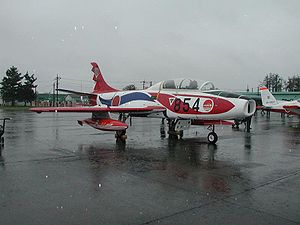
Bager1968Just going back to the power question, is there enough power to generated to move the ship, for hotel functions and to fling aircraft of the front.
Total power production for the chosen set up is 112mw, maximum power consumption by the 4 electric motors is 80mw leaving 32mw minimum for hotel and EMALS.
EMALS delivers a peak out put of @60mw but of course is charged over a period of time, any one know what the charge rate is?
The publicly-available number is 6.35 MVA.
This is the continuous pull from the power grid per catapult while that catapult is launching aircraft.
This power is used to spin up the rotors, which then provide the actual launch pulse via regenerative braking.
Bager1968is 340 f35c (including usmcs planes) enough to operate 2 active squadrons per carrier, with attrition reserve etc? Usually PAI comprises at best some 70% of TAI, total ac inventory. Will 210 f35cs be enough for 8 active carriers? That is enough for barely 12 plane squadrons and not enough for 14 plane squadrons. And even with that, there wouldn’t be almost any additional f35s ready for extra squadrons. 2 sqds of f35 and 2 sqds of f18 may be peactime loadouts but in war we’re sure to see the need for a squadron or two extra per carrier, where needed.
12 plane squadrons would be enough to provide with perhaps 2 more such squadrons to be place wherever on demand. Of course, if one wants just 10 plane squadrons everything becomes much easier.
Or is all this a clear sign of USN getting permanently rid of some carriers, where in the future only 7 carriers would be ready for action within 1-3 months?
Even if so, USN will have a visibly higher ratio of f18s per carrier than with f35c, which makes the claim of 50/50 sqd (f18s and f35s) per carrier more dubious. Something doesnt add up.
The USN hasn’t operated 14-aircraft fighter/strike squadrons for years.
A Strike Fighter Squadron is usually made up of ten to twelve F/A-18 Hornets or F/A-18E/F Super Hornets.
From the Navy Times article:
The Navy continues to plan for a fleet of 10 carrier air wings, with 44 strike fighters per wing, organized into 10- and 12-plane squadrons.
This will most likely be 2×10-plane F-35C squadrons and 2×12-plane F/A-18E/F squadrons (the extra Super Hornets are to provide “buddy tanking” services).
This means that 200 F-35Cs will be assigned to the 10 CVWs.
Of these, only 3-4 CVWs will be on deployed carriers, 3-4 will be assigned to carriers undergoing post-deployment pier-side maintenance or pre-deployment training/work-ups (and thus will be at their “home” land airfield most of the time) and 3 will be assigned to carriers undergoing more intensive maintenance (usually in drydock), and thus will themselves be undergoing training and maintenance cycles at their “home” airfield.
The 11th carrier is the one undergoing its “mid-life” 4-5 year-long Refueling and Complex Overhaul, and has no CVW assigned.
Five reserve squadrons will also fly strike fighters. Three Marine Reserve squadrons will fly the F-35B, one Navy Reserve squadron will operate the F-35C, and one other Navy Reserve squadron will fly single-seat F/A-18E Super Hornets.
The USN will continue to have some F/A-18s in the aggressor squadron (which is larger than a standard squadron).
Current USN plans are for the number of carriers to drop to 10 when CVN-65 decommissions in 2013, but to return to 11 when CVN-78 commissions in 2015 and remain at 11 until 2040, when it will drop back to 10 permanently.
I personally expect for Congress to order the retirements of the Nimitz class (CVN 68-77) to be sped up ~3-5 years, which will mean that CVN-68 will retire in 2015 rather than 2018, CVN-69 in 2018 rather than 2021, etc… thus keeping the number at 10 until 2040, when it would drop to 9.
This would mean that the number of CVWs would drop to 9, requiring 180 F-35C and 216 F/A-18E/F.
Bager1968Forgive my ignorance but if a “stall” was the cause – where did all that forward energy come from?
It seems quite evident in the last Photo that the Hurri was landed with full flaps and no gear down, sliding to a halt on the oil cooler fairing.
A stall, unless from a very great height, would produce a “much deeper” and shorter event marking.
Just my opinion…
“Stall” does not mean either a total loss of forward airspeed or a “vertical descent”… just that the forward airspeed was less than that required for continued aerodynamic flight.
With the plane in a level position, all that is required for a “stall” is for the pilot to chop the throttles when the plane is just above stall speed, and the speed would drop below the critical point.
The plane would then begin to drop… and since in a landing attempt the aircraft isn’t very far up, it wouldn’t have time for a nose-drop, a tail-slide, or to fall off onto a wingtip before the fuselage impacted the ground.
Since there is still forward airspeed, the plane slid forward.
As noted by hurri600, the pilot also failed to lower the undercarriage… two mistakes on the same landing attempt.
Bager1968The USMC is getting 80 F-35C to meet USN demands for Marine squadrons on CVNs. This will be 5 squadrons (the USMC currently provides 4 F/A-18C squadrons for this duty).
The other 340 USMC Lightning IIs will be F-35B.
Note: all bolding of text is mine.
http://www.navytimes.com/news/2011/03/navy_dfn_jsf_031411w/
The Navy Department still intends to buy 680 F-35 joint strike fighters. Of those, 260 will be Navy F-35Cs, another 80 F-35Cs will be Marine aircraft, and the STOVL version for the Corps will make up 340 planes, or half the total Navy-Marine JSF fleet. The Lightnings will serve alongside a total fleet of 556 F/A-18 Es and Fs.
This still means a major shift to a STOVL-centric USMC strike-fighter force.
The Marine F-35s will replace all aircraft in 19 tactical squadrons — 12 squadrons flying 261 F/A-18 Hornets, and seven squadrons flying 145 AV-8B Harrier II jump jets. All of the current aircraft in those squadrons are to be phased out by 2023.
The USMC currently has 406 strike fighter/attack aircraft, only 35.7% of which are STOVL.
When the transition to the F-35 is complete, the USMC will have 420 strike fighters, 80.9% of which will be STOVL.
This is more than double the percentage of STOVL combat aircraft in the USMC.
Bager1968Your link had a break in it… try this:
http://www.chronicle.gi/headlines_details.php?id=17025
And again I am struck by the difference in attitudes towards fallen servicemen of the UK MOD and the US DOD.
The article was 19 months ago… any progress?
Bager19683D View of EC-145
3D view of BK117
Note that the UH-72A doesn’t have the windows in the rear doors
Compare the BK117 and the EC-145, the fuselage is slightly different and the EC-145 has 1 window more.
Also the vertical fins are different in shape as is the motor housing.Gerard
Kinda like the differences between the UH-1B, the UH-1D, the UH-1N, and the UH-1Y?
Bager1968It’s a question of priorities and affordability as well: what type of vessel is needed now, and can we afford it? A less sophisticated ship, carrying helicopters and boats and basic sensors and weapons, would be a lot more useful and affordable for the next ten years at least, than a very expensive high-end frigate. RN frigates very little of their time escorting carriers at 25 knots these days.
First, “basic sensors” means less-capable, and therefore a greater possibility of a RN ship taking a torpedo or two, resulting in the loss of a ship & many of its crew, and (with the current/planned small numbers) likely a delay or cancellation of whatever operation the sunk ship and its ineffective escort were engaged in.
Hoe is this “more useful” than a ship that can actually find and sink the sub before it launches its weapons?
And even if approved NOW, they wouldn’t be in service for at least 5 years.
The military-ignorant vote-addicts running the government would never authorize their replacement before at least 20 years service, nor would they authorize an increase in numbers to provide faster escorts for the carriers.
This would leave the carriers with under-speed escorts for at least 15 years.
And this would be good how?
With only 1 fast carrier that is not sent anywhere, no, you don’t need many high-speed frigates.
With 1 fast carrier deployed into a combat zone (and the other getting an emergency re-activation due to the emergency), you need several high-speed frigates in service just for them… as well as for other missions requiring a fast repositioning and/or fast tactical maneuvering of a/some frigate(s).
Bager1968Does the follow on EC145 count?
The EC 145 was originally referred to as the BK 117 C2.
In 2006, the “UH-145”, a military variant of the EC 145, was selected for the United States Army’s Light Utility Helicopter Program, beating three other helicopters. The planned 345 helicopters have been designated UH-72 Lakota by the U.S. Department of Defense for the United States Army. The first UH-72A was delivered in December 2006.

Does anyone know if, besides the BK-117M, there was anyone who operated an armed BK-117?
Armed Scout 645
A proposed armed version of the UH-72/EC145 being offered for the US Army’s OH-58D replacement program.


 Sign In







