hopsalot
A claim that F-35 somehow matches Rafale bcs it can theoretically do M1.6+ is way too stretched. For an interceptor, not only the top speed is important rather than how fast can it get there and what is the fuel penalty connected with such effort.
Certainly acceleration and climb performance is also important, probably more so than max speed, but we don’t have the necessary numbers to do an apples to apples acceleration comparison.
Extrapolating from the numbers we do have…
Clean the Rafale will have the advantage. (but would presumably be flying at an airshow)
Lightly loaded for air to air (4-6 AAM(internal on F-35), +centerline tank for Rafale):
Max speed:
Rafale M1.6
F-35 M1.6
Max dry cruise:
Rafale: unspecified “supercruise.”
F-35 M1.2
If the Rafale drops the tank the brochure says it can sustain M1.4 on dry thrust. The F-35 can’t match that, but does have a much larger internal fuel capacity and will have greater staying power without tanks.
Bottom line, these two aircraft are broadly similar in the data we have available.(both superior to the Hornet and Super Hornet) There really should be no question whether the F-35 is capable of performing air policing missions without any difficulty.
I am still waiting for an explanation regd. what exactly happens with the F-35 after those 150 miles so that it can’t maintain the speed any further. Do you have an idea?
Obviously the article doesn’t make that clear, but I suspect that number is in the context of a broader mission profile, just as the F-22’s range is generally expressed as: “410NM, with 100NM supercruise. ” I think the fact that he goes on to say:
“There is a major extension of the fighter’s range if speed is kept around Mach .9, O’Bryan went on, but he asserted that F-35 transonic performance is exceptional and goes “through the [Mach 1] number fairly easily.”
I read this essentially as “In one mission profile the F-35 can sustain M1.2 for 150 miles, but there is a range penalty for flying faster.”
We can rule out any possibility that somehow the F-35 would exhaust its entire fuel load in 150 miles. (as that would require ludicrous fuel consumption numbers, in mil power no less…)
We can also rule out the possibility that somehow it would require most of the F-35’s fuel load to get to M1.2, as that is totally inconsistent with what O’Bryan said: “F-35 transonic performance is exceptional and goes “through the [Mach 1] number fairly easily.”
hopsalotI agree that there is a little information gap when it comes to top speed of Rafale with three tanks and no afterburner. We positively know it is a supersonic figure but we don’t know how much above M1.0. Maybe the already mentioned Air Fan issue could shed more light on this.
Anyway, I wonder what your criteria for the particular “performance classes” is? Is it engine thrust? Or weight? Or both combined? Because you have put a Hornet into the same class* with an aircraft capable of supercruising at M1.4+ with external stores – that is a strange classification, you have to admit..
*(purely kinematic performance, not sensors etc.)
They are in the same performance class in that they are all medium weight(though the S. Hornet is pushing that), twin engine, multirole fighters. All three are designed with a relatively heavy emphasis on sub-sonic/transonic performance and handling, advantageous for BFM and necessary for carrier operations.
As already said, I don’t entirely understand your performance classification system but it seems to be based on engine power.. then I have to remind you that an European 300bhp car is in a completely different performance class than an US-designed car with the same engine power. My car wipes floor with friend’s 5.7 V8 Camaro while having 177bhp less – and I am talking even straight line now, let alone in corners.. On the other hand, it surely ain’t more affordable than the Chevy, quite on the contrary..
I am not talking about units of measure here. I am saying that in two similar cars, for example, mid-sized performance oriented sedans, you can expect performance to improve incrementally.
In this case a comparison of the Rafale M to the original Hornet shows:
Empty weight(per Wiki):
Hornet: 10,400kg
Rafale M: 10,196kg
Dry Thrust:
Hornet: 2 x 11,000
Rafale: 2 x 11,250
Max Thrust:
Hornet: 2 x 17,750
Rafale: 2 x 17,000
Internal Fuel:
Hornet: 4,930kg
Rafale: 4,700kg
I think we can agree that as a basis for comparison these two are about as close a pair as you are likely to find. That is what I mean when I say they are in the same “class.”
Now I am not debating whether the Rafale has kinematic advantages over the Hornet, it does. What I am saying is that these are broadly similar aircraft and that those advantages are incremental, primarily due to the Rafale’s delta canard layout.
In contrast a single F119(F-22) engine produces ~26,000lbs of dry thrust (wiki), substantially more than the combined output of the Rafale’s two engines. That, in my opinion, is a completely different class of engine in a completely different class of aircraft. Similarly, a Gripen has roughly half the installed thrust of a Hornet or a Rafale, another different class of aircraft.
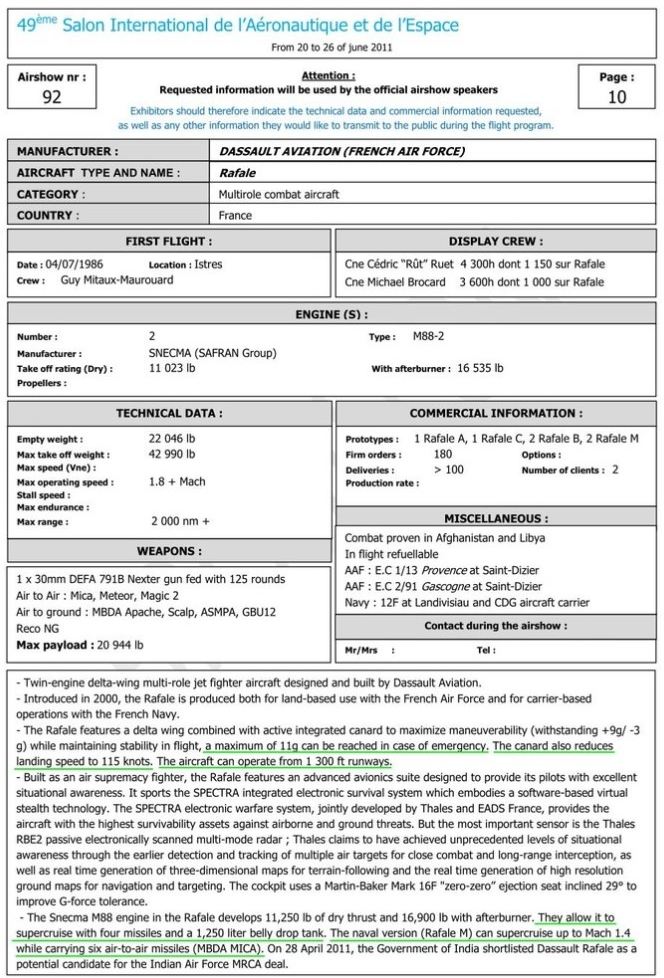
hopsalotI think the problem is that in the technical data sheet from Le Bourget it’s said “The Rafale M can supercuise up to Mach 1.4 with 6 MICA.” AND “the Rafale can supercruise with 4 MICA and 1 belly drop tank” but no speed here (M1.1, M1.2, M1.4 ??) I think these data are reliable but not precise.
Again, those were two separate claims. Both are believable independently, but some around here seem to want to combine them. (or in halloweene’s case embellish them even further by adding a couple extra drop tanks)
Anyway i dont think the F-35 can supercruise, so… 😀
This whole discussion kicked off, as usual, with claims made by some that the F-35 was too slow to do routine peacetime air policing because it can “only” go M1.6. That is to say it matches the Rafale and exceeds the performance of the Hornet and Super Hornet in their most likely air policing configurations. (4x AAM and a centerline tank)
As for whether or not the F-35 can supercruise, there is always this much discussed article:
The F-35, while not technically a “supercruising” aircraft, can maintain Mach 1.2 for a dash of 150 miles without using fuel-gulping afterburners.
“Mach 1.2 is a good speed for you, according to the pilots,” O’Bryan said.
The high speed also allows the F-35 to impart more energy to a weapon such as a bomb or missile, meaning the aircraft will be able to “throw” such munitions farther than they could go on their own energy alone.
There is a major extension of the fighter’s range if speed is kept around Mach .9, O’Bryan went on, but he asserted that F-35 transonic performance is exceptional and goes “through the [Mach 1] number fairly easily.” The transonic area is “where you really operate.”
Of course this is just “Lockheed Martin Vice President Stephen O’Bryan, the company’s point man for F-35 affairs” (also a former F-18 pilot) speaking on the record. Obviously that isn’t nearly as credible as someone on a messageboard claiming: “Seriously, I heard it from a guy at an airshow.”
hopsalotI see you use smart arguments. The details you saw were the technical data sheet from Le Bourget 2011.
Now you believe me or not (and i was talking about 1250L supersonic fuel tanks) or not, IDFC.
Keep doing planes eval from internet photos, i prefer pilots quotes.
This one was from 2/30 Normandie-Niemen Sqd. (and btw, there was also a UK exchange pilot nearby…)
So Either you are accusing a french officer to lie, or me.
Enough to me keep armchair expertise, i’ll keep asking operatives.Btw the drop tanks on your kit do not exist…
I want to be absolutely clear. Yes, either you or the pilot you claim to have spoken to are lying or badly mistaken. Both the “one crank of [afterburner]” and the supercruise with three drop tanks and missiles require much greater proof than “I heard it from a guy.”
The data sheet claims from Le Bourget are impressive, but perfectly plausible. M1.4 with six missiles in dry thrust would be excellent performance, approaching that specified for the USAF’s ATF competition back in the day, but within the realm of reason for an otherwise slicked off Rafale providing a marketing point.
Similarly “supercruise,” likely meaning a marginal M1.1, while carrying a centerline tank and four missiles is also impressive, and also plausible with an otherwise slicked off aircraft.
Expanding those claims to M1.4 with four missiles and a centerline tank, or to “supercruise” with three tanks and missiles takes them well outside the realm of plausibility.
If the Rafale were capable of those later two claims why on earth would they put the former two on the brochure? Seems like kind of a funny way to go about marketing doesn’t it?
hopsalotAll you say might be true.. But it’s still a speculation, at best.. I does neither approve, nor disprove that claim. But I understand what you’re trying to say..
What he is explaining to you is the difference between a plausible claim and an implausible one. When the site says a Rafale can reach M1.6 with four missiles and a centerline tank that is plausible. It is plausible because it is consistent with known performance characteristics of similar aircraft. It is faster than a Hornet, which nobody really debates, but at the same time it is in the same performance class. (which nobody outside a few Rafale fanboys really debates)
Expanding that claim to have a Rafale supercruising at M1.4 while carrying four missiles and a centerline tank… that is what we call implausible. It is implausible because it would mean that the Rafale would be in a completely different performance class than every other fourth generation fighter and is totally inconsistent with other available information, including for example this quote:
One Rafale pilot at Solenzara who has flown in the UAE remarked that one reason they want a more powerful engine is that its pilots are now used to the latest F-16 Block 60, which is essentially a small airframe built around a very big engine, and so find the Rafale underpowered by comparison.
I have to disagree once again. I do care what the data says, that is why we’re having this conversation. Note that I am also not resorting to cheap generalizations or comparisons in style better than Typhoon or almost as good as F-22… What we are arguing about here are definitely measurable, verifyable claims which as such can be 100% confirmed.. or debunked…
Lets suppose we are talking about a new version of a car. The current version has a 3.5 liter V6 engine producing 275hp. This car can go 0-100km/h in 6.2 seconds. (good reliable data)
The new version will see engine displacement drop to 3.2 liters but power rise to 315hp. While discussing its likely performance on a message board someone says they expect it will be able to break 6 seconds. Then a fan of the manufacturer announces that he has spoken to an engineer working on the car and that he said the car can go 0-100km/h in under 5 seconds, while carrying four adult males and all their golf bags in the trunk.
That is the difference we are talking about here. One of these claims is perfectly reasonable, the other would require some extraordinary proof.
hopsalotI can only quote a Rafale pilot met this summer at Sepentex : you will probably need 1 crank of PC to pass transsonic regime with 3 drop tanks in a A/A missile, than supercruise on dry thrust. Not very precise, but gives an idea.
It gives a good idea that the pilot you were talking to was full of crap… Seriously? 😮
How did we get from an official claim that a Rafale can “supercruise with four missiles and a 1,275 liter belly drop tank,” with no detail offered, strongly suggesting we are talking about an extremely marginal supercruise, to “the Rafale can supercruise with three drop tanks and missiles?”
[ATTACH=CONFIG]234176[/ATTACH]
Unverified photograph of a Rafale supercruising with wing tanks, missiles, and landing gear extended.
hopsalotB.S. not even the Typhoon claims that. Source it or be embarrassed like your F-35 range claim that was a joke. NO aircraft is doing Mach 1.6 with three external tanks and four aam’s external. It ain’t happening, and btw your not going to find that source.
edit- P.S. “rafale fan” is not a source
He is talking about this flier that was linked to earlier, but his reading skills aren’t up to the challenge.
http://rafalefan.e-monsite.com/medias/files/fiche-rafale-le-bourget-2011.jpg
hopsalotExcellent. 😉 Now let’s put those numbers together.
– Rafale can do M1.4+ supercruise with 4x MICA and 1x 1,250l tank
Let me stop you right there since you like to talk about reading comprehension.
The flier says:
“They allow it to supercruise with four missiles and a 1,275 liter belly drop tank. The naval version (Rafale M) can supercruise up to Mach 1.4 while carrying six air-to-air missiles (MBDA MICA). “
Do you see that little round dot just after “tank?” That is what we call a period and it denotes the end of the sentence. These two sentences should be read as:
“They allow it to supercruise with four missiles and a 1,275 liter belly drop tank.”
and
“The naval version (Rafale M) can supercruise up to Mach 1.4 while carrying six air-to-air missiles (MBDA MICA).”
Not some mixed up combination of the two statements. Not that it could supercruise at M1.4 with four missiles and a centerline tank. Get it yet? :stupid:
Congratulations, pretty much everything you have claimed in the last three pages was BS. Now, be nice, bow down and say “sorry guys, I was wrong”.
:highly_amused: Lets see how long it takes you to take your own advice.
hopsalotYou have misread the charts. All those performance specs for Rafale describe the max. speed using non-AB setting (supercruise).
From the performance standpoint, the F-35 and Rafale are tied as long as F-35 uses full afterburner and Rafale doesn’t use it, at all.
Perhaps if you clicked the link you would know what people were talking about. :stupid:
“En configuration 4 Mica + un bidon de 1250 litres, la vitesse peut atteindre Mach 1.6 (Mach 1.5 avec 3 bidons).”
… and since math doesn’t seem to be an area of strength for you either, M1.6 is not M1.4. :very_drunk:
hopsalotThe Rafale can reach M1.4+ without using PC with 4 MICA and 1 supersonic tank (1250 l ) or 6 MICA (supercruise).
[ATTACH=CONFIG]234161[/ATTACH]With PC in the same configuration is M1.6 (M1.5 with 3 supersonic tank)
With 2 big Tanks (2000 l ) and 4 AASM the speed seem limited to 1000 km/h.
(I don’t think it’s because of drag or lack of thrust.)Source: http://rafalefan.e-monsite.com/pages/dossier-rafale-avionique/performances.html
If those numbers are accurate, and they strike me as plausible, then a Rafale with a light load is incrementally faster ( .1-.2 mach) than an F-18 or Super Hornet with an equivalent load.
With 4 x Mica and a single supersonic tank (likely air policing loadout) the Rafale and F-35 are tied, at least from a max speed standpoint.
Is that sufficient for people around here to dispense with the “F-35 is slow and couldn’t perform routine peacetime intercepts business?” (until next week when of course the whole thing will repeat)
hopsalotTo bad the F 35 will still be handicapped by the fact that it’s 2 x 2,000 lb weapons bays are useless and carry a substantially limited number of actual ordnance.
Yeah, once again we are confronted with a case of you presenting your uninformed opinions as fact.
The weapons bays are useless? How did you come to that determination? The F-35 will be capable of carrying internally 2 x 2,000lb JDAMs, or 2 x JSOW, or 2 x JSM, or 2 x LGBs, or 8 x SDB, or 8 x SPEAR Cap 3, all while carrying a pair of air to air missiles. That is equivalent to what the aircraft the F-35 is replacing would carry in the large majority of their missions.
Bottom line, for all the bluster and hyperbole about decrease in “traditional” fighters with their under slung hard-point mounted weapons / drop tanks etc.
There is no “bluster or hyperbole.” I am simply providing necessary facts and context for people to understand how the F-35 compares to 4th generation fighters performing real world operations. Many make the mistake of looking at the F-35’s max speed and making a simplistic comparison to the stated max speeds of 4th generation jets, leading them to believe the F-35 is “slow.” The reality is that flying armed the F-35 will offer similar and in some cases better performance to the aircraft it is replacing. (depending on the specific mission and loadout) If an F-18 or Super Hornet is fast enough, then the F-35 is most certainly fast enough…
The F 35 WILL require the use of hard-points as well….simply to carry a useful load of anything…hence the exact same “degradation” of performance you have highlighted will effect the F35 as well.
The F-35 does have and will use external hard points at least some of the time. When it does its aerodynamic performance will be impaired. The use of external hardpoints will most certainly not be required to carry a “useful load of anything.” Four 2,000lb bombs (2 external) and 18,000lbs of fuel is more than the Rafale, Eurofighter, F-16, or Hornet can even carry. The F-35 is capable of carrying 6 x 2,000lb bombs (4 external).
[ATTACH=CONFIG]234162[/ATTACH]
(an F-35C with 6 x JDAMs, a load no aircraft the F-35 is replacing can match.)
There for the “streamlining” effect of the weapons bays will be significantly nullified by having to hang external ordnance, as well said external ordnance will make the F35 visible on radar as well…nullifying the”stealth”….so really where is the benefits for either? by simply making the F 35 useful, it becomes SLOWER and visible just like any other fighter, yet still costs substantially more?
Great deal there….
Yeah, a classic example of flawed conclusions following from a flawed premise. Garbage in, garbage out.
If the F-35 doesn’t need stealth it can carry a massive load relative to the aircraft it is replacing. If stealth is necessary then the F-35 can still carry a similar load to those routinely carried by the aircraft it is replacing, but they aren’t stealthy in any case so they wouldn’t be able to operate the way the F-35 would.
hopsalotas most aircraft having fixed inlets (f-16, F-22, f-18 or… f-35… to name but the few…) there’s a given speed limit. but it shouldn’t surprise us that some simple things like that are news to you. Any fixed inlet is optimised for a certain purpose and is better at that while giving less performance in other areas. While in CAS configuration, with big fat drop tanks and a big load of bombs the Rafale’s top speed will obviously be greatly reduced, the impact that a load of missiles and a supersonic tank will have on general drag of the aircraft are minimal.
This is incorrect.
[ATTACH=CONFIG]234158[/ATTACH][ATTACH=CONFIG]234159[/ATTACH]
As you can see from these two diagrams, both the original Hornet and Super Hornet are thrust/drag limited. This is evident in the graphs when you see the max speed taper to a point right at ~36k feet. If these aircraft had some other limitation (a structural or canopy limit for instance) then what you would see would be a vertical line at the right extreme of the envelope. This would be the case for the F-35 at M1.6. (which logically we know is not a drag limited speed given that it is shared by all F-35 variants, despite their differing drag profiles)
(Which is also what is depicted in the diagrams depicting the F-35’s speed and altitude capabilities in each developmental block.)
[ATTACH=CONFIG]234160[/ATTACH]
(Note the vertical line at the right extreme)
Returning to the F-18 and Rafale now, you can see in the chart above that even a single tank most certainly has a noticeable impact on a fighter’s performance. A Super Hornet with 4 AAM and a single centerline tank (its likely configuration in an air policing mission) tops out at M1.5. Thus in the real world an F-35 will be faster. Even if the Super Hornet drops its tank (returning it to configuration 1) it will still top out at M1.6, essentially bringing it up to the F-35’s level, but with far less fuel. The classic Hornet is a little bit faster and even with 4 AAM (and no tank) it can get to M1.7. If you hung a tank on it you can be sure that that would drop.
We don’t have an equivalent chart for the Rafale, but the same basic principals apply. If its max speed clean is M1.8, then it can probably match that speed with a pair of wingtip missiles and come close with a 4 missile load… but add a tank or any other heavier load and performance will degrade. That isn’t to say the Rafale is “slow,” just that in the real world its max speed is going to be very similar to that of an F-35. The Rafale will have an advantage of up-to .2 mach when very lightly loaded and the F-35 will have a substantial advantage at its max internal load. (2 x 2,000lb weapons, T-pod, and fuel to go somewhere)
hopsalotwhat????
it was designed to be able to reach that altitude, it have been tested to that altitude, what stop it from flying at that altitude when it going operational?????
In a flight test environment the F-35 has gone to (and in some cases slightly beyond) its max speed and altitude. There is no physical limitation that would prevent an operational F-35 from doing the same, but as of today their speed and altitude is capped. The only operators that this should affect are the USMC and USAF. (by the time anyone else goes IOC the restrictions will be gone)
hopsaloter, that would be true if their speed limit is there because of lack of thrust to go faster… the major limitation is the inlet design which basically manages the the shockwaves up to a speed a bit higher. The engines have the thrust to push the much faster, but even if the pilot asks for full power, it will use it only up to the designated speed limit. Once there, the thrust will be adapted (reduced) in order not to go any faster. IF you add a few missiles and a supersonic fuel tank, the added drag will be compensated by using a higher percentage of available thrust.
You are telling me that Dassault designed a fixed inlet that couldn’t go above M1.8? France should request its money back.
Seriously now, there are cases where factors other than drag limit airframe performance, but that isn’t what we are talking about here. A Rafale with a drop tank and missiles will most certainly see its top speed reduced.
If you have a source that says otherwise feel free to post it.
hopsalot9
1/ one may answer sevral things, first, tomorrow (27th december 2014) you have an interception mission and two fighters on the line, an F-35 and another fighter in service today (ok, forget also NK’s Mig15s).. say anything that flew after 1960… you order scramble, what happens?
the F-35 stays there and does nothing: IT IS NOT FINISHED, NOT CLEARED TO FIRE ANYTHING ON ANYONE
the other guy goes up and does the jobthat’s why I say that TODAY, it isn’t superior to anything operational
Again, brilliant insight. You discovered that we are talking about the future! Next I expect you will probably show up in the J-20, PAK FA, and Gripen NG threads and announce that you have discovered that none of those planes are operational either. Imagine if a country needed a fighter jet today. None of those planes would be useful because they aren’t finished yet!!!!
Thank you so very much for bringing this to light.


 Sign In