 N.Wotherspoon
I went into this a few years ago when looking for a Hurricane wreck that crashed, but was subsequently disposed of in a rubbish pit local to the crash site – caused a fair bit of head scratching, but the consensus seems to have been that as the wreck was deliberately disposed of, at a site other than the crash site, then no licence was required – seems the “deliberately disposed of” bit is crucial? (Snoopy on here will be pleased! :p)
However, anyone digging big holes anywhere could fall foul of planning regulations and more specifically the local sites and monuments registrar or County Archaeologist (usually one in the same in my experience). So probably best to get some expert advice on whether there are any likely archaeological remains in the area – as far as I am aware, this does not include aircraft remains, despite what some officials seem to think.
N.WotherspoonSaw that one too. Wasn’t it a Boston in the marshes up by Liverpool..?
Er No! Problem with facts again? Try Google!
Keep changing the goalposts Snoopy you will get to where you want to be in the end! :p
N.WotherspoonI’m sorry if I’ve upset one or two enthusiasts by calling a spade a spade, but general clutter dumped in the ground is ‘scrap’ by any normal definition. Just because we might dig stuff up today and value it doesn’t alter the facts.
I’m aware of most of the items listed by posters, but my point was clearly related to finding whole a/c buried/scrapped/hidden. Or quantities of engines perhaps. These adenoidal stories about Lancasters and Spitfires at VACBAF are for items of that order. I have little doubt that most wartime airfields might hold holes filled with some general scrap – but there is no precedent for whole machines. Yet.
Its OK Snoopy, I’m not upset, life’s too short, but lets be clear here, you are talking of your opinions not “facts” as you keep stating – you are certainly entitled to your opinions – but please remember – so is everyone else!
Oh! and you want a whole buried aircraft? – Try this one I made earlier 😀
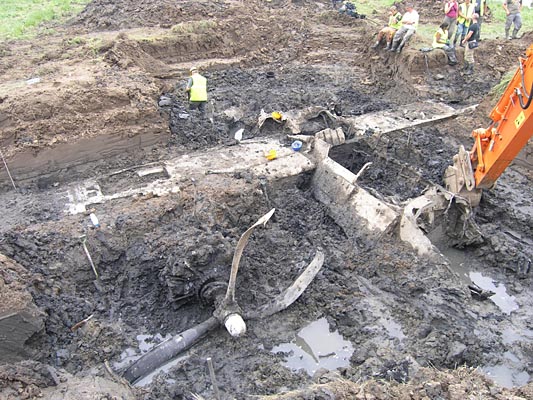 N.Wotherspoon
Whatever – the basic fact is, there really have not been any meaningful finds of buried a/c or engines in the UK – to my knowledge. These stories are like candies, everyone seems to want one. There is NO shortage of these stories, but, it seems, a complete absence of FACTS……!
I have certainly heard of, from reliable sources and seen photos of, a few pretty meaningful finds over the years, including the aforementioned turrets and Typhoon parts. But also recall the Albemarle sections recovered, that were buried at a well known quarry site in Cumbria – now IMO they were also pretty substantial as they filled two large articulated trailer loads and comprised two pretty complete centre section frames (shame they eventually found their way to the scrap dealer after all the effort put in to trying save them).
So whilst I personally think this particular story of buried Spitfires is another load of B***s**t being ramped up by a few individuals to serve their own obscure ends as well as the press for their usual reasons (which rarely let things like fact get in the way) – I have to say that the argument that it is “FACT” that no such finds have ever been made is rather weak here.
I have no doubt that there are still “meaningful finds” to be made & hope people will not be put off by these hyped-up fantasies and will carry on searching – but I think anyone needing funding is going to have a bumpy ride!
N.WotherspoonMy understanding is that it HAS to be dismantled, not chopped, to ensure that the Co. in the deep SW can make proper moulds. Might be wrong of course.
Was at the Canberra Club last night, but couldn’t see much from the car park – other than the preparations with a temporary “hangar” over the aircraft which would hardly be necessary for a chop job (a la Canberra :().
Passed again this morning and she is starting to look denuded with many panels and underside sections being removed – so looks hopeful – so far they certainly appear to be dismantling with some care?
N.WotherspoonAh! 🙁 my information is that the scheme does involve it being moved by road to the company taking the moulds – might not be such a good outcome then?
N.WotherspoonJust had an update from the contractors via a friend – It seems ZF580 is to be used to take moulds to produce fibreglass replicas to replace current gate guards – this one & XS928 I assume – probably to overcome maintenance issues (or perhaps a new line for BAE Systems? :rolleyes:). Also it now seems that no decision has been taken on its ultimate fate as yet.
N.WotherspoonFrom the other forum – it appears that nesting starlings are to blame for Corrosion in the airframe – IIRC this was the reason given for the removal of the Canberra a couple of years ago – but that was standing on its U/C with open wheel wells and the little blighters had indeed caused havoc 🙁
However, I understood that the Lightning was always better cared for – well until fairly recently anyway – and all hatches and apertures were closed off? – It does look a little scruffy with worn paint and faded markings – but certainly does not look like its falling apart!
N.WotherspoonBAE have had it on display for a long time now
True David – it has been on its stand a long time and more recently it was starting to look decidedly the worst for wear – hardly a good advert for a cutting edge technology company – perhaps the stand has been left deliberately for a plastic Eurofighter Typhoon – would certainly be a better image and easier maintenance?
Still I think it a shame it’s not going to a better home locally – although you rightly point out the company’s past generosity, there is relatively little in the North West now for aviation enthusiasts, despite the regions heritage as being the home of our aviation industry.
N.WotherspoonYes it was removed yesterday and a frame of a temporary hangar had been erected next to it which has now been placed inside on wooden trestles – I assume it will be hidden from view by the time I pass on my way home today as the covering is placed over the frame – I was hoping they were going to renovate it and put it back as the mounting bracket on the plinth has been carefully undone as if it is going back? 😡
Local paper alerted now 😉
N.WotherspoonDidn’t the prototype lancaster (or a test Lanc) go down when the life raft popped out and fouled the tail?
Not heard of that one – there was a Wellington – 16/11/43 – Z8799 – entered a steep high speed dive resulting in eventual structural failure and the break up of the aircraft. At some point during the last minutes of Z8799, the dinghy broke free from it stowage compartment in the nacelle behind the Port engine and is believed to have become entangled with the tail of the aircraft, damaging the control surfaces before breaking free. Whether the ice build up or the damage to the tail was the critical factor behind the loss of this aircraft was never ascertained.
Nearest I can think of Lancaster wise would be 11/09/44 – Lancaster III PB579
Mr S Gleave (Production Test Pilot) and Mr H Barnes, Avro, Woodford. One of every 10th aircraft that was checked to its terminal velocity dive speed of 375mph to verify control effectiveness and ease of recovery. During the dive the fuel jettison pipes tore off, hit the tailplane and stripped the elevator skin. The aircraft dived vertically into the ground at Siddington near Macclesfield. This was the only fatal accident involving a Lancaster out of the 3,958 tested at Woodford. 2 killed.
N.WotherspoonI have the remains of one somewhere from a dig (pre 1986 and not one of mine or it would have been handed back), think it is the face and back cover only as the works disappeared whilst loaned for a display 🙁 Fairly sure the back is not engraved as this one though? Will try to look it out and take a photo.
N.WotherspoonI suppose in these days of elf & safety + the current social attitude against smoking it seems inconceivable to us that crews smoked whilst flying surrounded by high octane fuel and oxygen etc – but that’s what recording history is all about. Although it seems pretty conclusive that crews did smoke in the cockpit, I don’t recall any incidents where this lead directly to a loss?
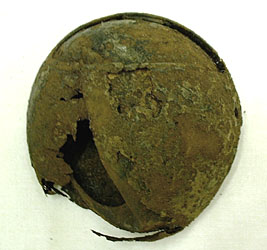
Pilot’s ashtray recovered from A-26 Invader 43-22336
N.WotherspoonAlloy? Is it not lead? Battery terminal post – certainly looks similar to ones I have found and numbering is similar to AM Refs, but not conclusive – anything else found?
N.WotherspoonThe quarry at Aspatria is (was) real enough. I visited on at least one occasion. Still parts of Albemarle and Tiger Moth airframe in evidence. I don’t recall seeing any signs that the stuff had been burnt. The only contamination I can recall was a (very) dead sheep!
We had several very large sections of Albermarle from there at one time and they were definitely very much burnt – only steel and stainless steel framework left all alloy fittings and outer shell long gone.
IIRC and it was from a knowledgeable source the site is contaminated with heavy insulating oil from industrial electrical apparatus – Goodness know where it came from, but if you are the one recovering something and release the contamination I understand it can very soon become your problem – and a very expensive one to clear up at that 🙁


 Sign In







