When I was trained:rolleyes: as a navigator 1950-51, we were taught how to lose ourselves using these monstrosoties. The sight is averaged by a clockwork motor so one has to keep the star or whatever in the bubble for that length of time. In an Anson bouncing about at a few thousand feet, not an easy task. We had to locate three stars and take a “three star fix” and plot out the resultant position line from each, transfer them forward to the time of the last star and so get the three lines to cross so as to form a “cocked hat” :D. by choosing stars nicely seperated one hoped to have a triangle plotted and one was somewhere within it. Reducing each sight entailed fumbling through the Air Almanac and a another great book of tables in order to produce each position line.
A very laborious procedure which we were expected to carry out within 20 minutes, i.e take 3 sights, and plot them out. I well remember the laugh with my roommate produced his chart. We did triangular flights in the Anson, roughly 100 miles each leg, his fix formed an excellent star of David with his tracks, so at least he was somewhere in the vicinity of where he was supposed to be.
Our poor bomber navs in the early part of the war had this tool as their main navaid, little wonder the Butt? enquiry found we were bombing the wrong towns, sometimes even the wrong country.
Sorry to be longwinded, I was extremely glad to be posted onto a night fighter squadron and escape such contraptions.

Agreed
For SkyRaider and anyone else interested, I put this thread up on 29th May 2011 “RAF Gunnery in the late War to mid 1950s”. Sorry I’m not techy enough to link back to it.
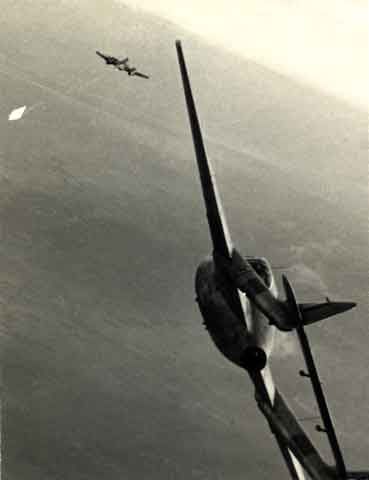
I also pinched this shot from a Venom squadron website which shows the procedure very well against a flag target.

Speaking of the flags or banners or whatever the proper term is, they seemed to be made of polypropelene sacking and pilots had strict instructions not to fire on them at less than 30 degrees deflection to avoid the risk of ricochets hitting the tug.
When we were on detachment to Habbaniyah the wing co flying was mad keen to add the Meteor NF to his list of types and arranged for us to do some air to air firing. He disobeyed the instruction and put a round neatly up the tailpipe of the tug.:mad::D:D
This immediately ended the exercise as we only had one aircraft with the mod to tow the banner.
Drawing wedding tackle by contrail was a favourite occupation of fighter pilots in the ’50s. You could almost guarantee one on a fine day somewhere over East Anglia. I suppose the powers that be got fed up with the complaints from the maiden aunts who had had it explained to them.
I don’t know about gun alignment with datum on the Mosquito. However I understand our guns were “harmonized” at 350 yards, i.e. bullet drop was allowed for at that range.
Thanks Jim Jobe for the url
Can anyone enlighten me as to where I might acquire an indicator unit for AI Mk10 (SCR720)
Not the brightest pic I’m afraid. But the harness is fixed at the back corner of the seat mount.
The Germans used gun laying radar much earlier than we did. Accurate rangefinding was important and radar gave it easily at night.
We did not have a decent gunnery radar until the American SCR584 was introduced in 1944 just in time to combat the V1 threat. This coupled with the proximity fuse at last gave us capable AA.
I well remember watching a battery of 4 3.7 guns near us using this system. They fired 5 shots each automatically laid by the radar. 3 times out of 4 they hit the target, generally by round 12. We boys used to count the bursts until the satisfying explosion.
Res,,,many taildraggers have retractable tailwheels…
Yes, like the Mosquito. That only had 2 greens for the main wheels, so ours had the tailwheels locked down as apparently it was not uncommon for them not to come down on command. The pilot would have no indication resulting in more carpentry.
It used to be “Finals, 3 greens” to confirm that the undercart was down and locked, before the pilot chucked it at the runway.
Yes, standard fitting in the dinghy pack in the 50s. From memory one had to line up the object to be flashed at(!) by using the string and sighting through the hole.
I believe the Barrage Balloon Command score favoured the Germans, however in their defence the main purpose was to keep Stukas or other low flyers away from their targets.
When I went to the Simon Langton Grammar School in Canterbury in 1943 we had a barrage balloon stationed in the playground. After Canterbury was blitzed in 1942 it also was subjected to some attention from the tip and run FW190s. There is a picture somewhere taken by the Germans from France!!! of one of these raids.
May 1939 at age 7. My father took my younger brother and I on his bike to Hawkinge for the Empire Air Day. He told me to start walking out of the village and set off with my brother on the bike, then he dropped him off further up the road and told him to carry on walking. Then he came back for me and took me past my brother and then carried on repeating the process till we got there, and repeated the exercise on the way back. It was over 3 miles each way with some decent hills, that was real devotion to duty.
I vividly remember this new wonder fighter being demonstrated, when the commentator said the Spit was coming in to land it did another high speed pass, but then entered the circuit and landed. I was immediately hooked and my sole ambition from then on was to be a fighter pilot. Of course just over a year later we had the BoB fought right over our heads. Great excitement, collecting cases and watching aircraft crash and crew coming down by parachute.
Memories :D:D
I can only guess at TR1154/55 or GEE and possibly a sextant