Sorry my bad, hadn’t seen a C.2 panel. It must be quite different to the rest of the Sea Prince, Prince, and Pembroke series.
Just a thought though, the Prince/Sea Prince has a type no. of P.57, the RAF Pembroke P.66, some versions allowed access to the nose area, maybe this style of panel allowed for that?
Not like any Sea Prince that I’ve seen, they use one main central panel with two less populated corner panels.
Doesn’t quite look like Canberra either.
The Gannet is looking good, looks like a lot of effort has gone into restoring it back to its former glory, before its Sandhoft phase.
Wouldn’t 4-5ft diameter would be pretty big for a Meteor though?
Nearest first, T.17, T.4, & T.19.
The other nose type that loosly fits your description is the more rounded noses that were fitted to some of the B.6s (and B.6 MOD used by RAE etc) used by Signals Command, similar in style to WT333 at Bruntingthorpe, http://www.andysimons.co.uk/Photos/Aircraft/Military/UK/English%20Electric/Canberra/WT333-03.jpg
Generally speaking, Canberra bomber noses are made of clear perspex and smaller than you describe.
The Canberra T.4 trainer has a short and curved metal nose cover, the PR.9 has a large metal nose section.
I’m wondering if it could possibly be a fibreglass radome from a T.11/19, seen here, http://www.flickr.com/photos/8782469@N05/4790025571/.
The T.22 features a fibreglass radome which is the same as a Buccaneers, but it is long.
There are of course countless modified Canberras, really need to see a pic of the said item.
Now that is what you call a Historic Flight! Fantastic vid, thanks for posting.
Looks like the RAT was deployed in the shutting down sequence?
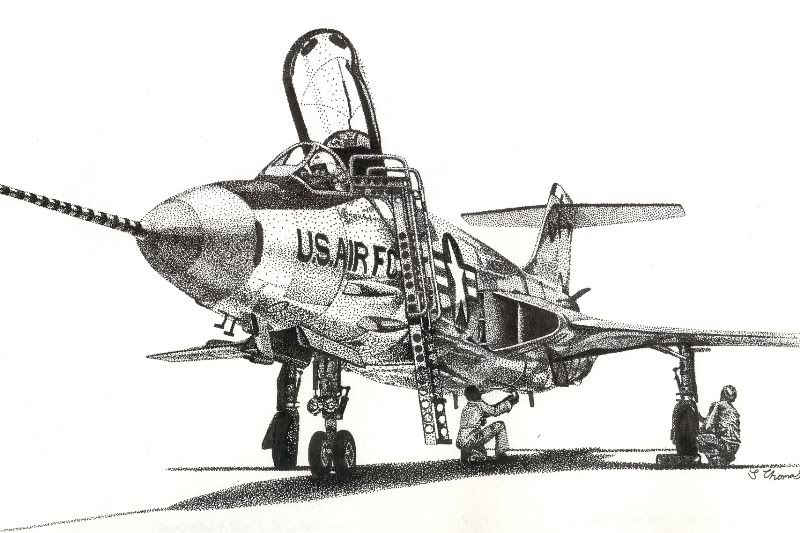
This is an old ink dot pic I did of a F-101A, possibly the one pictured earlier at Edwards AFB.
…which kind of reminded me that the Voodoo did carry 4 x M39 cannon originally, seem to think that one of the cannons was usually removed for some reason, nav kit or something?
I’d guess the 101’s job was to shoot missiles at fairly long range.
Considering it had no gun or close range AAMs, that’s about all it could do.
I would consider the single seat F-101 (as opposed to the original concept of the XF-88) combat variants to be tailored towards long-range high-performance tactical nuclear or conventional strike aircraft for Tactical Air Command, similar to the F-105.
The 102 & 106 were more in line for ADC as long-range stand off interceptors, as were the two seat F-101Bs, complete with the SAGE ground control system and Falcon missiles.
Not sure, I don’t possess the special pass to Delfinium land!
Another Yak-52 in yesterday as well

YAK-52 G-YAKC 11 April 12 by jamtey71, on Flickr
New arrival from Germany this afternoon…

L-29 Delfin RA-01611 by jamtey71, on Flickr

L-29 Delfin RA-01611 by jamtey71, on Flickr

L-29 Delfin RA-01611 12 April 12 by jamtey71, on Flickr
Unsure if he needs them, but Mistyar66 (http://forum.keypublishing.com/member.php?u=21401) owns and is restoring a HS125 cockpit, hopefully he will see the thread, maybe worth a PM.
A B2 it is then.. title amended..
For a B.2 you would need to reinstate the intake at fin base and Kauchman carrots, and change the paint scheme a bit, oh and increase the wing span slightly (probably get away with that though)!
The Victor K.2 was a Mk.2 conversion from the B.2 bomber, the B.2 has many differences, major (inc engines, nacelle area, & intakes) and subtle, from the original B.1/B1A bomber.
On top of that the tanker scheme worn by BK.1s & K.2s was different to that worn by the bomber variants.
In short a K.2 can’t be converted from or to a B.1A.
Just to add to the confusion there was the K.2P which was a Mk.1 Victor tanker conversion, based on the B.1A, is this perhaps what you are trying to achieve here? If so it would still be wrong as the photo (very nice BTW) depicts a K.2.

Wouldn’t this be treading on MarkGs’ existing site? Wouldn’t have thought there was the ‘trafffic’ for two cockpit sites.