Yes they did, and it was a Cockpitfest prize-winner as I recall in 2002…or was it 2003?
Yes, they are Hornet gauges. I struggled to sell half a dozen, so selling thirty odd might not be that easy!
There’s a somewhat limited market for them! 😀
Looks like another “Lancaster” morse code thingy in this collection.
Are those Hornet fuel gauges in the 4th photo? DC?
I say, steady on old boy!
Cracking stuff Jon! Looking forward to watching this one come together. Keep up the good work.
M
Hi Mark, from memory there are some good older pics of Pembrey on AIX, pretty sure from early Hunter period.
Visited there again very recently, wonderful place still.
Thanks James (sorry for the late reply, been distracted lately and lost track of this thread!) – will drop you a PM.
Sorry to ‘pounce’ but if anyone has any photos of Pembrey (especially the mid-1950s) I’d love to see them too.
I can’t really comment on the change in atmosphere because I have no experience of what it was like ‘before’, however my impression is that CU seem keen to maintain a good atmosphere and relationship with the local community, if only by virtue of the public viewing area/car park they maintain and the station tours they run regularly.
I’m curious to know if there are any other stations that operate such things?
I agree with Bruce.
I say restore!
Mark
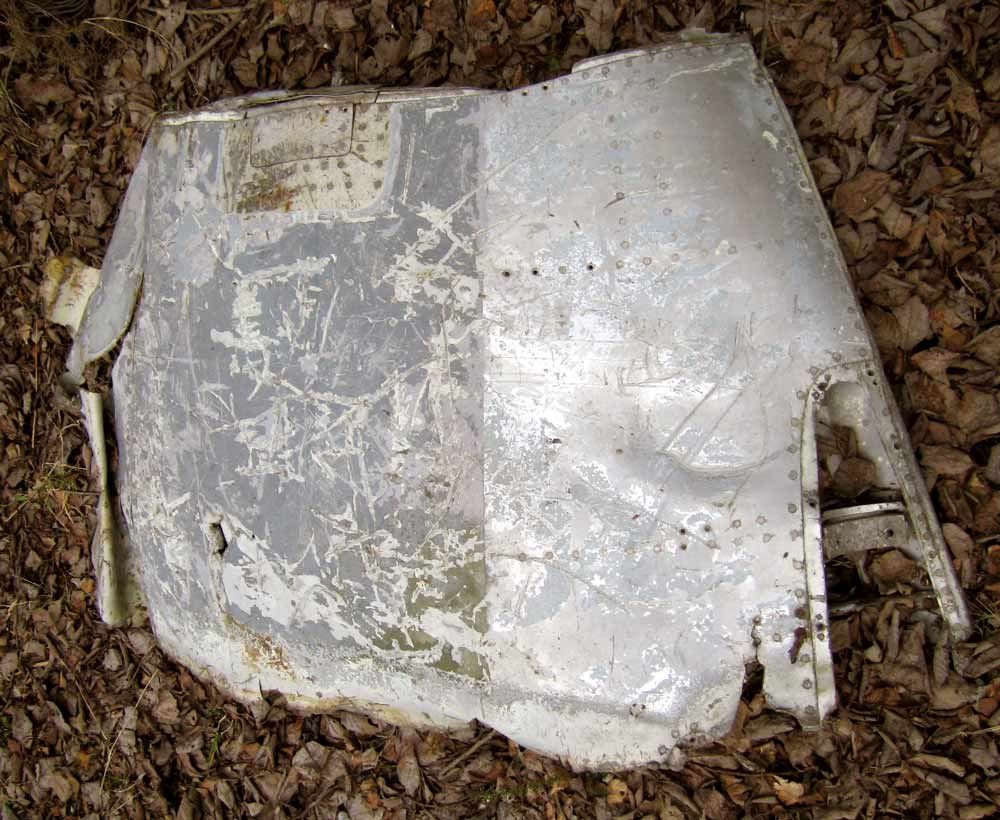
Another mystery panel…
That’s a section of Hunter nose skin. Starboard side section from frame 3 at the top of the photo to about frame 4 where it’s been ripped at the bottom – note the cut-out for the starboard inner gun blast tube on the right side.
That’s the ‘universal nose’ used on the later night fighters. It looks ‘odd’ in this shot because it’s unpainted.
My interest in 233 OCU stems from it’s previous incarnation as a Hunter OCU at RAF Pembrey (see my avatar!) but I remember discussing the markings used on the later Harriers with someone once before. I think the conversation started with musings over the use of the ‘old’ squadron badge (and Welsh Wildcat) and motto (“Ymlaen” = Welsh for “forward” or “onward”) for the ‘new’ Harrier OCU.
Regarding the colours in the squadron bar I think we concluded that the black was…er…black, and the others were most likely to be…
BS381C:356 Golden Yellow
BS381C:538 Roundel Red
BS381C:638 Dark Sea Grey
…as they were standard colours in widespread use by the RAF anyway and therefore would require no special mixing to obtain.
Not sure about the light blue background colour though – maybe BS381C:172 Pale Roundel Blue?
I had a similar thought, the port side, with the bottom of the windscreen frame still attached top left? :confused:
It’s possible but the design of the ‘windscreen frame’ looks a little odd. Having said that it’s had a battering so that may not be a good indicator.
However, I can see panel joints that are right for a Hunter and a group of four holes in the skin which match where a Hunter’s hood control box would attach.
The “Explosive Canopy” warning triangle is intriguing though. Yes, the later marks did have an explosive hood jettison system (in fact you can see the bottom of the starboard jettison gun on a couple of the other photos) but I’ve never seen an “Explosive Canopy” triangle on a Hunter only the standard “Ejection Seat” warning triangle. It’s also normally located further aft that the one in the photo – about where the jagged edge of the rear section is. So unless this particular aircraft had an additional warning triangle applied for some reason it’s a bit of mystery.
Interesting that this Hunter has clearly seen a bit of BDR action so, as a training airframe, maybe it had non-standard markings applied???
Edit: Looking again at the windscreen frame I can see that the windscreen ‘hoop’ has been completely removed right down to it’s base – so it does indeed look like a piece of Hunter. It just needs reattaching to the back part and rubbing down with a bit of wet ‘n’ dry! 🙂
There are some shots of the Canadian-built equivalent (T.27) here,
http://www.virtualmuseum.ca/pm_v2.php?id=record_detail&fl=0&lg=English&ex=00000430&hs=0&rd=109214
http://www.virtualmuseum.ca/pm_v2.php?id=record_detail&fl=0&lg=English&ex=00000430&hs=0&rd=109215
http://www.virtualmuseum.ca/pm_v2.php?id=record_detail&fl=0&lg=English&ex=00000430&hs=0&rd=109217
http://www.virtualmuseum.ca/pm_v2.php?id=record_detail&fl=0&lg=English&ex=00000430&hs=0&rd=109218
Not the clearest photos and the instrumentation differs from the T.III somewhat, but maybe better than nothing?
Cheers,
Mark
Firstly study the front face of the yokes. Every Oxford yoke I have seen has the four bolts that you can plainly see in photo 1. By contrast, every Mosquito yoke I have seen has a slightly differently machined face, with the two extra metal (steel?) inserts that you can see in photo 2. I do not know what the purpose of these is, perhaps Bruce can explain it to us?
Alan, the two “inserts” you mention are the points where the lock for the brake lever bear. This lock is a small lever hinged onto the left end of the brake lever. When rotated, with the brake lever depressed, the ends of the lock lever swing towards the inserts and prevent the brake lever from returning to the unbraked position. It’s crude but effective.
It’s also a good way to tell an Oxford yoke from a Mosquito yoke. The yoke in the auction is an Oxford 2nd pilot’s yoke, i.e. right hand seat, as you will note it has the brake lever mounted to the right of the yoke and has no brake locking lever. The 1st pilot’s yoke, on the other hand, has the brake lock BUT the brake lever is mounted to the left of the yoke and thus ‘points’ the other way. It’s a mirror image of the one in the auction with the addition of a brake lock lever in other words.
Now, the Mosquito yoke is a sort of ‘merger’ of the two in that it has the brake lever mounted on the right hand side of the yoke, but also has a brake lock lever. That means that all three styles of yoke, although at first glance similar, are different from each other in respect of their brake lever and lock arrangements!
So, to cut a long story short, this is a right hand Oxford yoke!