US Air Force Retains Requirement to Carry 9 Troops in Draft RFP for Huey Replacement
The platform must be armored and capable of carrying weapons, which could be a barrier to entry for civilian helicopters.
Source:
DefenseNews.com
They don’t want us to see the landing gear ?!!! Humm hummm 🙂
It’s completely impossible to fit 1900L in the current envelope. The pod would have to be even bigger than the 2000L tanks (which would make sense though).
Nic
Statically, Fr Navy have much lesser plane in flight around the carrier than its USN counterpart. It would probably be the same for the Indian Navy if equipped with Rafale. So why bother with an expensive larger redesign when the existing fits the needs (and the bill)?
What would make sense would be to have a dedicated replenishing/tanker aircraft now. at 20M$ plus per year of maintenance fee and 33% carrier availability in one single year the Fr Navy could certainly order one Osprey and Still increases its OP tempo.
Livefist has some interesting updates on F-16 block 70, Advanced S. Hornet proposals:
http://www.livefistdefence.com/2016/11/revealed-lockheed-martins-3-point-f-16-pitch-to-india.html
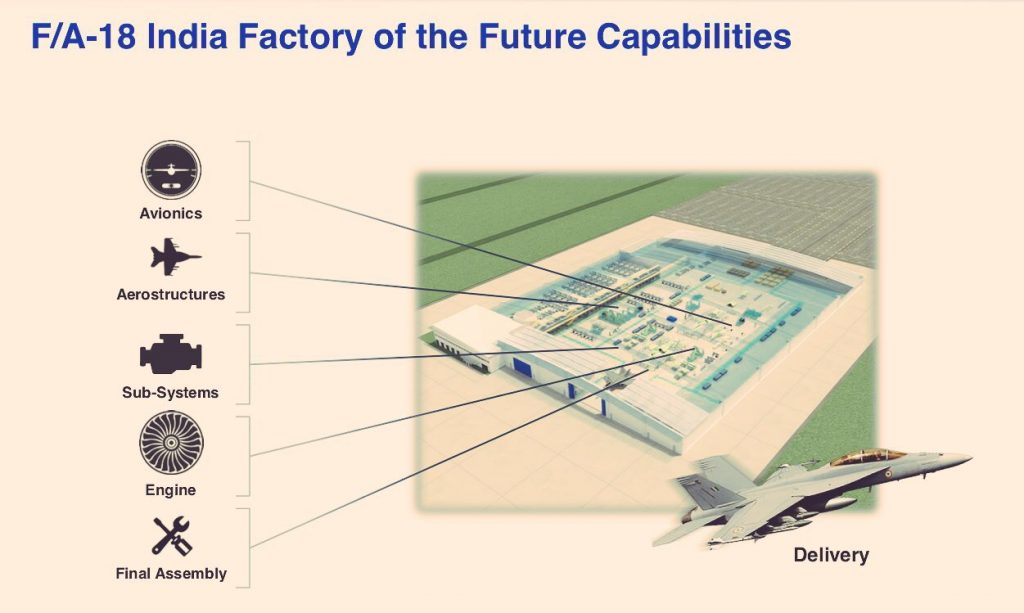
incredible opportunities for India with Saab’ GaN and the F16 from LM. Still, I like this (factory ready for AMCA:

Source:
http://www.livefistdefence.com/2016/11/boeing-unveils-an-amca-sweetener.html
you forget the Tejas is a delta… you can’t just put flaps on it as they’d make the aircraft pitch down.
To get to an acceptable approach speed Dassault had to develop close coupled canard configuration… India is far from there. As a result, it has to take off with a higher speed as well, which means require higher acceleration… at some point you can’t reduce weight anymore as you need strength as well… and so on
humm
Pitch down is there because of the increased curvature resulting from having the flaps down. Curvature is also dependent of the ratio b/w flaps length to chord section. A delta will be less affected with similarly sized flaps.
The problem lies in the resulting size of those on a delta. That’s it. Delta naval fighters are only embarrassed by the aircraft attitude and variability of sink rate (dependent of drag) during approach. The levcons add curvature (hence lift) minimizing the chord of the Flap at equal level of lift.
Often repeated, but have a look at the attitude of a landing B29/57/97 (or your jodel) 😉
The USAF, USN, USMC have been doing CAS using F-16s, F-18s, and Harriers for years and years. Given that the F-35 offers at least as good low/slow performance (better than the F-16) and a great deal more range/endurance there is no reason to think it would struggle to perform any CAS mission.
The only area it can’t measure up to the A-10 is the huge gun, and even that is basically a red herring as even the A-10 wouldn’t expect to use it anywhere but a counter insurgency type environment.
To complete what Amazingchickens said, I think that the idea now is to make composite wing. It’s not that much that the F35 won’t be able to do what a 10 could do, but it will increase drastically the efficiency of existing asset and let the number of new built 5th gen fighter bear the brunt of near peer and peer opponents.
It has been said during OP test that if you pair a 35 with an a10, the latter will benefits from the gathering of information and safety to loiter at range to the same effect (as said by a former a10 pilot part of F35 evaluation squadron – this was posted here)

Thank you TR1. Interesting.
https://lenta.ru/news/2016/12/01/mig31/
Two MIG-31s made emergency landings in Perm: 1 due to some engine instability, and other due to signal that pressure in breaking fluids was dropping.
Same flight, Same day?
During WW2, US fighters sometimes used drop tanks made of paper…
They were not very expensive.
You also need to drop tank to evade a missile threat. What is a very serious issue today.
1 kt = 1.852 km / hr.
270 kts = 500.04 km / hr.
500.04 / 60 = 8.334 km / min.
If F-35 flied 2 hrs and 10 mins with the same speed of 270 kts, then the range that it flied shall be: 8.334 x 130 = 1,083.42 km.
ro/ro0= 1083/1450=0.75 -> square -> 0.56 -> flown theoretically at 6000m/18500ft (does not include climb, descent, wind and traffic which will raise the computed altitude (cruise speed is different from distance from point A to B divided by distance)
Quick sheet here: http://www.experimentalaircraft.info/flight-planning/aircraft-navigation-speed.php
Standard Atmosphere: http://www.braeunig.us/space/atmos.htm
Done in 3 min (and had to be edited 😮 )
F104? 😀
4 survivors (one had died later).
La Ceja (crash site) is a hilly Andin plateau with nowhere to land. If they attempted to crash land as some have reported following a fuel starvation, it was the worst place to be forced to do so.
All my condolences to Brazil. Not the best time they have gone through.
I just noticed that the plane had been registered twice by the same company. Don’t know if it is usual.
Sept. 2014 YV3035 LAMIA new registration
Jan. 2015 CP-2933 LAMIA new registration
@Obli: It’s all about transonic drag. The tail cone is what it is on the Grip because the wing is a delta and the vertical fin has to compensate for the reduction in volume. The Mirage 2000 would have been probably quite similar if fitted with large close coupled canards.
The tail boat drag is reduced effectively by the funnel formed by the twin canted fins on the F35. The exiting gasses pulling the air all over the fuselage and funneled it that way (more lift, less parasitic drag and friendlier expension after the nozzle. All are major drag reduction).
On the Grip, the Swede had also to find a suitable location for large airbrakes (take-off and landing on small runway and rolling stability). Remember that those were the 80’s 😉
What the pictures in effect show (as was the vid I posted earlier with a dual formation of Thunderbird’s F16 and F35) is that the Lightning’s wing is tailored for higher cruise speed relatively to the Viper and (the video) demonstrates the ease at which the 35 get into high AoA at slow speed.
“Through a RFI it is possible to bring together visions as to what kind of solutions the recipients of the RFIs offer to replace the capabilities of the air force F/A-18 aircraft in the post-2030 security environment,” the defence ministry says.
Post 2030 for Fin is Sa500 rings all over a big chunk of their territory, Su35 and PakFa or, perhaps, the emergence of the PakDa.
It will be very interesting to watch what will be the content of some proposal.
Lot of talking.
A video: