 TomcatViP
Air Force C-17s resume airdrops in Afghanistan after more than a year
Senior Airman Jeremy Kosick, 816th Expeditionary Airlift Squadron instructor loadmaster, checks the cargo straps covering container delivery system bundles on a C-17 Globemaster III before an airdrop over Afghanistan, May 10. (Staff Sgt. Keith James/Air Force)
The C-17 Globemaster III has resumed combat airdrops to remote bases in Afghanistan for the first time in roughly a year and a half.
One of the first drops was conducted by an Al Udeid-based C-17 over undisclosed outposts in southern Afghanistan, between May 10 and 11.
“Our tasking and the aircraft selection for this mission really comes down to the C-17’s larger cargo capacity,” said Maj. Nicholas Coblio, the aircraft’s commander from the 816th Expeditionary Airlift Squadron out of Al Udeid Air Base, Qatar.
“The C-17 can complete this mission with one aircraft in one pass, minimizing risk and maximizing productivity,” Coblio added in a U.S. Central Command press release.
read also a report of the mission in the USAF thread
Source:
Air Force times.com
TomcatViPAir Force B-1 Lancer blew escape hatch in emergency landing, but its seat did not eject
Two photographs, one distributed by the Associated Press and one taken by the Midland Reporter-Telegram show that at least one of the emergency hatches above the crew in the cockpit blew open, suggesting the call to eject had been made.
Those images raised several questions, including whether the blown hatch or hatches had been found and recovered, and whether the ejection system had failed because the ejection seats did not deploy.
This was the object of our discussions earlier, on the 2nd of May, after watching a video of the plane surrounded by rescue vehicle on the tarmac appeared in local media:
B-1B Lancer makes emergency landing at Midland International
[ATTACH=CONFIG]260285[/ATTACH]
Did the hatch blew open?
See this still image (00:18s) extracted from the video here
[ATTACH=CONFIG]260286[/ATTACH]
Source:
Air force Times.com
TomcatViPAnd no, the little pirate is not dead for now: news comes from Argentina that 5 of them with enough engines are on their way back to service there.
The surplus French Marine Nationale aircraft (serials 1, 31, 41, 44 and 57) will be purchased including eight spare engines and a flight simulator.
Source (Via Tango III):
https://www.facebook.com/Scramblemagazine/photos/a.216124641747411.66937.145237522169457/2211033558923166/
TomcatViPAustralian search defended after 60 Minutes criticism
US scientist Victor Iannello said he had watched the episode twice and found nothing new in terms of evidence or insights.
“What I did see were some of the experts confusing speculation with facts, and cherry-picking evidence to support their pet theories while carefully omitting contradicting evidence,’’ he said.
An exhaustive and patient deconstruction of what those “experts” said during the show. All sourced material being available first hand in the ATSB report, it’s is stunning that a team of journalist did take such shadowy road well away from well paved methodologies of professional journalism*… Will one day someone take the occasion to make a TV show after the Lost 60 minutes team?
*Add to that the fact that the web see now a surge of similar articles about the alleged mad Captain and we are back to the Germanwings story: coordinated media lynching.
TomcatViPThe YF-12 was and is a delta 😉
TomcatViPThe Corps is down to one final EA-6B Prowler squadron
The last remaining EA-6B squadron in the Corps will begin its deactivation in October 2018.
“VMAQ-2′s deactivation in FY19 will mark the end of the EA-6B’s service in the Marine Corps, as well as its continuous employment as a joint tactical Airborne Electronic Attack (AEA) asset,” Burns told Marine Corps Times.
[…]
In mid-April, an EA-6B escorted a pair of B-1 bombers as they carried out airstrikes against the Barzah Research and Development Center located near Damascus, Syria.
The strikes were in retaliation for a suspected chemical weapons attack carried out by the Syrian regime against civilians in the village of Douma, Syria, in early April. The EA-6B escort was likely there to suppress enemy air defense systems.
Source:
Marine corps Times.com
TomcatViPDescribing the moment the F-35 jets will arrive at Marham, Lightning Force commander Air Commodore David Bradshaw said it will be a “hugely significant” moment which will be watched by Russia “with interest”.
Lockheed Martin describes the stealth capabilities of the F-35 as “unprecedented”.
With airframe design, advanced materials and other features making it “virtually undetectable to enemy radar”, the warplane could be sent into the airspace of an adversary if required.
Once there, the jet might be tasked with destroying the radar systems of that particular state, but to do so would require them to be triggered so they could be detected and destroyed.
RAF Marham station commander Group Capt Ian Townsend confirmed it has committed to 138 of the £100m aircraft, with the first nine due to arrive this year.
However he defended its high cost, saying the investment should be looked at over the aircraft’s 35 to 40 year lifespan, as well as in terms of the military benefits it will bring.
“We have to look at it long term,” he said.
“From an operational capability perspective, it puts us in a much better position to react to the unknown in the future.
“The F-35 really allows us to know more and if we know more, it allows us think quicker and act quicker. It gives us a tactical advantage.”
Source:
Eastern Daily Press.co.uk
TomcatViP@Loke: I totally agrees: the benefits of traditional fighter assets are a plus to any air forces fielding the 5th gen aircrafts.
TomcatViPFrom LM and the Belgian partnering industry in Wallonia*:
*French speaking southern region of Belgium
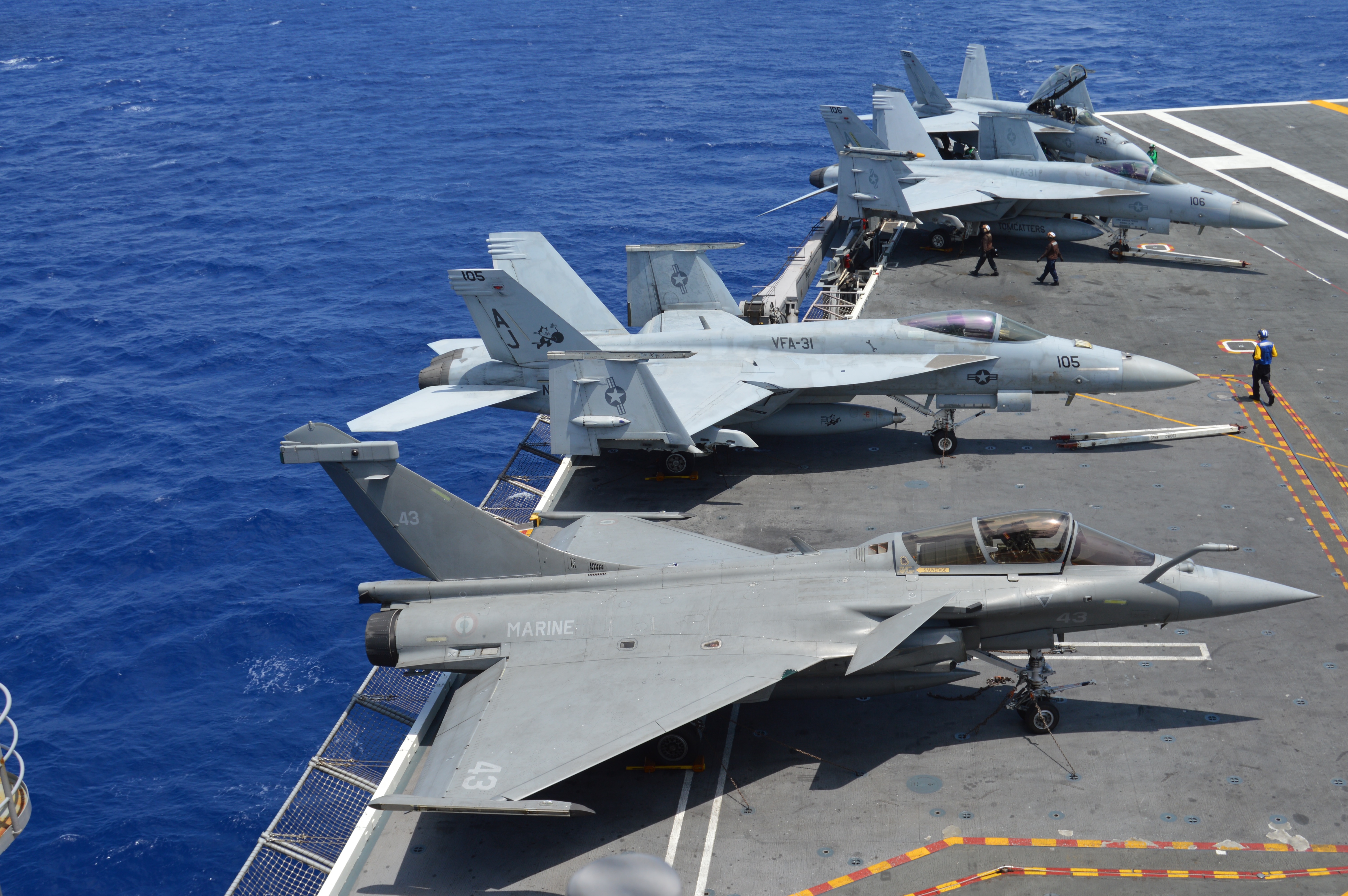
TomcatViPCmdr. Patrick Baker, executive officer of Strike Fighter Squadron (VFA) 213, told reporters that his F/A-18F Super Hornet squadron had seen “almost seamless operations with the French Rafales and Hawkeyes onboard. … One of the things I’ve taken away from this is, if there ever is an opportunity or a situation that develops, the French do bring a unique, complementary capability to a U.S. carrier air wing that could definitely assist us in strengthening our regional and our maritime capability.”
Source:
USNI.org
TomcatViPIf they go the Super Typhoon road (whatever “Super” means for any operational credibility for a plane built to be spearheading the 1990s RAF then forced into this role for the 2020s), the consequences are:
– new Tyhoons dev, production, training…
– New supporting hardware like expensive stealthy autonomous UCAV
– Full commitment to the Franco-German future manned platform designed to offer not much more than an F-35 does today with all the public expenses to be expected
– A frantic fight (with all the diplomatic consequences) to get more than a symbolic folding seat as an industrial partner
And probably, at one time or another, more F-35 to fill any Urgent operation needs that will invariably surface…
TomcatViPWhat is housed in the new(?) bulge in the front of the nose section? Is that the sense and avoid system?
TomcatViPAnd what about those 2 ships? Are those big deck only to play Dominos*?
Source:
https://www.ddcoatings.co.uk/1275/new-deck-coating-hms-queen-elizabeth-aircraft-carrier
*Oh, let me guess, you gonna sell them to Egypt.
TomcatViPCost Vs Performances. The PC-21 is certainly not a radical design in term of airframe. Then embedded simulation of systems (in-flight) is much more easier done (cost / fidelity) when the manufacturer has a close relationship with the user of the in-service plane you just bought. Then ETPS is certainly something else. Just like QinetiQ is with an Air force.
…
But you certainly know that at least better than me.


 Sign In







