 Chox
ChoxSome fascinating JP shots here – keep ’em coming!
Any shots of the delicious silver/grey and dayglow-era machines?
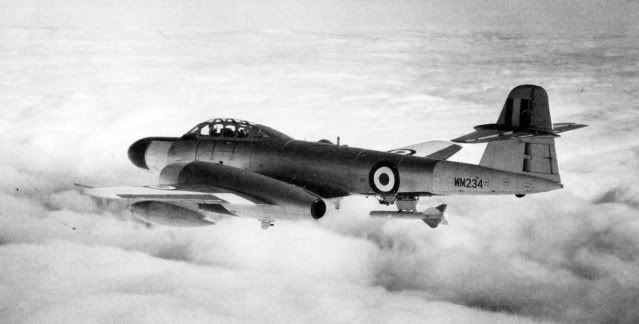
ChoxThat shot seems to fit the theory that the TT20’s all had the smaller roundels. Did the dayglow orange extend across the wing in the same way as the shot of WM234 above?
ChoxGreat, that would be interesting to see. The more I look into dayglow Meteors, I get the impression that the large-sized roundels were hardly (if ever) used even though they’re often shown like that on drawings in various publications. I think it might be one of these things that has been perpetuated for a long time without any real evidence. As far as I can determine, the vast majority of Meteors in the dayglow period had only small roundels as shown on the photo of WM234 above.
ChoxIt’s the first I’ve heard of it – as far as I could determine, they’ve mostly been destroyed or abandoned… unless anyone knows otherwise….
ChoxThis shot illustrates what I’m rambling-on about –
This appears to be a bit of a one-off though, carrying a Rushton target, possibly with FRU or the RAE? It has the earlier silver paint scheme but the later application style of dayglow which makes me think that the grey aircraft had the same paint/roundel layout on their upper wings.
ChoxAnother thing which seems a bit unclear is the application of the Meteor’s upper wing roundels and dayglow paint. On the silver machines it looks as if the dayglow comprises of a strip along the outer leading edge, plus stripes running chord-wise. On the later grey aircraft it’s unclear whether there is only a leading edge stripe, or if the dayglow extends right across the outer wing. My guess is that it goes right across the outer wing as this seems to have been standard practise on similarly-painted JP’s and Canberras, etc., but I haven’t seen any photographic evidence to support it. Likewise, it’s difficult to establish the size and position of the wing roundels. There seems to be a lot of confusion over this matter on later Meteors – for example some references show the FAA/FRU Black T7’s with large roundels outlined in white, but photographic evidence suggests that they were actually small roundels not outlined. My guess is that on the CAACU Meteors the roundels were small – unless anyone has evidence to the contrary?
It’s all very confusing!
ChoxThose photos say it all – there’s nothing left to save, it’s just a pile of scrap which looks vaguely like a Lightning!
ChoxAbsolutely fantastic stuff!
Dave, yes, that is evidently the infamous Mossie in that photo. You have to assume he did take a photo but sadly he’s decided to feature the less-interesting aircraft stood next to it doh!
I didn’t even know that the CAACU operated Vampires – I assume that they remained in service until the very end then, along with the Meteors – end of 1970?
These photos are just brilliant, thanks guys!
ChoxYeah, most of ’em were silver with yellow bands and striped undersides but there was evidently at least one aircraft that managed to adopt the later scheme with dayglow fabric stripes – just the thing to make my mouth water! It keeps getting covered in drawings and even the Corgi diecast model but it would be kinda nice to see an actual photograph!
ChoxI get the feeling it’s a bit beyond preservation – it looks unfit for anything except scrap now sadly!
ChoxBrilliant! I dunno why it is but aircraft from this era fascinate me – I’m only sorry that the dayglow thread seems to have gone quiet now!
I’ve never found much interest in Mosquitos (much like most WWII aircraft) but the silver/dayglow machine is something very different. I guess loads of WWII enthusiasts will probably think it’s an abomination but as far as I’m concerned it’s the most interesting Mossie of them all!
ChoxThanks guys. The colour shots on the AB site are great!
If anyone ever spots a shot of the silver/dayglow Mosquito… I’d love to see what that really looked like rather than seeing the usual drawings and models!
ChoxHate to sound defeatest but I really don’t know what you’re trying to achieve. What would be the point in making any sort of approach to RAFM? They haven’t got even the slightest interest in our views even though they’d doubtless claim to take our concerns very seriously… and I’m sure we’d all believe ’em…
ChoxI came up with the phrase “education through entertainment” .
That would be great if it applied to more than a handful of people. Sadly, most of the people who use places like Hendon as a playground won’t learn a thing – nor would they want to. They’e mostly there because their parents thought it might keep them occupied for an hour but of course it doesn’t as stuffy old aeroplanes in a hall don’t do anything exciting.
As Bruce mentioned earlier, maybe the days of free museums might end eventually and in some respects I think it might be a good thing. It would allow the museums to get back to their primary purpose instead of being obsessed with entertainment and getting bodies through the doors.
Oh, and as for any notion that I was accusing Hendon of making profits unreasonably, that’s precisely the opposite of what I think they’ve done with regard to the photo archives in particular. Evidently, someone thought that charging ridiculous amounts of money to use whatever they bother to make available would be a good idea. Of course it isn’t as it’s simply ensured that virtually nobody has the slightest interest in using their photos any longer so they’ve created a sort of double whammy – they don’t make any money out of them and nobody gets to see them either. Sad business.
But that’s the world we live in I guess. All about figures, ticks in boxes, presentations, public relations, and absolutely nothing to do with history, preservation, education or information.
ChoxKev, if you had any idea just how little money that jobbing writers get, you’d fall-over laughing at the very suggestion. That was what I mentioned previously – RAFM seem to think that aviation publishers are making huge profits and can afford to shell-out huge sums of money to publish pictures that (in most cases) were generally used free of charge in the past. Naturally, publishers just don’t bother even using RAFM and the result is that the photography will never be seen by most people. You can imagine what is likely to happen sometime in the future – some bean counter will conclude that as the archives aren’t used much, they might as well be sold-off.
Just seems to be another way in which RAFM seem to have completely failed to grasp the true value or purpose of the museum facilities. It’s all about making money and appealing to a mass market of people in search of entertainment. I’m firmly with those who believe that an important facility like RAFM ought to be something rather better than that but I fear it’s probably a lost cause. Graham’s suggestion that some sort of approach to Mr Fopp should be made is commendable but you just know what a complete waste of time it would be. You could almost write the platitudes, cliches and slogans that will be issued in response. It won’t change a thing, as aviation enthusiasts and historians don’t count for anything. It’s all about the mass market and appealing to as many people as possible. My guess is that they’d put a roller coaster in there if they could fit it in.


 Sign In







