IAA has already started making wings.
IAI is on contract with Lockheed Martin to manufacture 20 pairs of F-35 wings. Under a memorandum of understanding, production will increase to a total of 811 wings.
Only?….
Not so much 😉


Having a single source for any one part is rare and would be reckless if done in a widespread manner.
The only time it is used is when the cost of having multiple suppliers for a single component would be cost-prohibitive.
Even the F135 has several suppliers for each of it parts.
sure, just check “mission systems” part of your attached image Spud… besides…
seems that some others have noticed it
So “postponed 2/3 of the program tests” becomes “just look at a small subset of the tests”?
When you look at ALL the testing planned and added, they postponed only 2.2%… yeah.. earth-shattering. :very_drunk:
Lets just dig the numbers that were present in the 2011/2012/2013/2014 budgets for, lets say, 2016?
Four years ago, the “Fly Away Unit Cost” for a 2016 was going to be 89.164 million a piece… Right now the USAF expects to pay 114,5 million US$, thats a 22% increase.
In the FY2011 Budget they have planned on procuring 300 F-35As thru 2016 (including the 80 being built in FY2016). We now have 175 total F-35As (including the 44 in FY2016). Did you really expect them to build 44 for the same price as 80 or to be at the cost curve at 175 that the thought they would be at 300. These numbers don’t even include the production shifts to the F-35B or C either.
Like I said, disingenuous.
Sure they did.

You are being disingenuous.
The FY2016 costs are “maybe” a percent or two above what they estimated they were going to be, but they are still well under what the FY2015 jets were.
Question: Are the cost estimations done in Budget docs done in Current Year dollars or Then Year dollars?
btw, While you reported that the costs rose a percent or two (FY2015 vs FY2016 estimates), did you miss that the FY2015 costs have dropped from what they were in the FY2015 docs (FY2015 Estimate vs Contract)?
Confirmation that this “6th” gen fighter development project is NOT a F-35 replacement.
The Navy and Air Force have offices looking at a next-generation fighter that would replace the Navy’s F/A-18s and the Air Force’s F-22s, respectively. An Air Force official told Defense News in September that he hopes to have Milestone A acquisition activity started in fiscal 2018.
btw, Milestone A is as follows:
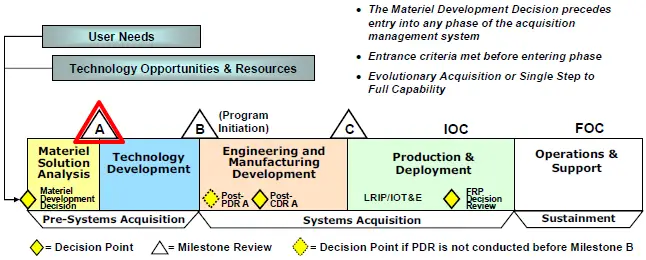
http://acqnotes.com/acqnote/acquisitions/milestone-a
To reach Milestone A, you must:
A Major Defense Acquisition Program (MDAP) or Major Automated Information Support (MAIS) may not receive Milestone A approval until the Milestone Decision Authority (MDA) certifies, after consultation with the Joint Requirements Oversight Council (JROC) on matters related to program requirements and military needs, to the following, without modification, from 10 USC 2366a, as amended by Public law 111-23, “Weapon Systems Acquisition Reform Act of 2009″, May 22, 2009: [1]
For MDAP at Milestone A, the MDA must certify in writing to the Congress that the Department has completed an Analysis of Alternative (AoA) consistent with study guidance developed by the DCAPE, in addition to meeting other certification criteria (10 U.S.C. 2366a).
We are a long way away from Milestone A for a 6th gen fighter.

FY2016 budget has been released:
57 F-35s (44 F-35A, 9 F-35B and 4 F-35C) which is two more F-35Cs than last year’s projection of FY16 needs.
No more Growlers
No more Superhornets
USAF – http://www.saffm.hq.af.mil/budget/ (not updated as of 2/3)
USN – http://www.finance.hq.navy.mil/fmb/16pres/BOOKS.htm (Up to date)
Along with a new engine, I see composites being used as load-bearing structural components as a major area where a 6th gen plane can save weight. The biggest advancement in composites has been in the area of CNRP (Carbon Nanotube Reinforced Plastic). The F-35 is the first fighter to use CNRPs in non load-bearing structural components. While the timing of CNRP & the F-35’s development did not allow for load-bearing use of CNRP, I see the 6th gen airframes as the first real opportunity for this application.
Here you can see where most of the internal structure is Aluminum on the F-35.
[ATTACH=CONFIG]235012[/ATTACH]
CNRP use on the F-35:
http://www.flightglobal.com/news/articles/lockheed-martin-reveals-f-35-to-feature-nanocomposite-357223/
Here is how Composites compare to traditional components in aircraft mfg.
[ATTACH=CONFIG]235013[/ATTACH]
Ok, I am still not 100% convinced, but maybe they really dropped {the GBU-39} it after all.
Pit Drop at 7:40
Live Drop at 7:55
There are two main drivers that lead to the F-35 IOC slide to the right, complexity and economic pressures.
The escalation of award to IOC times is not unique to US fighters.
The Rafale and Eurofighter both suffered from the same issues.
They have:
· First separation test of a GBU-39 Small Diameter Bomb, a 250-lb. precision-guided glide weapon (Oct. 21) and multi-separation test (Nov. 20)
Along with airborne test with ASRAAM (not separation yet)
·First F-35 external flutter tests flown with the AIM-132 Advanced Short Range Air-to-Air Missile (ASRAAM) (Oct. 29) and Paveway IV missiles (Nov. 13)
All Block 2B Weapons Test complete
“All weapons tests needed for 2B software, the software the U.S. Marine Corps will use to declare IOC, is complete and will be ready to go for their combat capability certification.”
http://globalaviationreport.com/2015/01/16/f-35-continues-on-path-toward-full-weapons-certification/
Good catch on the SDB2 part.
Considering it’s just a fit check, why not do it all at once? They have done other Block4 fit checks, most notably the JSM from Norway.