 SpudmanWP
The USAF is on track to declare IOC with Block 3i in 2016 and will include the same CAS as the USMC Block 2B.
2019 Would likely relate to when Block 3F goes Operational (assuming 1+ years after release to fleet).
SpudmanWPSpud – The gun comes with 3F, which is due to IOC (with F-35C) in 8/18-2/19. Is there a schedule for when the AF gets operational with 3F? “Delivered” in this context means delivered for training.
Sorry, but that is not what the article is claiming.
Here again in the title of the article.
The F-35 Won’t Be Able To Fire A Shot Until 2019 Due To The Latest Technical Problem
There are two glaring errors in that sentence alone:
1. It’s gun will be fired from an airborne F-35 likely by mid to late 2015.
2. The 2019 date (IOC) has nothing to do with a “latest Technical Problem”.
You & I both know that the 2019 date is IOC and that they could be used in combat prior to IOC (as they have previously stated).
My point is that this article is a blatant hit piece completely lacking in facts or supporting sources.
SpudmanWPBlock 3F is on track for a Fall 2017 Release to Fleet which means that it will be in testing for years prior.
2019 is a BS date for gun usage.
Software always gets a great discussion on this program because it’s really hard, and it is. And of all the things that are the most difficult to do on this program, software is still right up there as one of the hardest things to do. It’s just a really complicated system. It’s as simple as that.
The good news about software and the dot-dot-dot on the rest of the story about software is you always hear that our software’s been delayed. True statement. Our 2B software, if you go back to the 2010 baseline, is four months late from where we said the software would be done. But the dot-dot-dot rest of the story is that when we put that 2010 plan in place we knew we weren’t going to be perfect, so we built some margin into our plans. So despite the fact that the 2B software is four months late, it doesn’t affect U.S. Marine Corps IOC because we built some margin in there.
The exact same thing with the 3i software for the Air Force. It’s probably about five months late from that 2010 plan, but what you don’t know is we built six months of margin into that plan from the very start. Now it’s not good to eat five out of your six months of margin, I will agree with that, but we’re not at the point where we’ve moved any major milestones on the program. So when you hear the software’s late, the schedule is late, you’ve got to take the whole picture and the whole weapon system view of what’s really going on in the program.
Relative to 3F, it’s the same way. 3F is our final software that’s to be delivered at the end of 2017. Right now I would tell you we’re probably about six months behind, but that’s a risk. That’s not a real six months behind. If we don’t change something we’ll end up six months late, but we have an awful lot of time to improve ourselves up until that point and we do have plenty of margin to Navy IOC with that software. So you just have to understand the whole story of the program instead of just getting the sound bites of oh, this little piece is late or this little piece is late.
LtGen Bogden, Sep 2014
http://www.af.mil/Portals/1/documents/af%20events/Speeches/15SEP2014-LGen-Christopher-Bogdan-AFA-F-35-Update.pdf
SpudmanWPF-35 2014 Year in Review
SpudmanWPMOP would laugh at those sub pens.
MOP is 30,000 lbs and Tallboy was 12,000
MOP has GPS where Tallboy is unguided
MOP has much better material and nose shaping (all the extra weight of MOP is the steel case as they both carry ~5k lbs of explosive)
MOP can be dropped from higher altitude thereby ensuring higher impact energy
Grand Slam was a 22,000lb bomb but only carried 4k lb of explosive.
SpudmanWPIIRC, MOP does not use a shaped charge.
SpudmanWPBecause I have a military background, study history, and look at it with an eye towards what it can be rather than what it is today (which is getting better daily).
The two most powerful warriors are patience and time.
Leo Tolstoy
SpudmanWPNo, I meant 3 (Yes I know that RotJ is Ep6).
SpudmanWPYes… I did see Ep.4 13 times in the theaters after all 🙂
SpudmanWPComing to a battlefield in 2015
As you can see, my young apprentice, your friends have failed. Now witness the firepower of this fully ARMED and OPERATIONAL F-35!
SpudmanWPSA: Point-to-point MDAL is working & demonstrated now along with ESM, EODAS, EOTS, and radar fusion. The SA issues have been answered for the most part.
WW Support: there is no single location for support of any type. This means that if a customer has a problem with one supplier, they can contract with another. Btw, most Block upgrades can be done in the owner’s country and do not require a trip to a large support center, which are in the US, Italy, and Japan (not in Turkey). Turkey will have a engine maintenance facility, but so will several other countries.
And yes, I said low cost upgrades for a simple reason, scale. Take the Rafale AESA program as an example. It’s entire R&D and production has to be split up into a relatively small number of airframes. Upgrades to the F-35 will be shared across thousands of airframes and almost 10 countries. Btw, those same countries are already funding post-SDD development which is a lot better than can be said about the EF or Rafale.
SpudmanWPIt has nothing to do with perfs & capabilities whatsoever.
So being the only multirole fighter with a VLO airframe, best available SA, world-wide support & upgrade network, and ease & low cost of upgrades had nothing to do with it?
:very_drunk:
SpudmanWPIn a real war all these aircraft will be shooting long range CM carried under the wings…including the F-35…and if they want to survive any IADS they will have to fly fast and low…like in the 1980s…
The F-35 will likely be able to safely use LGBs, JDAMs, JSOWs, and SDB’s where others would need CMs.
There is a classified part of the report which we have not read. Maybe they have..
They clearly did not classify all the planes at the same risk level. When they wanted to show the same level of risk in a category, they used the term “All Aircraft were rated as Low risk” and when there was a distinction (in this case ‘State-vs-State’ they used “Medium to Very High risk”.
So, you think it’s ok to buy a plane that they think will have a “Very High risk” of not being able to perform it’s mission post 2030?
btw, My problem is with the reporting of this report, not the report itself.
SpudmanWPNot necessarily (yet it’s obvious) but my point was that the jurno’s reporting of this report kept making the erroneous conclusion that all the planes were ranked the same save for State-on-State action.
btw, Further reading puts the charts into simple terms:
Operational Assessment = How well it can do the job (SA, survivability, lethality,e tc)
Critical Enabling Factors Assessment = How well it can keep doing it’s job (sustainment, upgrades, maint, etc)
Integrated Mission Risk Assessment = The first two charts put together.
So, if there were one chart to pay attention to, it’s this one: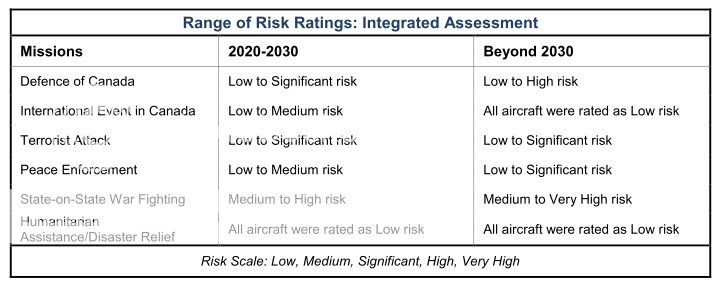
And this phrase:
Summary of Integrated Mission Risk Assessment Findings
The integrated assessment demonstrated that although the operational capabilities of the aircraft
under consideration were essential factors for consideration, as the assessment progressed, it
became apparent that the critical enabling factors that ensure the operational relevance of the
aircraft over its life were of greater material impact to the integrated risk rating.
It’s obvious that for all but the most benign of missions, there is a great divergence in risk, especially when the lifetime of the aircraft is taken as the driving factor.
SpudmanWPF-35, Competitors Equally Capable for Most Missions: Report from Canada
Am I the only one who actually read the report?
http://www.tpsgc-pwgsc.gc.ca/app-acq/documents/cf18-eval-eng.pdf
Reading through the report I noticed that they conveniently did not gauge the fighters individually, but as a group.
For example, for the “Range of Risk Ratings: Critical Enabling Factors Assessment” in the “Beyond 2030” category of the “Defence of Canada” row, the result is “Low to High Risk”. Gee, I wonder what plane is a Low Risk and which are High Risks? The report is stuffed full of this sort of confusing information.

What is very clear at this point is that FG, Ottawa Citizen, et al were completely talking out of their A$$ when they claimed that the competitors were equal to the F-35 in most missions.
The fact that this report does not once break out the assessments on a fighter-by-fighter basis makes my point.
The only saving grace that this report has is the last line:
A classified report with detailed results of the evaluation has been provided to the Government to
inform a decision on the path forward to replace Canada’s CF-18 fighter fleet.
Here are the other two charts:


 Sign In







