If you are buying a weapons system that will serve you for the next 30 years then you have to assume that it will be used as such within that timeframe in that role.
Otherwise, buy a civilian jet.
So let me get this straight… The only way the F-35 is better is if you actually have to take it to war?
Gee, why would anyone consider war performance when selecting a weapons system?
Dumbasses
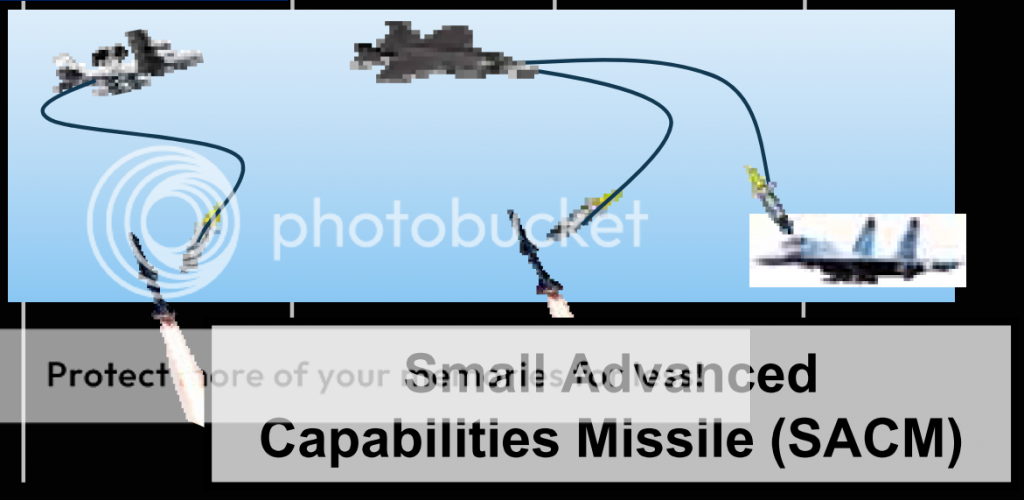
The SACM (Small Advanced Capabilities Missile) program stated one of its goals being the shooting down of rockets/missiles. The CUDA missile concept was designed with SACM in mind. I would assume that in order for SACM to work in that regard, the fighter’s radar would have to be the prime sensor.
Given that SACM is in the concept stages it most likely deals with radar features that would also have to be developed or matured.


The problem is.. who cares?
The people who actually sign the checks care very much. They are also the ones who know what is actually covered under the non-recurring section.
Projects to reduce future costs by developing new mfg processes are also covered in this section. Here is a recent example where spending $1.3 million now will save $125 million over the life of the program.
http://www.onr.navy.mil/en/Media-Center/Press-Releases/2014/ManTech-F-35-Manufacturing-Award.aspx
The growth is in the “Non-Recurring” section.
In FY2013 it was $54.7 mil and in FY2014 it was $376.9 mil (both years covering 19 airframes).
The only clue as to what that covers is:
Nonrecurring Cost includes such items as the U.S. Air Force share of Production Non-Recurring Tooling per the Joint Strike Fighter (JSF) Production, Sustainment, and Follow-on Development (PSFD) Memorandum of Understanding (MOU) between the United States and eight partner nations cooperating in the production, sustainment, and follow-on development of the JSF; as well as funding for Diminishing Manufacturing Sources (DMS) parts, concurrency engineering, technical assistance, and Cost Reduction Intiatives (CRI).
Cool, thanks for the info.
A flight of 4 F-35 at 800 miles distance away would face the same situation as if it was a single a/c,
there is only bearing here,
Using your example (800 miles), each 12 mile separation in sensors gives a 1 degree difference in bearing.
a rough bearing at that, given no amplification
The bearing can be made better by using EOTS.
and Ef operate in a bare minimum of 2
I have not seen any quote from EF that they share bearing data in order to generate a track.
The scanning rates withtoday’s IRST systems are extremely fast. On tof that, they use starring imaging in the WFOV mode.
That assumes that you are even scanning in the sector that the AAM is coming from or even CAN scan that sector (below, behind, etc). The major advantage of EODAS is that it is seeing everything, all the time.

i dont want to hear it…
Well, I am sorry that you have a problem understanding basic math. Do you have the same reservations about the Earth being round? :rolleyes:
the range issuing means you wouldnt know if the launch is from Afghanistan or Pakistan,
Again, turning to simple math tells us that two F-35’s that are 25 miles apart would see a 2 degree difference in an 800nm TBM launch to get a launch point. F-35s that are 100 miles apart would show a 7 degree difference in track. These calculations are based on just two F-35s up in the air equidistant from the launch point. However, it is far more likely that there will be multiple F-35s up that will provided additional vectors to generate a more accurate track.
you’re claiming an IR sensor on EF cant geolocate an F-35 or an amraam launch at 20 miles,
yet the IR sensor on F-35 minus the focal lens can do it at 800 miles.
That is due to several factors.
1. The EF’s IRST determines range based on a laser range finder which is limited to ~20nm (only good against air targets, not AAMs)
2. The EF’s IRST would have to be looking at the F-35’s AAM launch when it happened to even get an idea of where it launched from.
3. The EF’s MAW is an active radar based unit, not a staring IIR system so it’s angular accuracy is questionable at best.
4. No claim has been made that EF’s share MAW vector data in order to generate a track.
to pinpoint ballistic missile launch site with the DAS,
only to then in a consecutive post declaring that IR sensors have poor range measureThis is Foolean logic
Not if you understand how it’s done.
You do not need to measure the range using the EODAS, only the vector of the track. The multiple F-35s that are able to detect the track will then automatically share their vectors and by using simple geometry be able to determine range, bearing, target velocity, launch point, etc.
They can also use the EOTS to gain a tighter vector with the obvious benefit of thereby generating more accurate tracking data.
um… Follow-on Development (PSFD)
Check the Budget Docs.. Non-Recurring costs include Post-SDD R&D funding.
There is a F-35 news thread for stuff like this.
this is news to me, i was always under the impression 2×2000 lbs was the requirement overriding all other concerns
The 2k weapons (internally) were only a USN requirement. It was between the 96 and 97 SAR reports that the requirement stayed at 1k but the estimate went to 2k (but not for the B). Shortly after the 97 SAR, the detailed info was no longer included in the SARs.
At some point, they thought that they could cram a 2k into the B, but the miscalculation involved in that effort lead to the the infamous SWAT weight reduction program where the B had to go back to it’s original 1k weapon but the A got to keep the 2k.
Here is a scan from the 1996 & 1997 SAR reports.
Where did you get those from because the jets you are talking about are not F-16 replacement jets.
It sounds like there were several programs that were combined (F-15E/111/16 replacements).
You seem to be concentrating on the Advanced-Attack/Advanced/Fighter-Attack (A-X/A/F-X) program yet ignoring the Multi-Role Fighter (MRF) program. Both of those (among others) were merged into JAST.
btw, One thing that the F-35A gained over the requirement was a 2k bombload as the requirement was to carry 1k bombs internally.