 SpudmanWP
Please remove your tinfoil hat upon entering the room 😉
SpudmanWPThere is only one motor for the AIM-120D and it is the same one that has been installed in every AMRAAM since the C5 increase (due to electronics shrinkage).
http://www.atk.com/products-services/amraam-pep-propulsion-system/
The only range improvements that have come since C5 have been due to better flight profiles. Increased accuracy of the IMU and the new GPS guidance package of the -120D is what accounts for its increase over the C7.
ATK has been working on a new motor which if combined with another round of electronics shrinkage should add a decent amount of range.
SpudmanWPPhysicaly impossible. I’ll rephrase it again: The OLS-50 (Still assuming that the OLS-50 is ~11% better in performance then the OLS-35M) can detect targets that do NOT use afterburner and from the FRONT at a distance of roughly 100 kilometers!
Again, you fail to say how the VR can detect 5th gen fighters with the horribly inadequate AESA it has. Also, by using rockets and the high mach number (lots of friction) any OLS system will detect your fighter at distances well over 150+++ kilometers.
Your estimations are WAY off accourding to published OLS-35 data from official sources.

SpudmanWPMy fave pic of SH is of the belly showing off pylons & weapons pointing outward, can someone upload ?
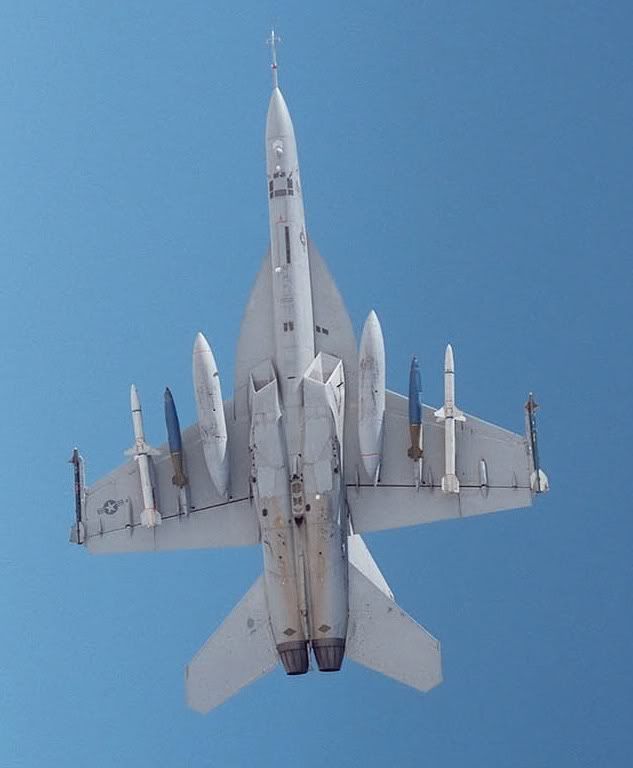
SpudmanWPLM is not the one selling the F-35, it’s the JPO.
Each Partner in the JPO get’s over 10,000 pages of test data a month on the F-35. They could not lie even if they wanted to without tempting fraud charges as they would have had to falsify the test data to sell it.
Eventually, the NATOP will come out (or get leaked) for the F-35 and we can finally put to bed this ridiculous argument 😉
SpudmanWP@Loke:
What I was trying to show is the consolidation of specialties (the two pie graphs) that would greatly reduce the manpower requirement portion of maintenance.
Somewhere I have a whole PDF on the subject.
SpudmanWPThey did not lie, technically, loosely, or otherwise. It’s interesting that you (Thobbes) point to the CPFH being at least 10% greater than legacy F-16s and claim that shows LM lied about being cheaper than the F-16. LM has never made (IIRC) any direct CPFH comparison in the past about being cheaper than the F-16. They have made cost comparisons in regards to Acquisition, O&S, & TCO but I have never seen a CPFH comparison.
Besides, the JPO and all the partners have access to the same numbers that LM has used and they have never made a claim of fraud. They might not like LM’s assumptions that the formulas are based on, but since they have access to all the data, they are free to adjust them as required.


SpudmanWPHere is a graph that puts you info in perspective.

SpudmanWPYou forgot the [Sarcasm] tags
🙂
SpudmanWPYou missed a key announcement in there
“During the flight tests, MADL functioned reliably with excellent range at multiples of required specifications while demonstrating ability to network fifth-generation fighters,” said Mike Twyman, vice president and general manager of the Defense Systems division for Northrop Grumman Information Systems.
It’s good to see some “exceeded spec” news rather than “missed spec”. 🙂
SpudmanWPF/A-18E the “Hi” to the F-35C “Low”??? In your dreams.
The “Hi” was to be NATF which never happened.
:highly_amused:
SpudmanWPI found more info on ATK’s development contract for a new motor.
It’s part of the ONR’s Counter Air AMRAAM program and has been in the budget as it’s own line item since FY2013 docs. I put the details up on the AMRAAM thread.
SpudmanWPMore info found on the ATK new motor tech development.
The Development contract (started in 2009) appeared in the FY2013 budget as it’s own line item (STK-FY09-03) as part of the Sea Strike section of “PROJECT 3346: Future Naval Capabilities Adv Tech Dev”
http://www.dtic.mil/descriptivesum/Y2013/Navy/stamped/0603673N_3_PB_2013.pdf
FY2013 plans
EC: STK-FY09-03 Enhanced Weapons Technologies
– Complete Counter Air Advanced Medium-Range Air-to-Air Missile (AMRAAM) Improvements – Demonstrate propulsion system, manufacture hardware, cast propellant grains, assemble rocket motors and test in both environmental and static conditions.
– Complete High Speed Components – Demonstrate an advanced radome, fabrication of full scale radome and performance testing under relevant environmental conditions.
– Continue Counter Air Defense Improvements – Demonstrate propulsion system, manufacture hardware, cast propellant grains, assemble rocket motors and test in both performance and insensitive munitions conditions.
Here is the relevant section from the recently released FY2014 budget.
FY 2014 Plans:
EC: STK-FY09-03 ENHANCED WEAPONS TECHNOLOGIES
– Complete Counter Air Defense Improvements – Finish materials and design concepts, and develop high temperature resin-fiber and high temperature oxidative-exhaust resistant materials with associated design implementations.
Searching for more info From the ONR comes up with:
http://www.onr.navy.mil/Media-Center/Fact-Sheets/Counter-Air-AMRAAM.aspx
What Is It?
The Counter Air (CA) Advanced Medium-Range Air-to-Air Missile (AMRAAM) Improvements Future Naval Capability (FNC) will increase the kinematic performance of the AIM-120D medium-range air-to-air missile, thus enabling extended range and decreased time to target.
How Does It Work?
The CA FNC will achieve this through a combination of propulsion technologies that include higher energy propellants, highly loaded grain design, composite motor case design and low erosion nozzles.
What Will It Accomplish?
By improving the kinematic performance of existing air-to-air weapon systems like the AIM-120D AMRAAM, CA will ensure the U.S. warfighter maintains the tactical edge in air-to-air engagements against any peer competitor.
The CA AMRAAM Improvements FNC is developing a missile propulsion system with substantially improved kinematic capabilities for the AIM-120D AMRAAM. To achieve this, the FNC is developing and integrating four advanced technologies: High Energy Propellants; Highly Loaded Grain; High-Stiffness/Pressure, High Temperature Capable Composite Case; and Low Erosion Nozzles. The kinematic performance enhancements are focused on improving the “no-escape range,” “time-to-target” and terminal phase maneuverability.
Many of the technologies being matured in this FNC are the fruits of ONR investment in a joint-service propulsion program known as Integrated High Payoff Rocket Propulsion Technology (IHPRPT). Developmental high energy propellant formulations from both industry and government will be considered on the basis of increased total impulse power achieved across the spectrum of operational environments. Highly loaded grain technologies will be investigated to enable the “end-burning” propellant grain, which will allow for higher volumetric loading of propellant within the rocket motor. A lighter weight composite case will be developed to offset the weight delta incurred by the new propellant and grain designs. Lastly, low erosion nozzles are needed to maintain motor efficiencies while enduring greater erosive forces, temperatures, and pressures yielded by the new higher energy propellant and grain designs.
The CA AMRAAM Improvements product is responding to higher kinematic performance requirements for AMRAAM as expressed by the Fleet. These kinematic performance improvements provide the potential to achieve warfighter-defined tactical advantage in the near future. The product will extend the missile’s no-escape range, while also decreasing time of flight to target at maximum range and increasing terminal maneuverability for air-to-air engagements. Additional benefits derived from the highly-loaded grain and composite case features are their inherently positive effect on Insensitive Munitions (IM) compliance.
The product is focused on transition to a pre-planned product improvement (P3I) program for the AIM-120D AMRAAM, but it could also serve as a solid rocket motor technology demonstrator for use in any potential future missile development effort.
The good new is that the program is funded & on track. BAd news, looks like Dual-Pulse is out in favor of more energetic fuel.
SpudmanWPThey reason people (the4 JPO, LM, etc) use Flyaway when talking about an order in any given year is because it’s the only constant that can be used. You cannot compare APUC from one year to the next let alone from one customer to the next.
This year alone the cost of simulators, a new RCS testing facility, Post SDD development funds, etc are added to the cost of the US jet & engine to become part of the APUC. Not only will these costs be different from year to year, but they will not be part of any sale to partner nations. The inverse is also true where MILCON and other costs that the Partners need to foot are not part of US APUC costs. That is why you cannot compare APUC to Partner sales in any given year let alone 5-10 years in the future.
The only constant that can ever be referenced with any bit of certainty is URF, which is the number that is quoted when asked how much the jet costs. Partner governments know that there is more involved and it’s only the simpleton analysts and reporters that raise a stink when it comes to cost estimations.
Look at it this way, when you see a commercial on TV for a car, do you think that is total cost you will ever pay? Of course not. You know that depending on what state & city you live in, sales tax will increase the price. Then there is maintenance, will you do it yourself or contract it out? Will you buy an extended warranty? How much gas will you need in a year? Will you buy a special trim package? Do you plan on building a new garage to put in in or are you going to use the one you have. All these things will add to the price and are pretty universal regardless of what auto you buy. You may need more gas, a bigger garage,etc but you know these things going in.
Btw, Bogden did say (about the Netherlands purchase) $75 million (likely a purchase average) in FY2012 dollars and he even said that with inflation it would get to $85 million. http://youtu.be/s5hPFzOxnBs
SpudmanWPcertainly the newer su-30 would spank the f-15a
Moot point since there are no more F-15As in the USAF flying inventory.


 Sign In







