 SpudmanWP
IMHO Coming in “low and hold some distance” is one of the worst tactics you could do against a VLO force with AMRAAMs (let’s assume a 120D or better).
Coming in Low:
The primary means which allows the latest generations of AMRAAM to achieve a higher range and larger NEZ is through the use of optimized flight profiles. To achieve this, the AMRAAM will fly an arching profile guided by an INS which has GPS. The AMRAAM will expend some energy to get above the target, coast in a parabolic arch to the target area, and then use gravity to dive down on the target. If the target is at a higher altitude than the shooter, then the AMRAAM does not have much potential energy that it can convert to maneuver energy to counteract the target’s evasions.
However, if the target is coming in low, the AMRAAM benefits from much more maneuver energy that gravity will provide. A target down low also only has basically 3 directions to turn (left, right, and up… as down leads to the ground).
Keep in mind that based on MFG data the MAWS on the Su will only see a coasting AMRAAM at 5km which gives a 20-25 second warning assuming only a Mach 1 dive.
Also, with the postponement of JDRADM/NGM, hardware upgrades are more likely to the 120D like the new dual-pulse motor being worked on by ATK. This will make this scenario even more dangerous since the diving AMRAAM will re-ignite its motor in order to have full maneuver energy in the endgame and the MAWS detection to impact time will be significantly shortened.
Holding your Distance:
You are assuming that you will know where the F-35s are while staying outside the engagement zone of the AMRAAM. This is a highly dubious assumption.
– – – Updated – – –
Sorry to see another lame spouter of BS lyrics in charge of the program @ JPO.
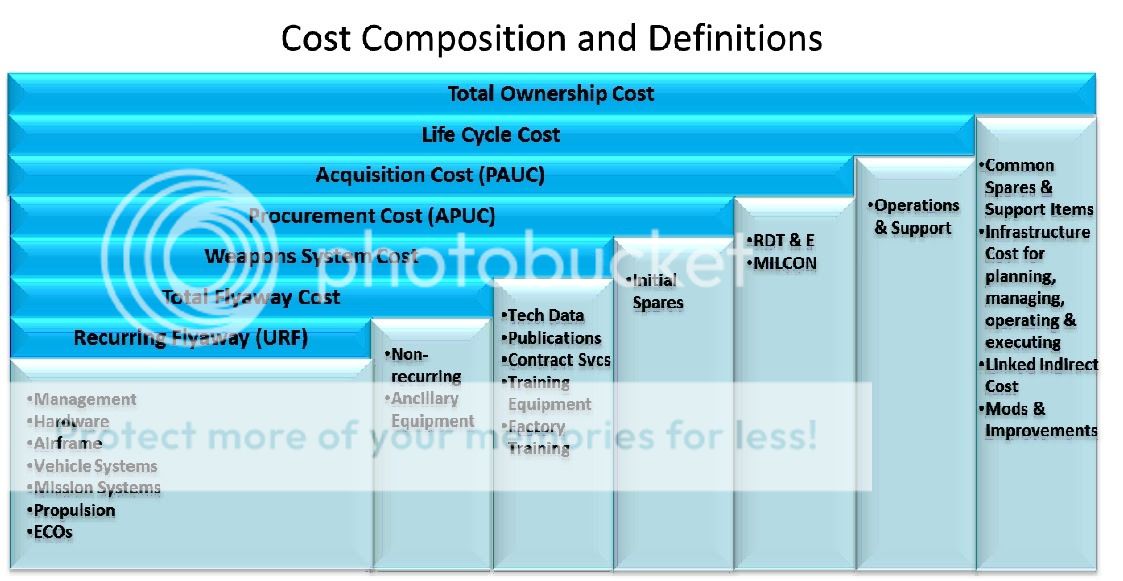
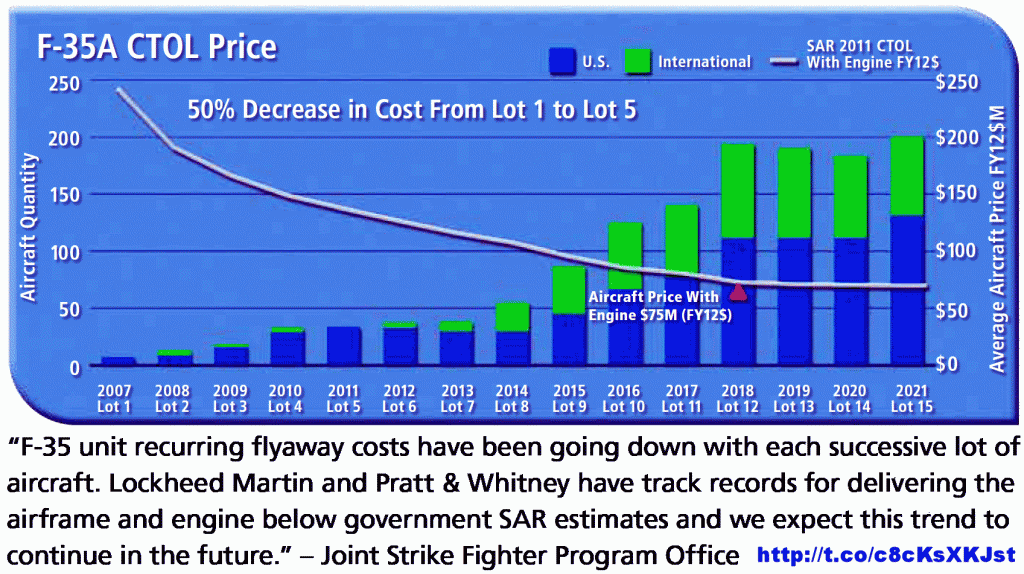
You keep making the same mistake that most naysayers do… you are comparing APUC of the current LRIP to Flyaway of a later LRIP batch or more likely an MYB FRP batch.
SpudmanWPSo you are saying Japan has only itself to blame for the F-35 acquisition disaster.
Too bad Japan’s cries are being heard by countries about to make decisions on F-35 purchases.
Where did I say that?
Joining the Partnership would have save SOME of the money but the biggest contributor to the cost increase that Japan has no control over is the US Government’s decision to GUT the LRIP build rates.
SpudmanWPIncreased cost due to exchange rate:
Tough break as that is the risk taken with international contracts.
Increased cost due to program cost increase:
Unintended consequence of gutting the LRIP schedule in a short-sighted attempt to save money. While unintended, it was completely foreseeable and inexcusable.
Btw, they did have the option of joining the Partnership which would have taken care of some of the cost increases.
SpudmanWPAs with all US missile systems, development is always ongoing for improvements.
In the AMRAAM’s case, a new motor is on the way that ATK has been working on (a tech demonstrator is due in 2013).
Besides physical improvements (seeker, motor, warhead, datalink, etc), the AMRAAM is continually getting upgrades to its ECCM & flight profile algorithms.
SpudmanWPI think Airborne DE self defense systems will be a dual path solution.
An EM/HPM solution and a laser solution to attack the seeker and guidance systems of the inbound AAM/SAMs to attack different aspects of the missile is what I am thinking of.
We are starting to see the 1st generation of this now with AESA radars able to concentrate it’s beam at an incoming missile and DIRCM being designed for fighters. Initially the systems will simple blind the missile while later systems that have more power and more efficient systems available with be able to actually damage the seekers & computers of the missile.
Before anyone says “IR Filters”, that may work for now (with low powered lasers) but once the power starts to crank up, the filter will overheat and deform or melt. This will degrade the track and cause the missile to lose track.
Before anyone says “The seeker will be hardened”, there are two pathways that will always remain open, the radar seeker and the datalink.
While the above seem simplistic (and it is), it shows the likely dual path that DE defensive systems will take.
SpudmanWPIt’s not ;), just an observation as to why they are are including it in the apples-to-apples comparison.
SpudmanWPThe MF2000 upgrade is Moroccan

More Info Here:
http://www.arabianaerospace.aero/mirage-upgrade-augments-new-fighter-force.html
SpudmanWPOne of the reasons why A2A missions do not mandate (although I have see them mounted) the FLIR pod loaded is that vibration and temperature play hell since being an external pod packed with electronics hanging on the outside of a plane going transonic is not a nice place to be.
Pilots wish they could carry a FLIR or IRST on every mission.
This is not an issue with the F-35 as everything is internal.
SpudmanWPHere is the TV interview that Gen Bogden gave to Netherlands TV.
Here is a slide that shows a Block by Block and Tech Refresh capability Level.

Here is the PDF (in Norwegian) that it came from.
Here is the Google Translate of the PDF.
SpudmanWPCurrent Russian systems:
http://www.deagel.com/Navigation-and-Targeting-Systems/OLS-35_a001926001.aspx
The OLS-35 provides a coverage of +/-90 in azimuth and +60/-15 in elevation with a target acquisition range for non-afterburning aerial targets of 50 km facing up to target’s front hemisphere and 90 km facing up to rear hemisphere.
Here is an image from a SniperXR pod (which the EOTS is better than).

Even at 36nm (66km) a fighter would be easily detected & tracked.
You still wont remember that 2 F117 where engaged (one crashed) and that the modern F15 is hopelessly inferior to the modern Flankers (in basically all performance) and that since the era of the T10 the F15 has been kinematically inferior (with similar weapon and fuel load).
You seem to have forgotten that the F-117 flew directly towards the SAM and was shot down at a very short distance of only 18km. Nobody has ever claimed that any VLO airframe (be it F-117, F-22, B-2, or F-35) can survive getting that close to a SAM site. The F-117 also had very little Situational Awareness and if it has the systems on the F-35, it would have been able to detect the radar and evaded the site long before reaching the threat area. Did you also forget that there were 8-12 F-117s in the air that night yet they only got one? So much for countering.
As for the F-15, if it’s so outmatched then why is Saudi Arabia buying it and South Korea considering it?
SpudmanWPThe problem in ‘Nam was that they put their trust in untested (little or no combat experience or realistic testing) AAMs and the idea of BVR combat.
The same cannot be said for the AMRAAM.
SpudmanWPAre you baiting me?
Notice I said “Track” and not “Detect”. The F-35 will rely on the ESM much in the way the F-22 does to gather clues and queues where to point the radar. Once it gets a hit it can then turn the EOTS onto the target and maintain a passive track.
Not all IRSTs are born equal as using publically available info from the both manufacturers puts the EOTS at an advantage vs Russian systems.
With the F-35, you have to detect it first before you can track it and it’s VLO airframe with make that extremely difficult.
Considering the fact that the F35 only will manage <5G sustained turns and needs an eternity to accelerate to supersonic speeds it kind of sounds like you just killed the F35 in the A2A part of the debate.
You are taking one small sliver of data, without context, and judging and entire aspect of its capability? Funny how the sworn testimony showed that even when they knew these limitations the F-35 still dominated the simulations.
At the same pace the offensive systems develop we have a development on the defensive side. This is what development looks like. You make a move, the opponent makes a counter move. Usually the counter move is more efficient and puts the opponent slightly ahead of you. So in the long run it pays to be a slacker and waiting to see what the competition brings 😉
Um, if that were so, where is the countermove to the F-117, F-22, B-2? Hell even the F-15 still dominates.
SpudmanWPIs spud really saying no official data has been released about the other jets like the Super Hornet or Gripen E?
No, I was referring to (and have clarified my above statement – sorry for the confusion) the Pak-Fa, J-20, etc. However, even when looking at upgrades to existing platforms (F-15/18SE & Gripen E), not a lot has been released (in the way of actual test data) about the new systems.
When it comes to jamming though I always tend to remember Red Flag 2008 where Indian Su30MKI had such effective jamming that the Apg63v2, a radar with similar performance to the Apg81 and way larger than the seeker in the Amraam, could not obtain a radar lock on the Flanker.
The APG-81 has much better signal processing and is tied directly to the ESM. Besides, EOTS ignores jamming and can track out to 50nm quite easily.
In these circumstances, does anyone actually believe that a Pk, even remotely close to 50% at long range, is possible with the missiles? I think that before we buy the hype the least we can do is check our history.
That was with a much older AMRAAM and could only be guided by radar.
The F-35 will use a MUCH better AMRAAM (GPS assisted INS, longer range, 3rd party targeting, better ECCM) and will benefit from 4 different guidance methods (radar, IRST, ESM, off-board).
SpudmanWPSchedule, because 5 years after intended IOC it doesn’t work and will not do so in reality for another 7.
I hope you are not implying a total of 12 years late 😉
It’s looking like IOC will be 5 years late for the USMC (2010 –> 2015) and 5-6 years late for the USAF & USN (2011/12 –> 2016/18 ish). Official IOC plans for the USAF and USN are supposed to be released this summer.
SpudmanWPI wasn’t impressed at all with the testimony and thought the LM presentation was severely lacking.
That’s what happens when you ask questions in a public forum that require classified answers. While they could not give classified details in public, there were very adamant about the capabilities & test results in general and sometimes specific terms.
You appear to believe all that the authorities say about the F35, i don’t take it for granted and analyse the data to come to my own conclusions. I have my suspicions as previously mentioned as to why this difference exists.
I don’t believe everything at face value, I just trust their opinions more than I do the likes of RepSim, APA, Wheeler, etc.
If the F35 was indeed the platform you clearly wish it to be the discussions that are currently ongoing amongst potential users would not be taking place.
The problems that the F-35 has been having with the JSF partners have been Schedule and Economic in nature, not technical. Big Difference.


 Sign In







