 SpudmanWP
If the F-35 does not fit your future requirements, where does that leave current 4th gen assets like the F-16, F-18, Rafale, Eurofighter, etc.
Don’t you see the the error is saying that the F-35 will not meet your requirement but instead you propose a fightertype that only meets today’s? Any new fighters you buy will saddle the respective service for 30-40 years.
Replacing a medium range fighter with a long ranged one will just jack up the development, procurement , and lifetime costs of the entire program. If that is what they wanted, that’s what they would have ordered.
They don’t and they didn’t.
You seem to forget that the USN only agreed to the F-18 because the A-12 was “just around the corner”. How did that work out?
SpudmanWPThe F-35 is not replacing the F-111 or F-15E as those are completely different requirements. That’s what future LRS is for.
The F-35 has a longer combat range than the F-16, which it is replacing.
That’s all that matters.
Question is do you need an F-16 replacement?
Are you serious? The F-16s are reaching the end of their useful life in airframe hours. The need replacing. The question is, do you replace them with the same airframe, or spend a little more and get a generational leap in capability. Guess which one the smart money is on.
SpudmanWPThe F-35 fits the UASF’s need for a F-16 replacement just fine.
It carries more, has a higher combat speed, is more survivable, is multi-role out the gate, has better SA, etc, etc.
SpudmanWP@Rii:
It doesn’t have the performance to handle opposing 5G+
1. There is no such animal right now as an opposing 5g (let alone 5g+) fighter. What is out there are years behind the F-35 in development.
2. You’re forgetting that the F-35 is a F-16 replacement, not an F-15 replacement.
3. Let’s wait till they actually fly publically (with all the avionics & weapons loaded) before we start claiming that they beat the F-35.
it doesn’t have the range to handle the Asia-Pacific or Arctic theatres
It has a longer combat range that what it is replacing while being more survivable.
@thobbes:
safe airspace for air refuellers, AWACS, E-11s, E-8s etc.
The F-35 is designed to rely less on all those assets that what 4th gen fighters require.
It does not take into account the need for long range penetration work against major powers
That’s what the B2, LRS, JASSM-ER, etc are for.
or that these powers will operate highly advanced fighter aircraft themselves (remembering that F-35 is a striker first).
That’s what the F-22 and it’s follow-on (USAF & USN) are for. Besides, the F-35 has shown to have a 1:6 LER in a 4:8 fight against “advance red air”. Show me one sub $100 mil multirole fighter that can claim that?
@Tu22m:
Bomber drones that are stealthier, cheaper and have better range than the F35 or the most expensive bombtruck on the market?
Like it or not but UCAVs are the future in the attack role.
They cannot defend themselves are susceptible to bandwidth and situational awareness limitations. How did that work out for that RQ-170?
SpudmanWPBF-17 heads to Edwards AFB as the first F-35 with Block 2B to be installed to begin Mission Systems Testing.
http://www.aerotechnews.com/news/2013/03/15/f-35b-arrives-at-edwards-for-missions-systems-testing/
“We have been preparing for a long time and the arrival of BF-17 will allow us to increase testing for the JSF Program Office. The aircraft was scheduled to arrive in January so we’re excited to now integrate this aircraft into our test fleet. We have started modifications to make it the first F-35B model to fly with Block 2B software, so the team is already taking great advantage of the aircraft,” said Lt. Col. George Schwartz, Edwards Government ITF director.
SpudmanWPYou cannot plan development & purchases today based on today’s battlefield, but on what it could or would likely be in 10/20/30/40 years.
What you are suggesting would be like cancelling the F-15/16 in the 1970s and thinking that the F-4/5 would still be relevant at the turn of the century.
SpudmanWPI actually don’t understand the design rationale behind F-35.
Stealth aircraft aren’t needed against most opponents. And against a relatively advanced opponent ala Saudi Arabia (current ally) they still have no chance against US military might.
The only opponents where stealth aircraft are required are the Russia’s and China’s of the world and they’re big countries that require something with a lot more range than an F-35 (hence these countries focusing on Su-27/-30/-34/-35/J-11 and J-20.
If we had only the Russians and Chinese to worry about, then explain Iraq (GW1). They tried a typical 4th gen attack plan with “Package Q” and we lost several jets in one day. Package Q was a complex mix of Strike Fighters (F-16s), CAP, Decoys, SEAD, IFR, AWACS, etc. They all had to work well together to be a success.
They didn’t and they weren’t.
After that, they only sent the F-117 to Bagdad.
The reason is simple. There is no way to protect yourself effectively against popup SAM and AAA threats when they can see you coming from so far off (your relatively large RCS, the need to put a package together, IFR, etc). You lose the element of surprise.
One mistake that Sadam made was letting us build up airpower in the area prior to hostilities. Others will not be as stupid in the future.
As to “Stealth aircraft aren’t needed against most opponents.”, that is true. The problem is that you do not know what you will need, where you will need it, and when you will need it. This applies to both short term and long term planning. Imagine a CBG steaming in the Gulf and the Iranians get real belligerent. Following your logic “most” of the fighters on the carrier are not up to dealing with the Iranian threat. Because of this, the CBG has to rely on a small (a half dozen or so) number of fighters to deal with the time sensitive and mission critical targets.
Many people scream about only 187 F-22s, but you are trying to put the F-35 in the same situation by saying we only need a few. One of the reasons why we need more F-35s is due to there only being 187 F-22s (with ~120 or so combat coded).
Yes, Package Q was 22 years ago. You forget that while our 4th gen assets have gotten getter, so have SAM and AAA threats.
We don’t play to simply win, but to dominate. A belligerent nation is less likely to get uppity if it knows that there is no way to stop an attack by F-22/35s. If it knows that it has a good chance to knock a few 4th gen assets down then it is more likely to press the issue.
SpudmanWPPackage Q….
And please take it to the “Debate Thread” as this is the “News Thread”
SpudmanWPAt least Dale Brown had the sense to put it on a B-1.
Patience, Young Padawan 🙂

SpudmanWPHeck, since you are flying around with such a large airframe, put a WedgeTail-stye antenna (or 4 APG-81s with larger AESA arrays) on the top and do your own cuing.
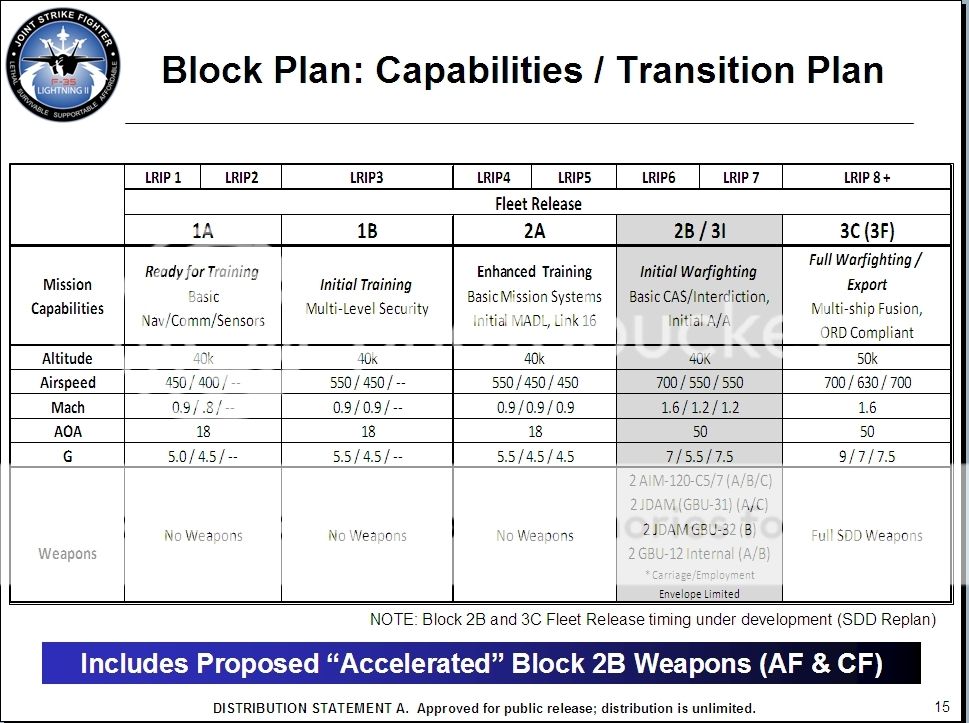
SpudmanWPBlk2A was released a while back and Blk2B will be released later this year.
On the issue of resources for a Candidate Weapon, Norway is paying for it out it’s own pocket.
SpudmanWPnot sure whether the current software block can actually allow for this weapon (or any other) to be launched, but i guess that part of testing is yet to come.
No it cannot as the JSM is a “Candidate Weapon” for Blk4.
SpudmanWPA major misconception is that an F-35 “needs” to return to the US for Block Upgrades. This stems from ignorance, bad reporting, and from the US having a “Reprogramming Facility” at Eglin AFB.
The largest misconception is that the “Reprogramming Facility” (RF) is for doing Block Upgrades. Here is what it is for
Although the JSF Program has contracted with Lockheed Martin and Pratt & Whitney for System Development and Demonstration (SDD) of JSF, contractors do not have laboratory space available or expertise to perform operational evaluation of lab and flight test data and support field recommendations to level needed.
The complexity and magnitude of JSF mission data loads drives decision to utilize government and contractor resources to design and develop a Joint-Service reprogramming facility at Eglin Air Force Base.
http://www.dtic.mil/descriptivesum/Y2013/Navy/0604800N_5_PB_2013.pdf
In other words, the RF is for the gathering and processing of all the data coming back from the SDD, OT&E, and field use of the F-35. The RF helps to develop a new Block, but planes do not fly to the RF for an upgrade.
As to the upgrades themselves, there are two types:
1. Primarily software only Upgrades
2. Tech Refresh Upgrades
The first one will have little or no hardware changes and may be done at the local level. This one may or may not have a change to the hardware.
The second has extensive hardware upgrades that would likely require a MRO&U facility. MRO&U means “Maintenance, Repair, Overhaul & Upgrade” and they will be located worldwide, not just in the US. For example, the Italian & Japanese FACOs were planned with the ability to also be a MRO&U Facility. There are also dedicated MRO&U Facilities that will be build worldwide.
http://www.sae.org/events/dod/presentations/2010/B8JohnSisson.pdf
SpudmanWPIs the reason that the JSM was tested on an external hard point on a F35B because it will not fit in the smaller weapons bay of the B, I understood it had been designed to fit in a Norwegian F35, an A I assume?
The likely reason is that the F-35B was available that day. External fit checks don’t take that long.
SpudmanWPTodays and future Norway is no longer in need of potential exports sells. Being part of most peace-keeping missions they have become very restrictive of every weapons-export and the limited gains from that.
Norway: Government Backs JSM Export Push
HELSINKI — The Norwegian government is working on an initiative to support the sale of Kongsberg Defense and Aerospace’s (KDA) Joint Strike Missile (JSM), with the F-35 as an immediate target.
The initiative will include political representations, close cooperation with the JSM consortium and financial supports to ensure the JSM project has adequate funding to meet its technology and marketing needs.
The lofty scale of Norway’s ambition was manifest when Defense Minister Espen Barth Eide met with U.S. government and Lockheed officials in Washington in January. Barth Eide outlined a state-backed program to sell the JSM not only to the U.S., but to all partner nations, such as Britain, the Netherlands, Denmark and Australia.
more at the jump
Two main takeaways:
1. While the F-35 is likely the first platform for the JSM, they are targeting others.
2. They plan on selling it anyone willing to buy (restrictions not withstanding).


 Sign In







