 SpudmanWP
One of the reasons why Norway is so Gung-Ho over the F-35 & JSM is that they see the potential export sales of JSMs.
It would be the dumbest marketing move ever to limit the JSM to only Norwegian F-35As.
If anything they should switch all NSM production to JSM and save on economy of scale costs (as long as the JSM can be surface launched like the NSM and if the JSM shares the same interface as the NSM).
SpudmanWPbtw, That is an F-35B with the JSM, not an F-35A.
SpudmanWPF-35 & JSM do it Externally
aka JSM competes external fit-check on an F-35.

Development of the new Joint Strike Missile (JSM) continues, and 27 February was an important milestone when the aircraft manufacturer Lockheed Martin for the first time mounted one of the missiles on an F-35 at the factory in Ft Worth, Texas.
The assembly was part of a “fit check” by JSM on an external weapons station on the F-35. This is part of Phase 2 of the development of JSM, which was approved by Parliament in 2011 and confirms that missile is suitable for external weapons stations on the F-35. Later this year they will also test the missile fit in the internal weapons bay.
– Although we are still far far from operational use of the JSM this shows that development is on schedule. As part of Phase 2 of the development program Lockheed Martin have received a contract through the JSF program in the USA that includes conducting such tests on all variants of the F-35, as well as conducting tests in the internal weapons bay on the CTOL model as Norway plan to buy, explains program director Anders Melheim.
JSM is the only long-range anti-surface that is specially designed to fit the internal weapons bay on the F-35, and developed by Kongsberg in partnership with the Ministry of Defence. The missile adds key operational characteristics to the F-35, and enables it to fight the targets protected by advanced defense systems. This is vital in order to be able to perform all kinds of operations in the defense of Norway. JSM is scheduled to undergo a “Critical Design Review” in summer 2013, which will confirm that the design is mature enough to be able to continue the integration and that the missile will be a formal candidate for integration on the F-35.
– We will ensure that Norwegian F-35 get the operational capability we need, and therefore we believe that JSM is an important project. At the same time it provides great opportunities for Norwegian industry, and it is an important part of the industrial cooperation we are working to put in place in connection with the procurement of new combat aircraft, says Melheim.
http://www.regjeringen.no/nb/dep/fd/aktuelt/nyheter/2013/bilde-forste-jsm-pa-f-35.html?id=717070
SpudmanWPThis is the Debate thread, please keep News in the other thread (sorry I simply could not resist… :diablo:)
Touché 🙂
SpudmanWPJust a heads up, AF-23 left Lubbock after 4 hours.
SpudmanWPCan we please keep debate out of the “News Only” thread?
On that note, the Lubbock F-35 was only it’s way after 4 hours.
SpudmanWPIt happened, therefore it’s news.
Good, bad, or indifferent, it’s news.
Better to get it out there now, than to be accused of only reporting the good stuff.
Actually, if you read between the lines you will see that these were two more jets for the Edwards OT&E unit that got two jets last week. Things are really picking up with OT&E.
SpudmanWPCaution Light causes a Cautionary landing in Lubbock Texas
http://news.yahoo.com/f-35-fighter-forced-land-texas-en-route-011439147.html
WASHINGTON (Reuters) – One of two F-35 fighter jets headed to a Nevada air base made an unscheduled landing in Lubbock, Texas on Monday after a caution light came on in the cockpit, according to a Pentagon spokesman and the plane’s manufacturer, Lockheed Martin Corp.
The next-generation stealth fighter was flying from the Lockheed plant in Fort Worth, Texas to Nellis Air Force Base near Las Vegas on Monday afternoon, when a caution warning light came on, requiring the pilot to land at the nearest airport, said Lockheed spokesman Michael Rein.
He said the pilot landed safely. The second plane landed as planned at the Nevada air base, joining two other aircraft that arrived there last week, where they will be used for operational testing and evaluation of the new warplane.
A team of Lockheed maintenance experts was en route to examine the single-engine plane at the Lubbock airport, which is about 300 miles from Fort Worth, Rein said. It was not yet clear what caused the caution light to come on, he said.
More at the Jump
SpudmanWPIt’s been posted & debated to death and considering it contains four factual errors in the first sentence means it’s a steaming pile of crap.
SpudmanWPStill, whatever, I don’t see how money was set aside for the F-35 while it is still in development now (and with technical issues)
This is just one of the many ways that JSF is “not your father’s” fighter program. Many lessons have been learned from previous programs, not the least of which is that planning and money are needed for LRIP upgrades.
With the F-35, they are setting aside some money every year and when the Blk3 spec is put into production, they can order the upgrades without putting additional budgetary pressures on that year’s plan.
Here is how the FY2013 budget was structured.

SpudmanWPSo when it comes to modernizing pre-IOC-standard jets, the lowest cost and fastest payoff is to start with the newest aircraft, which need least work and have most lifetime left, and then work backwards through the production numbers.
No it is not. In no world is building a $100 million dollar fighter and relegating it to a training role cheaper than spending $110 million to upgrade an existing fighter ($10) and using the new fighter ($100) in a combat role.
The FY2013 budget (which has passed both the House and Senate but needs to go to committee) has $127 million set aside for LRIP upgrades. Looking at the FY2013 budget docs will show you that from FY201q forward money is being set aside for the upgrades. Keep in mind that Blk1A to Blk2B conversions do not require extensive hardware changes that are part of Tech Refresh 2. Within a year or so we should see contract awards for the upgrades.
http://www.flightglobal.com/news/articles/jpo-plans-to-award-lockheed-upgrade-contract-for-93-f-35s-377526/
The result is that you end up with a rump of old airplanes that need a lot of work – which is where 40+ F-22s are stuck today.
One of the lessons learned from the F-22 program was that this was a VERY bad idea. Along with unusable or less effective low LRIP jets, they also left behind things like an IRST, a FLIR, cheek arrays, HMD, etc. The F-35 saw this as a big mistake in the F-22 program. This is one of the reasons that teh F-35’s SDD costs are so high as they are going IOC with all the hardware installed instead of hoping for future upgrades.
One of the reasons that early LRIP F-22s were left behind is that their avionics differed a lot from the Blk35 jets. This is not a problem with the F-35 (another lesson learned) .
Besides, you don’t seem to know whats going on with the likes of Typhoon at the moment.
Did the Rafale or Typhoon set aside money while it was in development in order to upgrade the T1 to a later T? I thought not.
SpudmanWPWhy would anyone buy LRIP 1-7?
It’s almost 400 useless machines that can only be used for schooling at best.
If this were a typical fighter development & procurement I would almost agree with you. However, unlike recent programs like Eurofighter & Rafale, the F-35 program already includes a plan (and more importantly some money) to upgrade early LRIP F-35s to a later Block standard.
There are two types of upgrades involved, Software and Hardware.
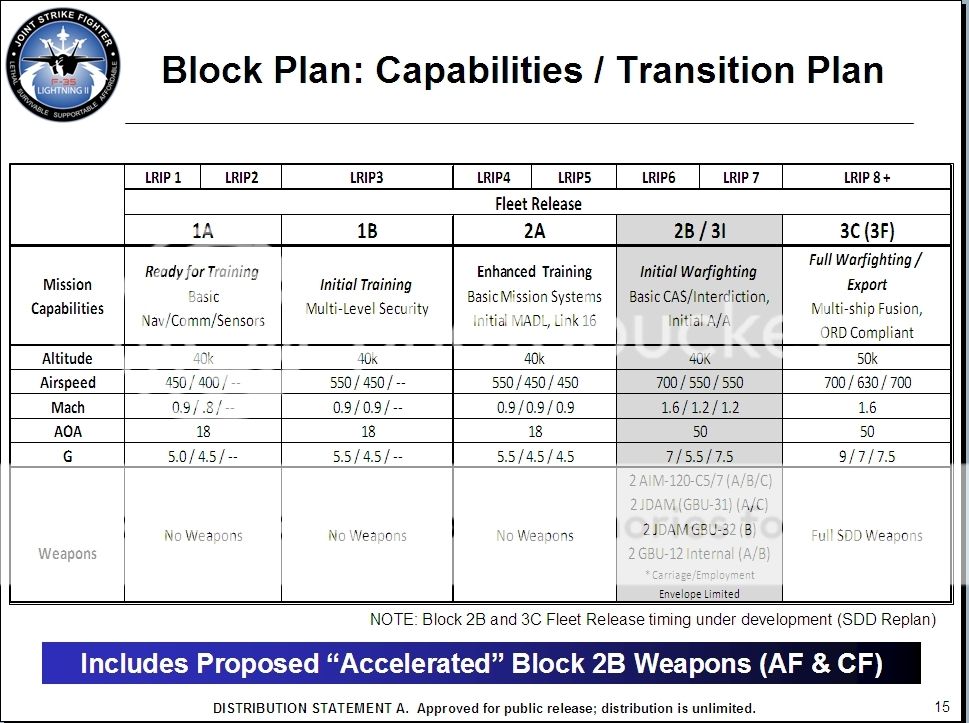
The transitions from the current (from the report) Blk1A up through Blk2B are primarily software in nature and require relatively little time or hardware changes. Current Blk1A F-35s will get upgraded through 2B during normal depot maintenance schedules and will have their envelopes opened at that point.
Going from 2B to 3i requires a new hardware package called “Tech Refresh 2 (TR2)”. Blk3i is basically Blk2B on the new TR2 hardware.
In order to save money, the JPO plans (and is funding) to buy the TR2 hardware at the same time they produce Blk3i fighters on the production line. This will enable them to save some money by increasing the “economy of scale” buy.
In no way will these Blk1A F-35s be left as Blk1A fighters, they will be upgraded along with the production runs of the F-35.
Btw, Only the first few LRIPs were 1A while the rest are 1B, 2A, 2B, etc as the SDD program progresses. They too will get the 3F upgrades as the production switches to those blocks.
SpudmanWPThey can and it’s a non-issue related to a block of software that will never see combat.
SpudmanWPLook and shoot, ‘if looks could kill’… it involves looking out of the cockpit. :diablo:
Not really as the target can be designated on the display, pK verified, and shot taken. No need to VID the target line up the target with the HMD.
SpudmanWPCheck again, that was two lines 🙂
In all openness I have said many times where the program has new issues, this is just not one of them. That report is on Block 1A and the limitations therein. All of them were known, many have been addressed, and many of those are fixed by Blk2b which will be done with development this year. Also, this only affects the training squadrons for a short period of time till they get the 2B upgrade.
Here is the envelope expansion plan. Notice that it follows the Block and is not arbitrary.


 Sign In







