 SpudmanWP
CFRP <> CNRP
SpudmanWPThe benefits of CNRP are well documented and a good Google search will turn up lots of white papers that go into it.
As far as testing goes, anytime that you replace a load-bearing part with another of different quality, you have to redo a lot of testing to verify how that part behaves. If LM will not do it when the testing costs could be spread across several thousand airframes (and they have reduced the price vs CFRP by so much), there is virtually no chance of Sukhoi doing it when only a few hundred T-50s are being produced.
The problem with RAS on a fighter is, like I mentioned before, that most of the LO effort is related to cover joints and rivets/screws.
You have to treat the fasteners on any VLO fighter, RAS or not. What makes Fibermat better than traditional RAM is that it does not get damaged in normal use and that you can create panel openings that do not require treatments once they are closed.
SpudmanWPThe 2nd part of that FG article is more relevant.. LM was able to produce the CNRP at 10% the cost of CFRP.
If the T-50 tries to switch to CNRP after it’s flight testing is done, then it would have to redo it just like LM. That’s a lot of cost increase for so few airframes. Best to solidify the production process, understand the material, and plan the next plane around it.
It’s too expensive to retrofit into load bearing structures.
SpudmanWPThe F-35 does not use “coating” type RAM. It is part of the composite structure of the F-35. It’s called Fibermat.
http://www.military.com/features/0,15240,215074,00.html
Lockheed officials avoided the need to use stealthy appliqués and coatings by curing the substance into the composite skin of the aircraft, according to Tom Burbage, executive vice president of F-35 program integration for the company. It “makes this airplane extremely rugged. You literally have to damage the airplane to reduce the signature,” he said in an interview with AVIATION WEEK. This top-fiber mat surface takes the place of metallic paint that was used on earlier stealthy aircraft designs.
The composite skin of the F-35 actually contains this layer of fiber mat, and it can help carry structural loads in the aircraft, Burbage adds. The F-35 is about 42% composite by weight, Burbage says, compared to the F-22 at 22% and the F-16 at 2%.
I missed this gem in that AFA article.
Moreover, the surface material smoothes out over time, slightly reducing the F-35’s original radar signature, according to the Lockheed Martin official. Only serious structural damage will disturb the F-35’s low observability, O’Bryan said, and Lockheed Martin has devised an array of field repairs that can restore full stealthiness in just a few hours.
You read that right, the F-35’s RCS gets BETTER over time, not worse through normal use.
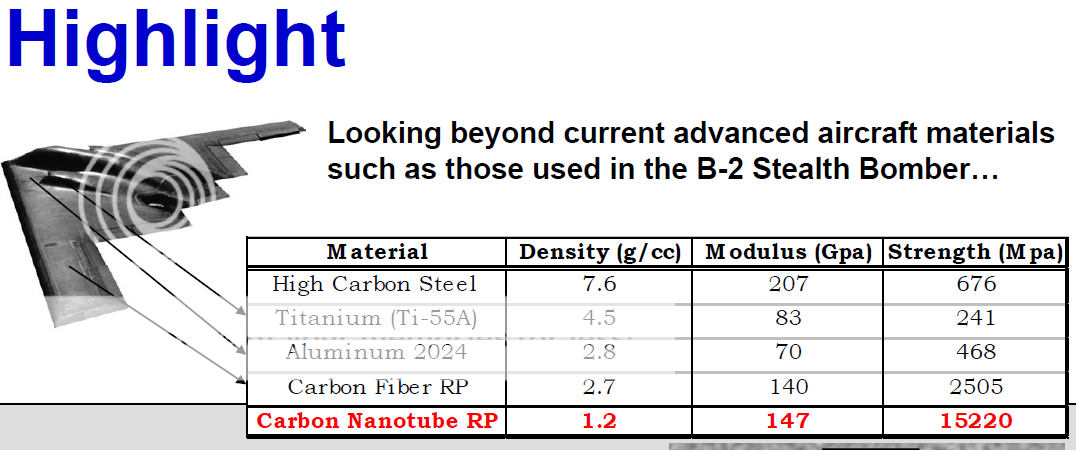
LM has come up with a very good solution to address the weight issues of the F-35, but it would require new structural and flight testing. For now they are limiting it to non load-bearing structures because no new testing would be needed. It’s called CNRP.
Lockheed Martin has revealed the F-35 Lightning II will be the first mass-produced aircraft to integrate structural nanocomposites in non-load bearing airframe components.
A thermoset epoxy reinforced by carbon nanotubes will replace carbon fibre as the material used to produce F-35 wingtip fairings beginning with low rate initial production (LRIP)-4 aircraft, said Travis Earles, a manager for corporate nanotechnology initiatives.
I see this innovation helping LM with post F-35 more than helping the F-35 program directly as they can start with a clean-sheet design and not have to retest for a retrofit.
To give you an idea of how it stacks up against CFRP, steel, titanium, etc.
SpudmanWPBacking Boeing would not result in APA getting any money. The only chance they would get to get paid is for their claim of “royalties” to be honored or for them to be paid for F-111 upgrades.
Backing Boeing (or any other asset besides the F-22) does not lead to either of these.
SpudmanWPA bigger version of this?


SpudmanWPCorrect in the that the 600 gal wing tanks cannot be jettisoned.
SpudmanWP(cough “MATRA” cough) “T4” family….If there´s one thing that MBDA does have is “experience”.
You want to compare experience? How about 65+ years across a wide variety of systems.
AIM-9 Sidewinder
AIM-7 Sparrow
MIM-23 Hawk
AIM-54 Phoenix
AGM-65 Maverick
RIM-66 Standard MR
RIM-67 Standard ER
AGM-88 HARM
MIM-104 Patriot
RIM-116 RAM
AIM-120 AMRAAM
AGM-154 JSOW
RIM-156 Standard SM-2ER Block IV
RIM-161 Standard SM-3
RIM-162 ESSM
RGM-165 LASM
RIM-174 ERAM (SM-6)
GBU-53 SDB2
That’s just the high performance SAMs, AAMs, and A2G munitions for Raytheon alone that stretches back to the late 1940’s.
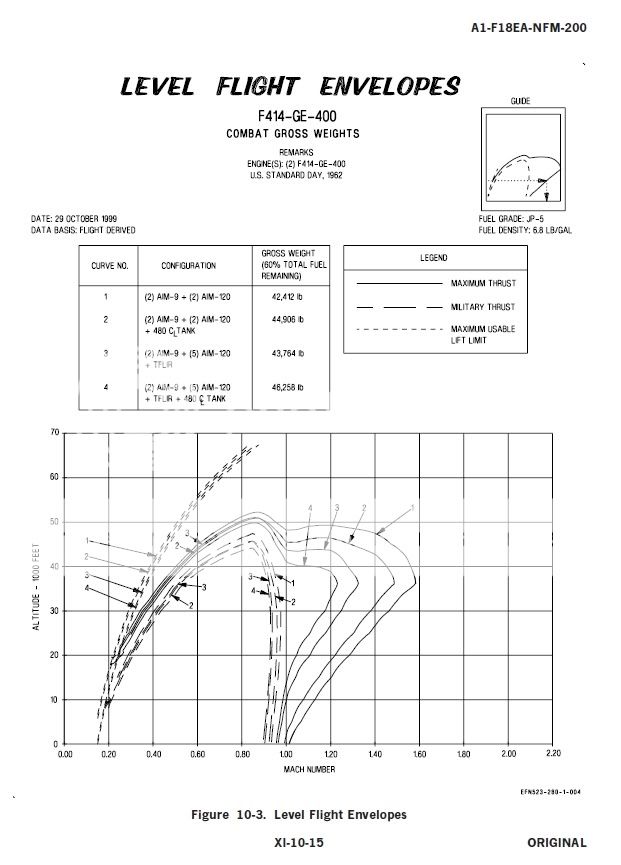
I think its a fair bet that the FA18E with the EPE will get above mach 1.6 with BVR missiles. Or what do you think? 20% extra thrust gives over 2% extra speed?
It might. Keep in mind that the F-35 is not at max thrust at m1.6 as it is a design (read we don’t want to operate past this) limit. The program has already said that they will test above m1.6 “just to see what happens”. Given this, it will likely have a much lager part of it’s envelope intersect the m1.6 line.
SpudmanWPThe AIM-120 has been upgraded twice since the Meteor started it’s development (C7 and D) and already has post D upgrades in the works like a new motor from ATK (due out of Dev next year).
“Utter tosh” would apply if you had anything to say otherwise. If not, then you are guessing. Just because it’s new, does not make it better when the people making it have less experience than you at similar systems (ala Tejas vs F-16 or Pak Fa vs F-22).
I base my assumptions (remember that I did say “likely”) on Raytheon having more developmental, testing, operational, and combat experience with the AMRAAM than MBDA has with Meteor (or any of it’s predecessors).
SpudmanWPThe F-18E has a lot of inherent drag that keeps it from getting to m1.6 while carrying just 2xAim-9 and 2xAim-120. Going 4xAMRAAM would be even worse due to extra canted pylon on each wing.
SpudmanWPWhere did I say that either the EF or Rafale were high drag while armed designs?
SpudmanWPWhat do you mean by “planes like FA18E”? Do you mean planes with a thrust/weight ratio below 1, fighters of same weight with a top speed of m1,8+, 4,5 gen fighters?
I meant planes with external weapons that have a high drag penalty.
SpudmanWPA likely max-range engagement with the F-35 boosting to > m1.2 in order to push 2 of the GPS guided -120Ds to max effective range. They would then likely throttle < m , repositions, and then maneuver to finish off the survivors.
SpudmanWPUtter tosh, you dont have one single reliable comparison source in the open public about the MBDA Meteor (or by the way on the “Delta”)…
Which part? The -120D has benefited from many upgrades over the AMRAAM’s lifetime including multiple ECCM upgrades, warhead, datalink, control section, etc. The datalink is now 2-way, it’s INS has GPS built-in which allows for a more range, a more accurate endgame & a higher pK, and it has several HOBS upgrades.
If you’re going to demean somebody’s motives from the cover of a pseudonym, at least try to be logical. If APA were in it for the money they’d be pushing Typhoon or Rafale – unless you think LockMart would cut them a fat check the day the first RAAF F-22 gets delivered.
Typhoon or Rafale would not get mean money for the APA because they are true multimission fighters while the F-22 is not. This is why the F-111 is needed along with the F-22 (according to APA). APA expected the Australian government to pay them “royalties” for coming up with the idea or an actual upgrade contract for the F-111 work.
In stealth mode, the F-35 enters an x-on-x combat with almost any contemporary at a disadvantage in terms of load-out (with four radar-only missiles), agility, acceleration and maximum speed.
In a BVR engagement detection range & ID are the most important factors while agility is the least. The F-35 excels at both primary factors and can still launch it’s missiles at m1.6+ if needed while planes like the F-18E cannot ever get that fast while carrying AAMs.
SpudmanWP??? what length?


 Sign In







