 SpudmanWP
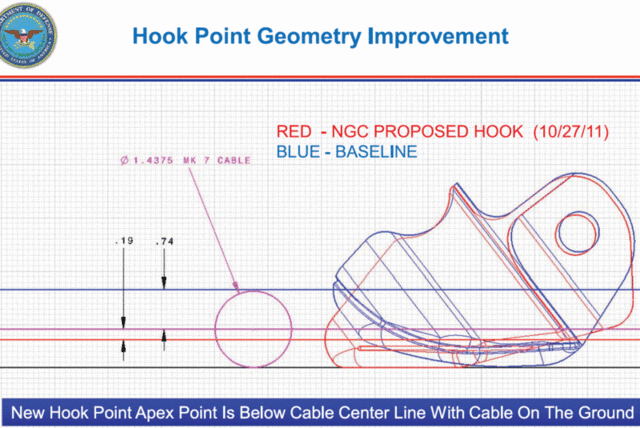
well, the problem was that the wire was smacked down against the deck by the wheels passing over it and it didn’t have the time to rise back up for the hook to catch it.
The new hook has it’s “apex point” below the center of the wire now. This is no longer a significant issue.
SpudmanWPThe main problem with F-35 is that it’s going to be forced upon everyone that can pay for it an even to countries that can’t justify it’s adquisition.
Nobody is being forced to take the JSF (except maybe the USN 😉 ). Any Partner can pull out of the program if they want to (there are penalties, but they knew that going in).
SpudmanWPEODAS is already on the edge of obsolence.
Really? Considering that NOBODY has anything operational like it, how is it obsolete? You don’t know it’s size, it’s capabilities, etc and you are assuming it will never get upgraded.
Just FYI, the resolution the EODAS offers is identical to the resolution of a pocket-size imager I got on my table as we speak.
It’s job is not to ID (that belongs to EOTS), but to track. You do not need hi res to track. Again, you are assuming it never gets an upgrade.
As for the mentioned 650 parameters for identification of a potential threat, it is a strictly software thing -(un)fortunately quite easy to upgrade with simple software updates. These don’t even have to be integrated with the particular 4th gen aircraft – a modern targeting pod will do..
Source? Thought not.
Swing and a miss.
btw, The F-35 is massively software driven. So as you upgrade admitted to, it will be easy to increase it’s capabilities. This is another benefit to the F-35 vs other 4th gen systems (low cost to develop due to large customer base, low cost to upgrade due to software driven, and low time to upgrade since it’s mostly software).
SpudmanWPwhat is this uber-sensor that F-35 has but noone else has anyway ?
EODAS
It shines primarily as the missile is launched (thereby increasing the chance of taking out the launcher) but also potentially plays a part in VID/track as it flys around.
how exactly?
Per recent sworn testimony:
Air Vice Marshal Osley: And so the strength of the joint strike fighter—and I use this as an example—is that it {F-35} has the ability to have up to 650 parameters by which it will identify a potential threat out there. Other aircraft, such as the F22 have about a third of that {~200} and fourth-generation aircraft have perhaps half a dozen. So if you are in an F18 or in some of the other Soviet aircraft you only have a very limited understanding of what the threat is and being able to identify it at a distance. If we are able to do as we plan with the F35, and that is to have good access to the software and to be able to program it appropriately with mission data, it will have the ability to identify hostile aircraft at quite a considerable distance. Then decisions will be made within the formation, it will play to its strengths and it will defeat it, but not by going within visual range.
SpudmanWPUnderstood.
You’re referencing the system as a whole rather than speaking directly about the hook-to-wire interface.
SpudmanWPThe moving deck/buffet is what the damper/FCS is for. The hook’s ability to snag the wire when presented is done for the most part.
SpudmanWPRecent tests showed 5 of 8 traps with the 3 missing ones due to the hook not being in the right place. In other words, every time the wire met the hook, the hook grabbed it.
This was done without a new damper.
So now it’s down to:
– Testing the new damper (to keep the hook on the deck longer)
– Software updates (to land the F-35 in the right spot)
– Pilot training (to use the FCS properly)
SpudmanWPOh you are so right, not.
F-35C will be operating up to 600+ nm away from the carrier (or any solid surface) and they are not worried about it.
Swing and a miss.
SpudmanWPYes, only one wire on the test pad, IIRC.
http://www.vancouversun.com/news/national/engines+have+ingested+birds+since+1988/7275133/story.html
Not only does that article not say anything about the CF-18 being safer than the F-35, it makes no mention of how the CF-18s were damaged by the birds.
btw, The F-35 has gone through ingestion testing.
SpudmanWPunless LM´s offer is absolutely head and shoulder´s above the rest i am not seeing the USAF delivering this contract to them.
I think that if there is one thing that the recent tanker bid has shown us is that companies are not afraid to take the DoD to court if they feel that the decision did not follow the guidelines of the RFP. I doubt very seriously that the RFP will have some kind of handicap in place to help Boeing or hurt LM.
In other words, the LM bid does not have to be head and shoulders above the rest, just better IMHO.
SpudmanWPYou’re making too many assumptions when trying to come up with an RCS value. You’re assuming that the study had access to all the info, you’re assuming that it references an RCS reduction of 95% rather than a detection rage reduction, you’re assuming that it’s referencing a 4th gen 5m2 value as a baseline, you’re assuming that they would give you the actual RCS value rather than the minimum goal of the program, you’re assuming, you’re assuming, etc
From that you present your analysis as fact and expect the rest of us to go along. Not gonna happen.
Swing and a miss
Ohhh, so close. You almost have learned the lesson of providing sources when making absurd claims.
I was under the impression that you knew about this; every F-35 critic does. You surprised me by not knowing this critical piece of information, so I overestimated you.
Still no source?
SpudmanWPBoeing is a criminal company and the tanker fiasco is evidence of that. But LM benefits from the higher protections because:
Wear tin foil hats much? 😉
The fact is that the F-35 program is $180 billion over budget and…
Still no comparison numbers to back up the your claims I see. You cannot call someone the the worst without comparing it to everyone else.
SpudmanWPMy bad on SFC as I was just throwing numbers…
Here is some that I found.
F119-PW-100
(MIL) 25,000lbs @ (~0.800?) lb/HR/lb st (Speculation varies between 0.600 – 0.860…)
(MAX) 37,000lbs @ (~1.950?) lb/HR/lb st
So AB is either 2.5:1 to 3:1 -ish in fuel consumption.
What that does not show, however, is at what speed, altitude, and drag penalties are involved. Since we are talking about drag penalties for <= MIL only we need more detail.
For that you need a chart like:

SpudmanWPThe fact is that going > M uses more gas than < M for any given distance. If you can supercruise then it only costs ~2x the gas. If you cannot supercruise then it will cost you ~4-5x the gas (depending on AB fuel flow rates). There is no way around the supersonic drag penalty.
The end point being that your potential combat radius goes down the more time you spend > M and that the F-22 spends most of its time and range < M in a “typical” mission.
SpudmanWPIf even F-22 cannot stay over M1.0, then what is the supercruise feature good for?
The basic idea of supercruise, as I understand it, is that your fighter spends MOST OF THE TIME in the supersonic region, so that it immediately enjoys speed advantage whenever an unexpected encounter occurs. Much like MiG-31, only without AB.
If USAF fly their Raptors in subsonic, then they basically negate all the F-22s were designed for..
You cannot negate physics. Supersonic drag will suck gas at a much higher rate than subsonic. The point of supercruise is that you can still go >M without using your AB.
Here is a LM F-22 site: http://www.f22-raptor.com/technology/data.html
The range listed at the bottom is 410nm with only 100 of it being supercruise. If the F-22 wanted to spend it’s entire time in supercruise, its overall range would be <300 as I’ve seen quotes of supercruise requiring twice the gas as subsonic for the F-22.


 Sign In







