 SpudmanWP
AARGM is slated for Blk6 already. If the UK (or someone else) wants to throw more money at it I am sure they could accelerate the timeline.
SpudmanWPThe Turkish SOM is on the list as a Blk4 candidate and is already working on UAI integration.
SpudmanWPSpudmanWPHopefully by next year Blk4 will have been settled (as far as a plan) and some contracts can get issued.
Since MBDA does not have a 500kg class (think JSOW) internal standoff weapon, maybe they could partner with the Turkish SOM team? Also, SOM is already working on UAI so that would give MBDA a headstart in that area.
—UPDATE—
I was reading that Raytheon presser about PWIV and noticed some juicy tidbits.
Sled tests of a penetrating warhead have recently been conducted with Qinetiq, while work is also under way on a new blast/fragmentation charge offering reduced collateral damage effects. Both will have the same mass and centre of gravity as the current weapon, removing the need for additional integration activity, Marsden said during a 3 April briefing at Raytheon’s Harlow site in the UK. Longer term, the weapon could also gain a range extension kit and a data link.
SpudmanWPDid you miss the Raytheon info? It is contracted and is actually at the Pit-Drop stage.
btw, the latest info (as of March 2012) specifically shows ASRAAM and PWIV as part of IOC Blk3.
http://www.dtic.mil/ndia/2012annual_psr/WERTH.pdf
Considering that 2020 is 7.5 years away, there is pleanty of time for MBDA & LM to get a lot done re:integration. They could even put UAI into MBDA systems to speed the process up.
Another option is to put emulation modes into newer weapons so no software has to be changed in order for it to fly. IIRC, they did this with JASSM-ER to get it to fly on JASSM platforms.
btw, to complete the same mission that now requires the Tornado & CASOM only requires and F-35 with JSOW, but CASOM is likely coming in Blk 4 or 5.
—Final Thought—
The reason why there are no “contracts” for Post SDD integration is because the Partners have not decided what will be included in Blks 4&5. That is why they are called “Candidate” weapons. As soon as they vote to determine what will be in Blk4, then the contracts will start to flow.
This is why Japan only ordered 4 F-35s in it’s initial batch, because it is LRIP (orders are made year to year). Once FRP comes, then buyers can order in larger lots to save money. Point being, you cannot sign a contract to do something before you know it will be available when the time comes.
SpudmanWPI’m not talking short term, but Late LRIP/FRP deliveries.
@Sintra, So you consider FOC to be operational with every weapon planned and not simply a ship full of IOC F-35Bs?
—-Update—
A lot more is being done re: UK weapons than you might be thinking of.
http://www.jsf.org.uk/JSF-UK-Industry-Team/MBDA.aspx
MBDA’s Advanced Short Range Air-toAir Missile (ASRAAM), Storm Shadow and Brimstone are all threshold weapons for JSF. ASRAAM is scheduled for Block 3 integration (SDD) while Brimstone and Storm Shadow are post SDD.
Consequently, MBDA is currently supporting, under contract from Lockheed Martin via BAE Systems, the integration and clearance of ASRAAM and the provision of Storm Shadow and Brimstone on JSF within the System Development and Demonstration (SDD) contract. Future weapons such as Meteor are being considered for the F-35 platform in due course.
http://www.ainonline.com/aviation-news/2012-07-08/theres-no-escaping-mbdas-meteor-missile
July 8th, 2012
MBDA has just finished work on a preliminary contract with Lockheed Martin to study how Meteor will fit into the F-35’s internal weapons bay. Wind tunnel tests to study the airflow around the bay doors as the missile is ejected will be next. The UK’s first operational F-35s will carry AMRAAMs, but the Meteor is scheduled for the stealth fighter’s Block 4 software release.
Raytheon Systems Ltd. announced this week it has won a $24 million contract to integrate Paveway IV weapons on the F-35 Lightning II.
http://www.flightglobal.com/news/articles/raytheon-nets-60m-uk-paveway-iv-order-370322/
Apr 2012
The Paveway IV will also be carried by the UK’s future Lockheed Martin F-35 Joint Strike Fighters. A first pit-drop test of the weapon from an F-35 was performed at Eglin AFB, Florida, in late March, Raytheon says. The weapon will be suitable for both internal and external carriage by the stealthy type.
SpudmanWPWell, if RAF really decides to retire Tornado GR4 at the time of 2019, then it must need a platform that is able to carry Storm Shadow / Brimestone and to do the job of SEAD/DEAD at that time.
And since the FOC of F-35B won’t be ready until post-2020 or even post-2025, I think Typhoon + AESA radar with electronic attacking capability shall be the only possible and practical choice to be ready to do these jobs at the time of 2019.
Do you have a schedule handy of when the UK will be getting their F-35Bs?
What do you consider FOC?
SpudmanWPThis is what you may be thinking of, but it only works for ships as the ship can position the IR Screen between the ship and the incoming missile.
There is also the issue of the IR screen needing to be in the same IR band as the seeker.
SpudmanWP“Isolation material”?
If you are trying to block the FOV from the seeker, that may only work for a few seconds and only if the missile is coming in from a tail chase.
SpudmanWPIf that’s true, no wonder why the system was successful, and probably still is.
Maybe against legacy (Aim-9P [export version btw], Aim-9L/M) Sidewinders, but I would not give them much of a chance against newer IIR based missiles.
SpudmanWPUm, if you directly hit the plane, then ALL of your energy is imparted and all fragments hit.
If you miss, then only a small fraction of the energy & fragments transfer to the plane.
In no way will a prox detonation damage the plane more than a direct hit if they are aiming for the same spot.
Think of it this way, it’s the same damage potential as a grenade… the closer you are the more damage is done.
SpudmanWPSorry, that’s what I get fro doing a Google Image search with dirty contacts 🙂
Here is the original:
Here is the Japanese one:
SpudmanWPMax warhead lethality will almost always involve impact as anything else means wasted energy and fragments hitting nothing but air 🙂
SpudmanWPIt is a Japanese Apache Longbow with a Camo paint scheme and Stingers on the wingtips.
http://www.flightglobal.com/news/articles/first+japanese+apache+longbow+unveiled-205542/

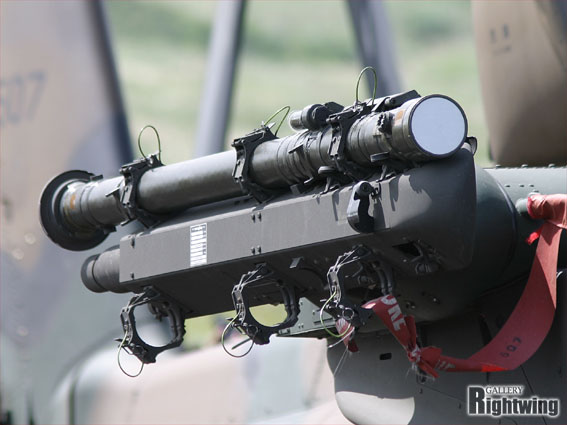
SpudmanWPI don’t see how no internal IR missiles is an advantage;
Sorry, I was not clear enough. What I meant was that there is room for 3 AMRAAMs per bay as opposed to 2 AMRAAMs + an IIR. One gives the option of carriing IIR if needed and the other forces the issue wheter it is wanted or not. Much like the concept of a Multi-Role fighter, it’s all about having options.
Also, since WVR combat is quickly becoming a suicidal move, having more BVRs is the better option. However, future AAMs are coming that are Multi-Mode so the BVRs become the best of both worlds.
BVR does not involve IIR? I would not make that statement so categorically. News to the MICA IR, ASRAAM and AIM-9X people, particularly AIM-9X Block II with datalink.
I was specking of Missiles that are for the JSF. btw, ASRAAM does not have a datalink and can “barely” be called BVR, if at all.
And you can look at the historic timelines for missile development – and at the US industrial base and experience in high-speed missile development – and take a guess at when NGM might be ready.
Did you forget the continued development of T3? It should fly by next year:
FY 2011 Accomplishments: ($18.891 mil budget)
– Conducted preliminary design review of T3 concepts.
– Initiated T3 critical design activities.
FY 2012 Plans: ($30.820 mil budget)
– Conduct hardware-in-the-loop integrated subsystem testing.
– Conduct propulsion system ground testing.
– Fabricate and ground test demonstration vehicles.
FY 2013 Plans: ($38.500 mil budget)
– Conduct captive carry test of flight test article.
– Conduct ground launch of test article.
– Conduct airborne launch of test articles against three target types.
I don’t believe for a moment that it was a major factor. If it had been, it’s hard to see how either F-18E or Typhoon was considered ahead of upgraded F-15s.
I did not say it was a major factor, just a factor in cost estimations.
If you look at the numbers:
The defense ministry says it gave each contender a score in four areas. A maximum of 50 points was available for aircraft performance, 22.5 for cost, 22.5 for domestic industrial participation and 5 for after-sales support.
The cost to adapt the IFR was a small part of a category that itself was less than 1/4 of the total points available.


 Sign In








