They are planing on three separate JSF/WASP test deployments. I would imagine that they are keeping to the basics during the first.
The 2010 SAR puts the STOVL mission parameters as having a 544ft STO and carrying 2 JDAMS & 2 AMRAAMS. BTW, the KPP says HHH profile. It does not state VL or standard landing (my bet is on VL).
The latest Fast Facts files says “13,500 lb / 6,125 kg”
but I expect that we’ll see a lot of jets like the Block 20 F-22s, confined to test and training and not economically attractive to fix.
There is already money set aside in previous budgets (ie already spent) to upgrade Blk1&2 jets to Blk3. The reason is simple; Blk1&2 jets are primarily Eglin AFB training jets. You cannot effectively train a pilot for a Blk3 jet using Blk1&2.
Also, the JSF program learned it’s lesson well about the need to upgrade early jets from the mistakes of the F-22 program. The JSF program designed the avionics of the F-35 so that there is a great amount of growth potential built in.
It’s a short range fixed focus system, as far as I know. A far cry from an IRST, indeed.
You’re confusing EODAS (the 6 IIR cameras that surround the F-35) and the EOTS (the Sniper-XR derived FLIP/IRST that has focus and optical zoom capability) located underneath the nose of the F-35.


Well they are training jets (hello, Eglin AFB). One of the hallmarks (and potential headaches) of the JSF program has been its concurrency. By the time the Eglin pilots are to the point where they are to be dropping bombs and shooting missiles, AF-2 would have gone through its weapon separation testing to validate what is in Blk1. Concurrency allows these things to happen in close proximity rather than waiting for the testing to be compete before production of the training F-35s begins. Again this is why Blk1 jets can be delivered 10 years after dev start compared to 15 years from dev to delivery for the EF.
Really, not an IRST? You might want to check you definition of an IRST. You might not like it’s location, heritage, or wavelength.. but don’t confuse that with it’s functionality.
Really , HMD not working? Do some research. The only function not working properly is the nighttime display of EODAS camera footage. All the symbology and head-tracking functions (traditional HMD features) work just fine.
The F-35 can pass info upstream via it’s SATCOM, only the F-22 (as currently configured) needs BACN to pass the info upstream.
As to UAI, the whole point is that “one size fits all”. It’s like a print driver for your computer. Remember to old days of DOS and waiting for each program (Word Perfect, Lotus 1-2-3, etc) having to each have drivers for every printer/video/modem/etc. Thankfully those days are long gone and so will making changes to fighter software for each weapon used.

Actually, yes (with UAI as part of Blk3).
Thanks. However it demonstrates one thing, weapons testing has not been done yet so it will still take some time before the necessary clearances are obtained. Thus the blk 1 isn’t yet ready for employing AMRAAMs, JDAMs and GBU-12. It might be able to carry them and the aircraft’s systems might support them, but they haven’t done any separation trials yet, have they?
Weapon testing is ongoing and is one of the primary jobs of AF-2. Don’t confuse the ability for something to be done in software with whether that ability has been verified in testing.
– Launch cruise missiles (similar to Scalp EG) Blk4 – JASSM, JSM, Stormshadow, etc
– Launch nuclear cruise missiles (similar to ASMPA) Blk4 – DCA integration
– Launch anti ship missiles (exocet) Blk3 with JSOW-C1 and Blk4 with JASSM, Stormshadow, etc
– Strike fixed and moving targets off boresight and up to 50+ km from high alt or up to 15 km from very low alt. Blk3 with SDB1 and JSOW
– Lock ground and air targets from their radar emissions, and destroy them with either air to air missile of aforementionned weapon Blk3 – any weapon can be targeted using any sensor [radar, ETOS, EW, EODAS, etc]
– Do a reconnaissance mission with a dedicated reconnaissance pod unknown as not publically stated as part of it’s dev cycle.
– Refuel other fighters with a nounou pod Not part of the requirement, we have a whole fleet of tankers for that.
I can play that game too. Wake me when the Rafale has:
-Operational AESA in all planes
-Operational IIR IRST in all planes
-Has an HMD
-Can passively track non-emitting airborne threats (both aircraft and missile) in the WVR rangeband.
-Has a directional LPI datalink
-Has the ability to integrate new weapons WITHOUT changing or upgrading the software on the fighter.
They are Blk1 awaiting the okay to start training. AF-6&7 have completed their “maturity testing” flights to verify Blk1 as ready for training and are just waiting for the official OK from the DoD.
It will be what the F-35 “should cost”, both in acquisition and O&S costs. It should be broken down by variant (as they should not be the same cost). Multiple puns intended 😉
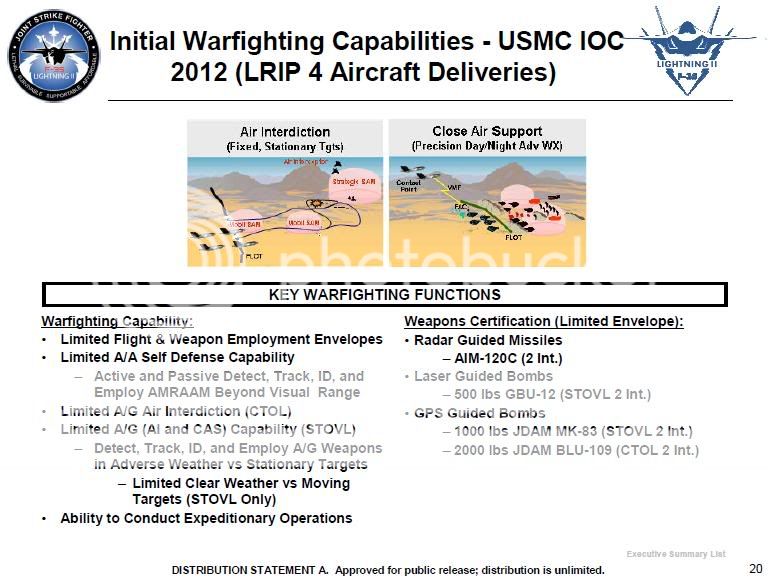
Per request, here are the two docs I have showing combat capabilities in F-35’s Block 1 and Block 2.
Block 1
Block 2 (everything from above and)
The “should price” should be out this month, pun intended 😉
Here is what the F-35B’s Block 1 includes.

Full sensor fusion, basic A2A & A2G including several different laser and GPS based smart munitions, HMD, etc.
Block 1 will be used at Eglin AFB for initial pilot training. This is in “service” in a way, but not IOC. This is my point though, the JSF program decided to wait for IOC until ALL it’s systems were fully matured and not finish basic development after IOC.
As far as the IOC dates:
For EF I started in 1986 (when the EAP flew) and work on the EF’s design began. I put it’s IOC date as 2003.
For the F-35 I used 2001 when the X-35 was chosen and the SDD contract was signed.