 SpudmanWP
Someone presented a revised shedule in the hope it gets unnoticed to bolster the own claim. :diablo:
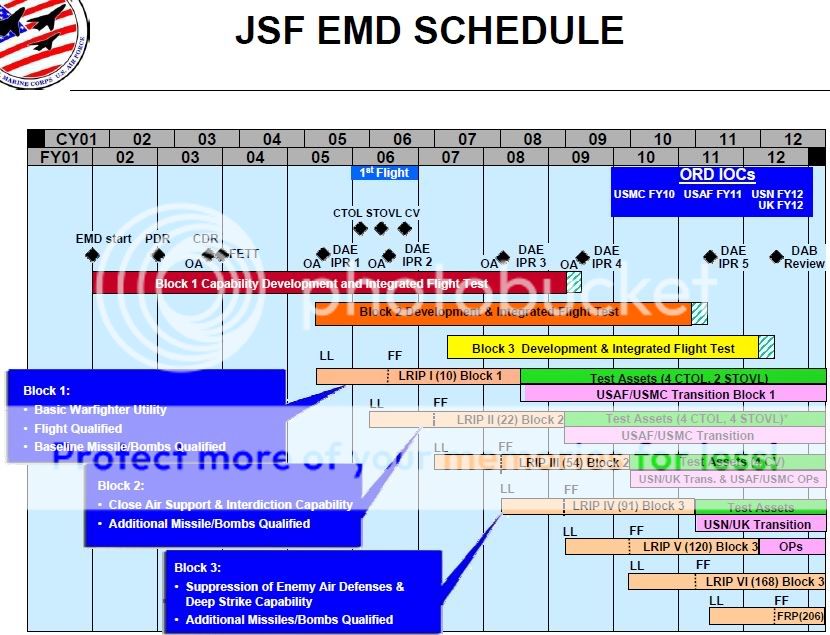
Are you trying to be a troll? The first is pre-SWAT and the second is post-SWAT. The point of the second slide was to show you that FF meant “Full Funding” and not “First Flight” which you were implying. If you knew anything about the procurement process you would have known what LL & FF meant and I would not have had to school you.
Scorpion82, the slide is from a 2009 Western Aerospace Alliance conference and presented by Keith P. Knotts who is LM’s F-35 International Business Development for Canada and United Kingdom.
http://www.manitoba-aerospace.mb.ca/events/conference_09/keith_knotts_lockheed_martin.pdf
btw, Canada’s Chief of the Air Staff was also at the conference, although he would not have to have been to get this info as Canada has it’s own personnel in the JPO and would have had this information years earlier.
http://www.canadawestaerodef.ca/documents/WAA_Conference_Program_2009.pdf
SpudmanWPAnother fact is that the F-35 is or at least was supposed to achieve IOC in block 2 configuration, not block 3! You appear to try to turn the delays in some kind of pro argument…
The USMC was the only customer who wanted to go IOC at block 2. The USAF and USN are waiting for Block 3.
So you have no problem to explain “FF” in the CY scale at least. 😀
Easy, it stands for Full Funding.

The Canadians are reportedly concerned about insufficient STOL capabilities and the fact that the F-35A uses a different AA refuelling method than the F/A-18 currently in use. I wonder whether LM has investigated in that issue (AAR)? Canada is most likely not the sole customer who might prefer the hose & drogue refuelling method and as the B & C models use it, has LM considered fitting F-35A with the as well for export customers?
Holy Crap…. Are there any “journalists” who actually bother to do research anymore? You wonder if LM has “investigated the issue”? Not only that, but they have planned for the F-35A to have P&D refueling as on option from the very beginning. Space for the same P&D probe that the F-35C uses has been reserved in the F-35A design and it can be installed for any customer who wants it. The same applies to a drag chute.
Information was available about both programs over two years ago. This is a 2009 graphic that deals specifically with Canada and the P&D and drogue chute.

SpudmanWPIn order for the F-35B to do cats and traps would require too much weight to be added, mostly to strengthen the airframe.
The second problem is that the location for the tailhook is where a door for the 3-bearing nozzle is now.
SpudmanWPum.. you might want to look at that schedule again. That “LL” on the far left of LRIP4 means “Long Lead”. In other words, that is when they STARTED to produce the sub-components that will make their way into the LRIP4 jets when they start to produce them the following year (2009). Two years after that is when the first LRIP4 jet was to roll off the production line (2011).
Next time don’t bring a knife to a gun fight. 😉
SpudmanWPYou might want to go back to learning English as you seem to have a problem understanding it.
All that was claimed is that Blk 1 includes full sensor fusion (from the listed sensors). 2016 is seen as a possible IOC date for F-35s [b]IF[/] they are not able to address the issues at hand. Blk 3 jets, however, will be flying many years before that.
btw, the first F-35 to have Blk1 was flying in early 2010, not Dec.
2008 was NEVER a date to have Blk 3 jets flying, let alone IOC.
This schedule from 2001 (the year the F-35 production contract was signed) shows operational jets flying Blk3 in 2012, not 2008.
Fact-checking called for. The day IOC was declared, Eurofighters were assigned to QRA in Italy. That was in 2005.
BTW, when did the F-22 get an IRST?
Swerve, your making my point re:the F-22’s IRST. The JSF program did not want to fall into the trap of waiting on spiral development to get basic functionality…. Because it may never happen.
On the IOC status of the T1 Rafale and T1 EF:
1. What were their A2A and A2G capabilities?
2. What weapons were certified?
3. Did they have HMDs?
SpudmanWPThe production quantities in Europe are much smaller, you can’t compare production run of US fighters with those of European fighters for that reason.
My point was that in the first year of production delivery, they did not deliver at the same rate they did 5 years later. Also, the reason that we are using LRIPs is that, in order to get the jets to units ASAP, we are developing and producing at the same time. In the long run this may cost a little more, but it gets the jets to the units much quicker.
I haven’t changed anything! I asked whether the sensor data are fully fused, may have added the question what are the exact requirements wrt the level of sensor fusion?
Yes you did change the subject. Your initial question was if they were fused or not, now you are questioning the functionality of the sensors providing the data to be fused.
Maybe but they don’t offer ALL of the capabilities and stuff guys like you talk about all the time when it comes to the F-35. The truth is that the F-35 follows a spiral development path like other recent fighter designs did and that capabilities are continuously added.
The IOC F-35s will be fully functional combat unit jets. This cannot be said of jets like the IOC EF. It’s IOC jets were training jets and they did not get to combat units till years later. The EF did not even get an IRST till T1 Blk5.
There will always be some level of spiral development in any program, but what makes the F-35 unique is that it’s IOC jets will be fully combat capable for any of the multirole missions it performs. The same cannot be said of the IOC versions of the Rafale, EF or even the F-22.
There will continue to be improvements made to the F-35 and new weapons added (btw, the F-35 after Blk4 will not need new Blk upgrades to get new weapons). But for IOC, everything that it has works and there are not empty spots or missing multirole functionality.
SpudmanWPEF went through prototypes, a batch of development & test aircraft, then a full-rate production order. LRIP seems to be a modern US thing.
They may have ordered 150+ EF T1s at one time, but at what rate did they deliver them (how many per year for the first few years)?
–edit–
I just saw that in 2009 they delivered the 200th EF. That is a rate of 30 per year. Btw, that is what the F-35 is doing now in LRIP.
The article talks about fusing, that doesn’t mean that full functionality is provided
Changing your subject much? There is always room for improvement as technology and operational needs improve. But, the meaning of fusion is clear.. whatever data is being sent by the sensors (production level for EOTS btw) is fused completely. The individual sensors have been testing and flying for years and they would not dumb them down in order to do Blk1.
Because at the time those things were cancelled the design was already frozen and built in provisions aren’t bad. The F-35 doesn’t feature a DIRCM either, but the aircraft is built with the necessary provisions in mind to integrate them latter for example.;)
But why were they canceled for production? The answer is that they wanted to reduce costs and they told themselves they could add them later. The DoD remembered this lesson and chose a different path for the F-35.
Correct and the same is happening with the F-35. Much of the functionality won’t be achieved before the latter blocks and that is in fact a spiral development. You are full aware of all the charts for the F-35s block improvements which is a planned spiral development (full EOTS functionality, DIRCM, 6 internal AAMs etc.).
Not quite. Later blocks (which will come every 2-3 years) will be icing on the cake. Blk 3 F-35s will be able to do the entire range of missions required of a multirole fighter. That cannot be said of IOC Rafales or Eurofighters.
SpudmanWPIs it really full right now?
Yes it is.
The Block 1 software will enable most of the primary sensors on the F-35, which possesses the most powerful and comprehensive mission systems package of any fighter ever to fly. Block 1 forms the foundation of all subsequent software blocks. It enables information fusion from the F-35’s radar, electronic warfare system, distributed aperture system, electro-optical targeting system and other sensors, and provides initial weapons-release capability.
http://www.lockheedmartin.com/news/press_releases/2010/101115ae_f-35b-flies-block1software.html
Well other aircraft didn’t have LRIPs to cut from in order to increase development funding.
So the EF & Rafale went straight to FRP?
Much of what you state for the F-22 was either not planned for the basic configuration or cancelled on cost grounds in the first place.
Really, then why did they leave space in for the AIRST and cheek arrays (I forgot about those ;))?
Conventional spiral development? It was in fact common practice to complete development and start production in the past.
That is not what Spiral Development (SD) is. What is currently happening with the EF and Rafale is what SD is. They were produced with rudimentary functionality and declared IOC. Then they started developing the technology to bring them up to full multirole functionality. For instance how long did it take the Rafale to get LGB capability? Hows that AESA program going?
SpudmanWPFull sensor fusion for the F-35 (including but not limited to EOTS, EODAS, APG-81, MADL, and EWS) is working and flying today in both the CATB and the F-35.
On the budget, my point was that it’s developmental & LRIP schedule was cut to pay for Dev funding needs. If they had left the schedule alone and still paid for the increased Dev needs, then that would constitute “throwing money at the program”. They would also have had more test jets flying today and decreased the cost of production at a faster rate than they
One of the main drivers in the length (and cost) of the F-35’s development is that they are trying to do most of the planned development for IOC. They learned from the F-22 in that later budgets may not allow upgrades that are planned today (ie where is the AIRST, HMD, jammers, and WVR tracking for the F-22). They are going for full sensor fusion, installed IRST, fully functional EODAS, AESA radar, RAM coatings now instead of gambling that the budget will allow it for later.
The F-35 will have a higher multirole capability at it’s IOC than it’s contemporaries did when they went IOC. The DoD and it’s partners know this and that is why they are willing to pay and wait for the F-35 rather than use a more conventional spiral-development process.
And as far as a “Plan B”, we have one (and are using it as needed), it’s called SLEP and new buys of our latest 4th gen aircraft.
btw, what 2nd Rafale? If your speaking of the M, how is it different? The F-35C sports a larger folding wing, larger tail (both vertical and horizontal), new nose gear, tailhook, and a beefier structure throughout.
Yes, the F-35 can be upgraded from earlier blocks to later ones. Money has already been budgeted in FY2011 to upgrade all Blk1&2 LRIP F-35s to Blk3. The Norway docs also said that all purchased Blk4 jets (early purchases) would be upgraded to Blk5 (later purchases).
SpudmanWPThe fact is that shaping affects RCS returns. Radio waves reflect off objects when they strike them. If they did not you would not get any radar return. VLO shaping is all about controlling how the waves are reflected.
Granted, different frequencies are not affected by the same shape in the same manner, but the fact remains that a properly shaped VLO aircraft will have a greatly reduced RCS no matter what the radar frequency. This is not to say that the RCS will be the same, just not as bad as the “340km vs a F-117” suggests.
To support this assertion, I have a pic from a 2002 Cal-Poly VLO Bomber design study.
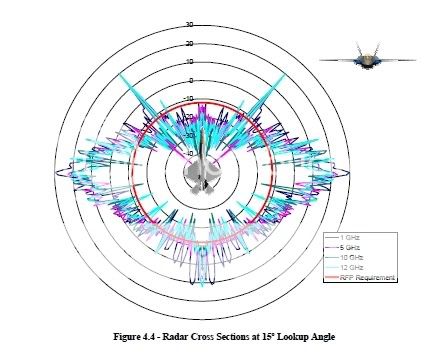
Things to notice:
1. They have no agenda to falsify data and they will fail the class if their data is not accurate.
2. All RCS measurements were done assuming bare metal.
It is important to note that the addition of radar absorbing material (RAM) would further reduce some of the returns on the aircraft. Also, currently the RCS software is treating the entire aircraft and all of its parts as purely reflective metal surfaces.
3. RCS, across all bands, is affected by shaping. This affect is roughly the same (within an average of about 10db).
SpudmanWPX-35 flew in 2000. F-35 in 2006. The programme has had money thrown at it …
The F-35 program has had it’s budget cut almost every year. These cuts also included test aircraft that are now having to be borrowed from LRIP jets.
Despite having to design three different jets, deal with SWAT, track three flight test schedules, and with deal with development cuts… the F-35 will likely achieve a shorter First Flight to IOC timeline than either the Raf or EF.
SpudmanWPThat logic about RCS and frequency does not jive. For instance your link (2d VHF) on the detectability of a F-117 is nearly identical to that of a B-52, yet is only 1/5 the range of a B-52 when in the presence of jamming. How does that work?
The 350km vs a F-117 is obviously a mistake (and the whole link is not official anyways).
Even Kopp (who hates all things F-35) admits that range scales with RCS.
Here is VHF:

And UHF & L-Band:

SpudmanWPCorrected:
“Protivnik GE 3D L-band: Range:400km”
That is 340km vs a 1.5m² target. The B-2, F-22, and F-35 are several orders of magnitude smaller than that.
“Barrier E L-band:Range: Range:500km”
You need to read deeper. It’s meant to be part of a 500km package (10 units connected by a 50km link). It’s antenna is only 2.5m*5m (12.5m²) in size and uses 1-10 watts. By comparison, the Nebo set uses 100kWs of power (that’s 10000 times more power) and has a much larger antenna. Did you notice where it says “fill gaps (40-80km) in the radar field”? It is meant as a short range tripwire type of radar.
“Nebo UE 3D AESA VHF: Range:400km”
Again read deeper. It says that it’s detection range for a fighter type (that’s 3-5m²) is only 310km. The B-2, F-22, and F-35 are several orders of magnitude smaller than that.
SpudmanWP???
SpudmanWPThe delays up to this point have been hardware, which has delayed the testing and development of the software… BTW, Blk1 (fully integrated avionics) is flying today in both CATB and F-35s.


 Sign In







