 SpudmanWP
Any contract signed is with the DoD, not LM.
MEMORANDUM OF UNDERSTANDING
AMONG THE
DEPARTMENT OF DEFENCE OF AUSTRALIA
AND THE
MINISTER OF NATIONAL DEFENCE OF CANADA
AND THE
MINISTRY OF DEFENCE OF DENMARK
AND THE
MINISTRY OF DEFENCE OF THE REPUBLIC OF ITALY
AND THE
STATE SECRETARY OF DEFENCE OF THE KINGDOM OF THE NETHERLANDS
AND THE
MINISTRY OF DEFENCE OF THE KINGDOM OF NORWAY
AND THE
UNDERSECRETARIAT FOR DEFENSE INDUSTRIES ON BEHALF OF THE
MINISTRY OF NATIONAL DEFENSE OF THE
REPUBLIC OF TURKEY
AND THE
SECRETARY OF STATE FOR DEFENCE OF THE
UNITED KINGDOM OF GREAT BRITAIN AND NORTHERN IRELAND
AND THE
SECRETARY OF DEFENSE ON BEHALF OF THE DEPARTMENT OF DEFENSE
OF THE UNITED STATES OF AMERICA
CONCERNING THE PRODUCTION, SUSTAINMENT,
AND FOLLOW-ON DEVELOPMENT OF THE
JOINT STRIKE FIGHTER
(Short Title – JSF PSFD MOU)
SpudmanWPLooks like a ramjaet may still be in the works for JDRADM.
Aerojet Successfully Demonstrates Next Generation Solid Ramjet Fuel
(Source: Aerojet; issued August 10, 2010)
SACRAMENTO, Calif. — Aerojet, a GenCorp company, announced today that it has successfully tested an advanced solid ramjet fuel in an engine ground test. The fuel is being developed to provide long-range, high-speed capability for the U.S. military and potentially for the future USAF/Navy Joint Dual Role Air Dominance Missile (JDRADM).
Ramjet engines have historically used liquid fuel which mixes with atmospheric air in order to provide thrust at high speed. However, for tactical missiles, the military services have expressed interest in a storable solid fuel. In order to meet this need, Aerojet developed the world’s first throttleable solid-fueled ramjet for the U.S. Navy GQM-163A Coyote missile target starting in the year 2000. Since that time, Aerojet has been developing a family of advanced formulations called AerGen fuels with properties suitable for a tactical missile ramjet engine. The fuel burns very efficiently, resulting in more delivered energy and reduced visible exhaust.
The ground testing was conducted at Aerojet’s Airbreathing Test Facility located in Orange County, Va. A full-scale engine was tested at conditions simulating high-altitude, high-speed flight. “Our airbreathing propulsion business represents cutting-edge technology aimed at future military requirements,” said Aerojet Vice President and Deputy to the President, Dick Bregard. “Aerojet is proud to demonstrate our commitment to advancing our country’s military capability through this innovative ramjet fuel research.”
Aerojet is a world-recognized aerospace and defense leader principally serving the missile and space propulsion, defense and armaments markets. GenCorp is a leading technology-based manufacturer of aerospace and defense products and systems with a real estate segment that includes activities related to the entitlement, sale, and leasing of the company’s excess real estate assets.
SpudmanWPThe reason is that they had to completely redo the contract as the original LRIP4 contract was a Cost+ model and the new one is a Fixed+Incentive (IIRC) model.
Both sides are going over every item in the program to make sure that there will not be any surprises that cannot be accounted for.
SpudmanWPIIRC each side F-15SE bay can carry 2 SDBs.
SpudmanWPA funny claim to stay polite. The true cost are the ones a customer has to pay for his F-35B when he signs the order. Just examples ordered after 2016 will be delivered to true costs by your logic. 😀
Which part is funny?
Any choice, and contracts signed, will be made several years from now when the F-35B is much cheaper than it is today. To compare the F-18 to what the F-35B costs today (early LRIP) is what is truly funny.
SpudmanWPNot really. LM and the DoD have already stated that LRIP4 will be AT LEAST 20% below the SAR numbers.
Once LRIP4 (and especially LRIP5) starts, we will have a much better understanding of the F-35’s true cost.
What is very obvious is that the latest SAR blew the costs estimates.
SpudmanWPRecovery speed is 135 knots, compared with F-35A 155 kts. Takeoff speed is 15-20 kts lower.
F-35C is rated at 7.5 G sustained with limited 9G and has slower acceleration and roll rate, but improved sustained turning ability.
The lower G of the B/C models is not a design limitation, but a artificially imposed limit to reduce maintenance costs.
SpudmanWPThe C has larger wings (more fuel), a fuel tank instead fo the lift fan, and a longer bay that can have a 2k lb weapon (B can only fit a 1k).
The C has the longest range of all three varients. The Combat Radius in nm for all three is 590/450/640 (A/B/C).
SpudmanWPPersistence to prevent enemy movement
That is what UCAVs and other ISR assets are for. A fighter will not be efficient if it always carries a huge amount of fuel around just to play whack-a-mole.
Multi/hyperspectral sensing to find camouflaged targets
The EODAS is a step in this direction. There is another system (I forget the name ATM) for UAVs that can view dozens of targets simultaneously (2-3 fps video rate).
Hypersonic “something” to kill time sensitive targets before they disappear.
Already in development. Check out things like HyFly
http://www.globalsecurity.org/military/systems/munitions/hyfly.htm
SpudmanWPThe USAF has an airborne radar testbed. Here it is testing the B-2.
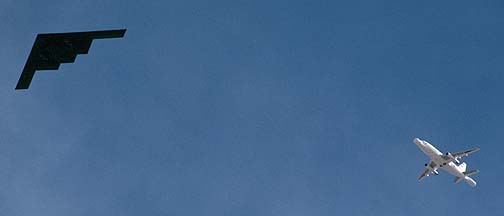
The main drawback to this type of testing is lack of consistency and only one radar antenna at a time. The ground based systems have a dozen antennas covering a huge range of bands.
SpudmanWPThe F-35’s fuel-based cooling system keeps it away from the leading edge and skin by dumping the heat out the rear of the plane via a heat exchanger in the engine inlet.
SpudmanWPWhile they have not publicly made any statements about current IR testing, they have made many statements that say that IR suppression is part of the F-35’s design.
SpudmanWPWhat would be more important for the RCS confirmation
That’s easy. A lab test because YOU CANNOT TEST A REAL PLANE due to structural limitations.
The key to a lab test is the ability to control the environment and be able to replicate the results.
As per this PDF, the F-22 was tested in the same way.
When all the flight tests are done, they will likely do some aerial RCS tests, but this will be just to verify information that they have already gathered and simulated.
What kind of test is being done in the F-35? right now, at this moment.
You need to be more specific as most aspects of the F-35 are being tested in some way.
Here is a good source on RCS testing facilities.
http://www.thehowlandcompany.com/Bluefire.htm#RCS101
SpudmanWPSerious? Really?
If you do not know how a pole model is useful then why are you making any comments?
SpudmanWPover G, your original post stated that RCS testing would not happen till after the flight testing was over. We were just showing you that LM has several aspects of the F-35 program that are in SDD at the SAME TIME.
These include:
1. Simulation testing of various systems
2. CATB (and other) flying testbed aircraft
3. RCS testing of the HALO (and other) models
4. Ground static test models
5. Final flight clearance testing of Flight Sciences (AA-1,AF-1,2,3,BF-1,2,3,4,CF-1,2,etc) airframes
I am sure that there a more that I missed.


 Sign In







