Well, the EF MAW may not track a missile with that much detail… it may only get sector and range, since it is not AESA and not a moveable antenna.
That looks like a hypothetical advantage to me. It might be a big plus if the emitter has the same altitude as the target. At the same time it will reflect back the whole energy if the emitter has higher altitude.
They just made a tactical decision considering the vast majority of emitters will be below or at the same level as the F-35.
@Spudman.
It’s funny you claim, EF’s MAW can track missile, but can’t track a plane. How did you figure that out?
It’s easy, they never made the claim that it can.
What did they nickname the PT-7.. the “Monica”?
Interesting info on the older MAW, which is scheduled to be replaced in T2 or T3. The biggest drawback with a RF based MAW is that operating it will make you visible on virtually every RwR in the area. RF based systems can also be jammed. These may be some of the reasons why they are going with a UV or IR based system.
There are a few things that need to be cleared up…
The APG-81 can do an initial scan of the full 120 degrees in well UNDER a second. If you watch the YouTube APG-81 video (pre-production gear btw), you can see the speed at which it scans.
1:00 Mark
http://www.youtube.com/watch?v=gNhc4y1jPwk
The EF’s MAW (and all others) cannot track planes, just missiles. All MAWs are either IR or UV based, not radar. The RwR would detect the active seeker of a missile or plane, not the MAW. The F-35’s EODAS is the first system to have the ability to track missiles, planes, and moving ground targets in a 360, WVR sphere around the F-35. This works regardless whether the target goes active or not. Other RwR systems can do some tracking, but that only works if the target goes active.
The EF’s MaW CANNOT generate IR imagery.
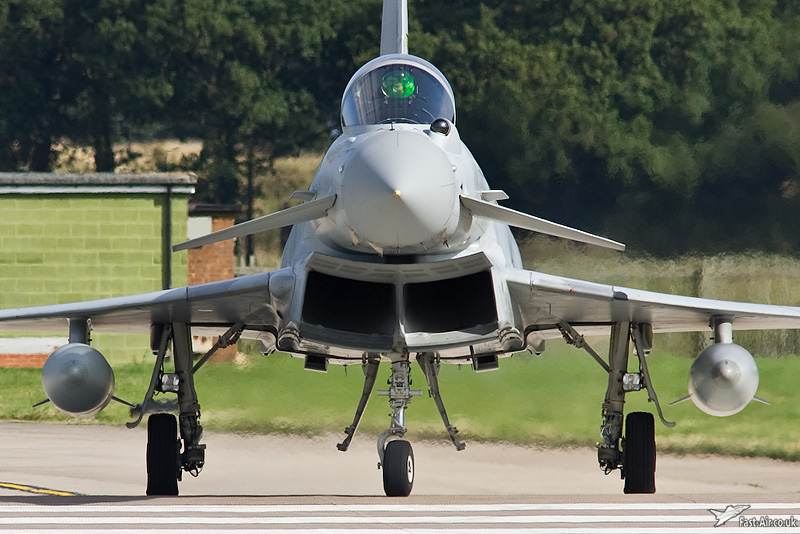
I found a good head on shot from the nose and it is blocked from looking straight down and for most of the right hand side of the jet.

I drew the angles here.
The EODAS system in the F-35 only claims to be able to detect and track planes in the WVR rangeband. No specific number has been given.
What the EODAS can do at longer range is MLD functions since the AAM’s rocket plume is much easier to detect than the fighter itself at that range. The EOTS IRST can also detect targets at much longer ranges than the EODAS.
Kopp keeps being brought into it because most of the BS that flows within the pipes of the F-35 naysayer comes from his a$$. The whole “can’t turn, can’t climb, can’t run.” , the L-Band wing AESA, etc, etc, all originated with his “analysis“.
PIRATE is an IRST that is mounted above and on the left of the EF’s nose.

It cannot see below the EF.
Can it be slaved to the HEA?
Just curious, did you source that from a cereal box?
hehe.. no.
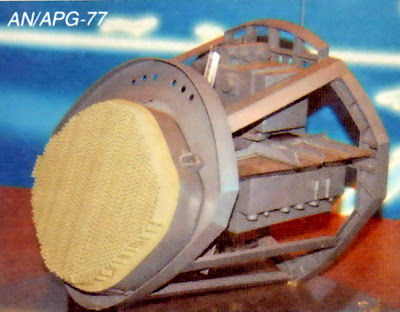
I did a Google image search and looked for one that could show the cant.
Here is another one.

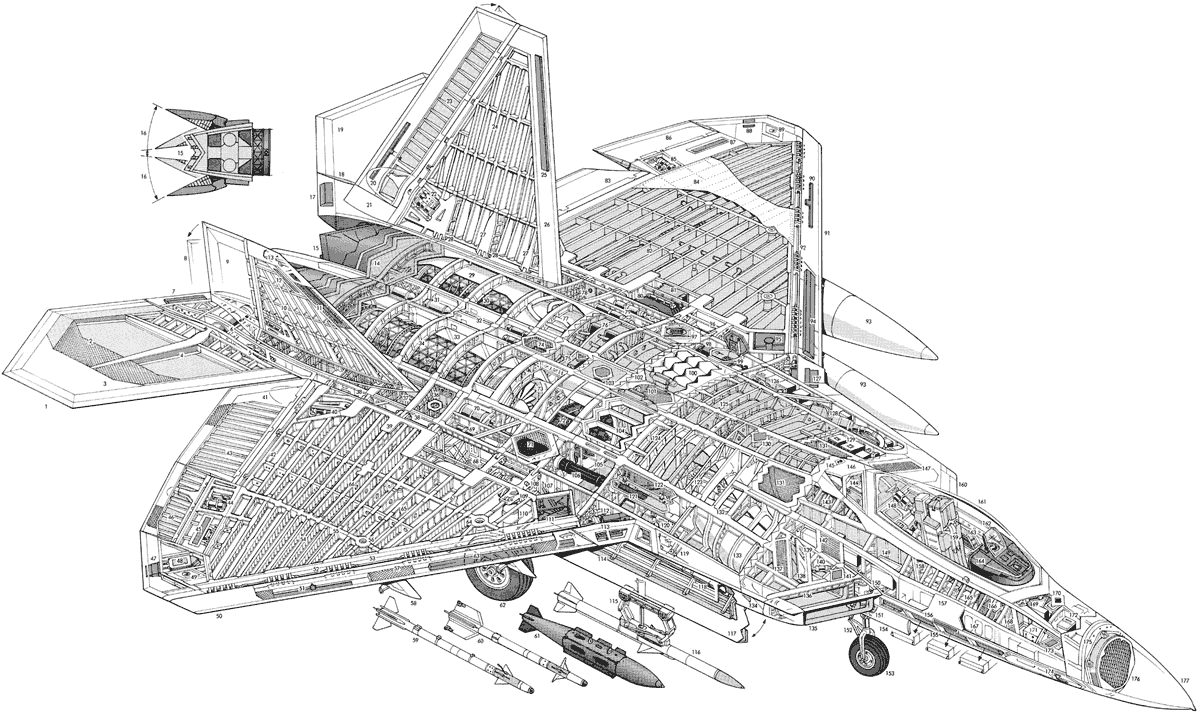
The APG-77 is canted.

What huge Non-Recurring costs? The plane is still in LRIP.. what do you expect?
Partner nations, and most of the DoD buys, will be late LRIP (7 or 8) or MYB and the costs will be much lower.
Of course every year the percentage will be different, but in 2010 the REC flyaway is 69% for the USN and will likely be the same for the USAF. Unfortunately, the USAF did not make it easy for us and state it in B&W like the USN did.
But, the numbers are in line with what we know the cost difference in the various versions will be. We know that the F-35B&C will be ~$15 mil more than the F-35A. Since the USN was kind enough to provide the EXACT REC flyaway cost of $155 mil for the F-35B&C, this confirms the $136 calculation for the USAF F-35A.
The reason people (and governments) use the REC flyaway cost is that it directly addresses the cost of the plane alone. No matter what system you go with, there are many ancillary costs involved that can mislead as to the cost of a plane. Some customers need more training, bases, weapons, etc.
Here is the numbers for the F-35 TODAY.
$135.89 million REC flyaway cost for 2010 USAF F-35A fighters. Unfortunately, the USAF did not make this easy to figure out.
Here were the steps (Both Docs prepared in May 2009):
1. Download the USN FISCAL YEAR (FY) 2010 BUDGET ESTIMATES at
http://www.finance.hq.navy.mil/FMB/10pres/APN_BA_01-04_Justification_Book.pdf
2. On page 33 it states (per F-35B&C)…
… A. Total Weapon System Procurement Cost is $4,478,048,000
… B. USN F-35 REC flyaway is $155,420,000
… C. USN REC Flyaway as a percentage of Wpn System Cost 69.41% (A/20/B)
3. Download the USAF 2010 Exhibit R-2, RDT&E Budget Item Justification at
http://www.dtic.mil/descriptivesum/Y2010/AirForce/0604800F.pdf
4. On page 3 it confirms the USN Total Weapon System Procurement Cost (2.A above)
5. The USAF Total Weapon System Procurement Cost is $2,349,430,000
6. Using the same 69.41% from 2.C and dividing the cost from 5 (above) by 12 airframes, the cost comes to $135.89 REC Flyaway.
Now if it is $136 mil when only 32 (yes I know that 30 are in the Def bill, but the USAF have not changed their docs yet) are being produced, what is going to happen when they start making more than 200 a year? The price will drop well below $100 million and likely below $70 million in the end.
The USAF, not LM, has stated in 2001 or 2002 that the average lifetime cost is $83 mil. This was before LM, for the last two years, has produced the F-35s UNDER BUDGET (by 3% and 5% respectively).
Wilde – looking at the 2010 USAF budget doc above, and including ALL procurement costs (spares, parts, basing, etc). it only comes out to $210… NOWHERE near $370.

I think they are trying to avoid a veto. Remember the warning was a veto if it DISRUPTS the F-35 program.
Yawn.. Given the fact that the F-35 is the plane West needs to depend on for the next 40 years, the Super Flanker is the least important problem it will have to face..
The USAF and USN are already talking a follow-on to the F-22 in a couple of decades (USAF in 2026 graph below). They are not planning on the F-35 being the top dog for 40 years.