 santi
santiKohlers Flottenkalendar in mid-1990s had some drawings which were more similar to the Lurssen family of fast attack craft (maybe an evolved MGB62 or Kilic design)]
I have a very rude linedrawing that someone sharing in this or other forum.
I’ll search for it…
The thing with the broken links seams to be a standard problem on Navantias web page since I can´t get access to some of there projects.
Yeah. Navantia’s site isn’t the best you can find 🙁
From the renewal of the site the links to the ships on catalogue have PDF docs that drive to a “work in progress” generic doc, but the links to the projects themselves work and give some data, thought scarce, and an image of the ship.
The mysterious links I mentioned didn’t work at all (well, they asked for password :diablo: ) and then disappeared.
Thanks Santi for that additional info on those SAN proposals.
This is the Yarrows contender (F3000) for the SAN corvettes. Note the same weapons arrangement that in P590A:
I knew the MEKO contender for the Chilean FRAGATA program thanks to your work in Shipsbucket 😉
This is the Izar-Navantia contender for the same program, obviously based in F-310 design (this drawing is a present of CVA02 🙂 )
Regards
santiDoes anyone know anything about this project?
Sorry, I can’t help here 🙁
Do you have a date for those great South African “what ifs”?
Well, the initial SAN corvette program is from the early nineties. The Spanish P590A design would be dated in 1993-95 timeframe. The evolved P590B (a very different design, in fact) would be dated in 1998-2000.
The first one is a 2500-2800 t light frigate with the same line drawings than the Bazan F592 project (1994), but with different weapons and systems.
For the second one I haven’t any accurate data but I suppose a size not far from MEKO-A200SAN now in service.
This is a line drawing of F592 light frigate.
Data are: 104 x 12,9 m (wl), 2.800 t fl, 27-31 kn (depending on the selected prop.)
4.000 nm/18 kn, 165 crew.
1 Compatto, 1 Meroka, 16 VL Mk48, Harpoon, Mk-32 TLT, 4 SRBOC and 1 SH-60B
Proposed frigate of 3.000 tons by Fincantieri with vls, 8 SSM, 3 76 SR
Excellent, Enrr. I know some of the Finncantieri designs of those days (from an old magazine 1.000 km far from me now 🙁 )
Regads
santiI begin with the designs make for Bazan-Izar for South African corvette program.
Bazan design was selected with others from Yarrow and B&V. In fact the Spanish one wined the competition in a first round, but then the corvette program was redefined and integrated with others in a vast defence re-equipment program. In that second round and improved Bazan design lost vs the MEKO-A200.
This is the older and more successful design. Note the couple of Compattos fore and the 8 Skorpion SSN specified, both of them would be recuperated from the Saar 4 FPB.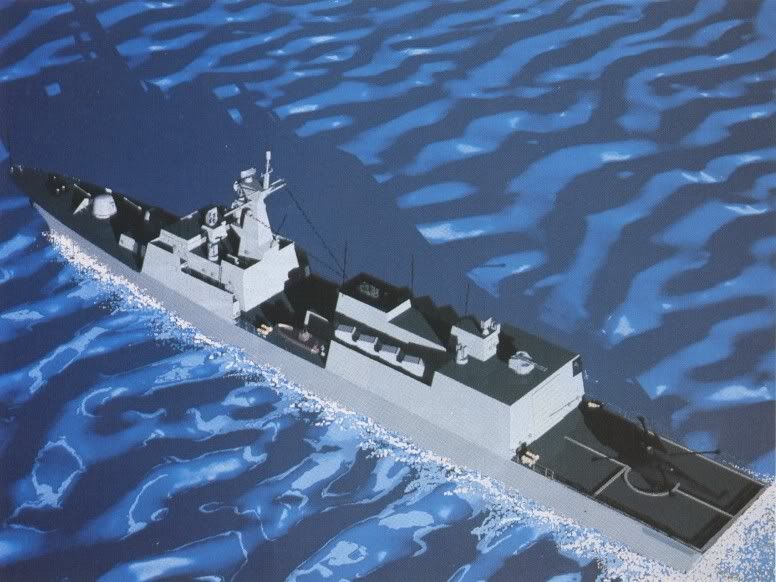
… and this is the second one. Note the more advanced systems like the Umkhonto VL-SAM.
Anyone else 😉 ?
santiOne that has been on my mind, is the “Enlarged Descurbierta” class with possible helicopter hangar that was mentioned in Convays book
Imaging a bit larger Descubierta (2.400 vs 1.600 t) with the Bofors LR-375 replaced by an Albatros/Aspide launcher (same disposition like in MMI Maestrales) and a telescopic hangar aft, replacing the 40 mm’s and missile launcher there. 40 mm’s would be relocated both sides of the hangar.
All other stuff reminds unchanged (76mm, Harpoon, Mk-32, WM-25, DA-05…). It would be a ship very similar to Italian Lupos, but with CODAD propulsion and w/o 127 mm.
It exists at least an artist view of this design but I googled for it without success.
For comparison, take a look to the hangar configuration of the Descubierta derived OPV offered to Turkish CG some years ago.
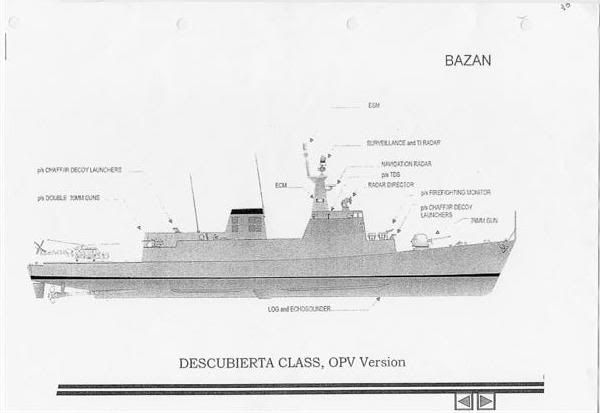
I’ll search in the deeps of my PC for some other Spanish “Newer wheres” 😉
Regards
santimy guess is that the price tag would make that unrealistic. Any news on the sixth unite
Yeah, but the possible options are:
-more F-100, may be improved “flights”, but built at slow pace. A bit like the Burkes in the US Navy (Have I comment the admiration devoted to the US Navy by Spanish Armada? 😀 ).
-a new class of vessels not before 2020, once some actual programs (F-100, S-80, BPE, BAM) were payed for.
The actual philosophy in Armada is: the best escorts we can achieve & OPV’s, and nothing between them, even that this would suppose lower numbers, thought the official goal is already 12…
How about a hi-low mix fleet for the future with six F100 and six LCS type ships replacing the F80?
GOTO precedent paragraph. The idea is that a possible future escort would relegate F-100’s to the role that now make F-80’s. Brand new richman philosophy? may be 🙁 . Nothing that some years of economic recession couldn’t solve 🙁
Do you mean this? 🙂
No 😉
One or two month ago a “gremling” on Navantias web showed some scarce references and inactive links to a “9.500 t DDG”, “Avante family of frigates”, “30.000 t AOR”, and other things.
That events were commented with surprise in some Spanish forums, and a couple of days after any reference dissappears misteriously 😀
Regards
santiI have wondered, were those extra two F80 procured because of the delays in the NFR-90 program or was that decision not connected at all to those events?
Yes, the F-85/86 were a preventive measure on the delays of NFR-90 and, of course, were later included in PAM.
A similar thing happened in Germany btw. Originally it was planned to build 12 Nato Standard Frigates (F122 Bremen class) in two batches of six each. When enrolling in the NFR-90 project it was hopped to build more of those instead but due to the delays a further two F122 and later four national designed and build F123 were ordered instead, reducing the number of needed NFR-90 to 3-4 in total.
Interesting. I wonder if M frigates were the Dutch alternative solution or it was a previous program.
I also read somewhere that the F110 “project” evolved into a land attack ship after the decision to “upgrade” the F100 from an ASW into an AAW platform. Any truth in that or just wishfull thinking?
In any case that isn’t related to PAM (“land attack ship” seems a more recent concept).
Once the definitive F-100 program was on course “F-110” became simply a name for a future replacement of the F-80’s, following a numeric logic. I doubt that any serious studies on it were made.
Nowadays if you ask to most of the Armada officers what they want to replace F-80’s they would say “more F-100”. There is a total commitment with very capable AAW ships. Land attack assets would be TLAM and 5 inch guns, beginning with F-100’s themselves.
If other land attack stuff, a second helo, UAV’s or something like that is considered in the future it would be preserving AAW capabilities (It seems that Navantia has a preliminary design of a 9.500 t DDG 😮 ).
Regards
santiIt also had some details of older plans, and in those, particullary the ones preceding the principe de asturias mentioned some cruisers (I got the impression, that the idea was revisited for sea controll ship). I’ve always wondered what those would have been like….helicopter carriers or real cruisers Also, I once read in somewhere else that Spain was also offered Essex class carrier in place of the Dedalo?
Hi Gollevainen
During Franco dictatorship there were different naval plans. Some of them unrealistic, like the one in the first forties that foresaw 4 battleships of the Roma class, 2 battle cruisers, 36 destroyers, or something like that, I don’t remember the precise numbers.
Later, in the mid sixties Admiral Carrero suggested and ambitious plan including:
-2 CVL (similar to the Clemenceau)
-2 “Light cruisers” with Terrier SAM
-8 Destroyers (probably C.F. Adams)
-12 ASW frigates
-20 Light frigates or corvettes
-8 SSK
-60 Minesweepers!!! (Bluebird class)
Carrero has great influence on Franco but, thought Spanish economy was growing fast those years, the plan was impossible. May be its intention was to warn on the great weaknesses of Spanish Armada.
But some general drawings of the Carrero’s Plan were followed, counting with the help of the US: The Cabot/Dedalo CVS, 5 FRAM, 4 Guppy-II, 12 MSC, 3 LST and, of course, the support on the Baleares program.
In those years the “English way” was discarded (Leanders and, may be other types of ships) in attendance of political conflicts and “French way” was selected for the future submarines.
It’s true that an Essex class and two Independence were offered to choose, but the first was rejected and, of both Independence, Cabot was preferred.
I think that it was a wise decision. Operating a 40.000 t CATOBAR and its corresponding airwing seems a big burden for the Spain of 60’s and 70’s.
In the seventies other plans foresaw:
-3 DDG’s, that became later the first 3 FFG
-1 cruiser, supposedly an Spruance derivative, but not necessary an “air capable Spruance”, that was later replaced by the SCS/PdA
-2-4 “oceanic submarines”, the Agosta class
-10 corvettes, the Descubierta class, later 8 and finally 6
-6 missile FPB, the Lazaga-TNC57 class, that never embarked its missiles…
-10 torpedo FPB, the Barceló-TNC36 class, finally 6, that never embarked its torpedoes…
Regards
santiCan you tell me more about the Plan Alta Mar, please?
Well, it’s an old and long story :rolleyes:
Plan Alta Mar (PAM) was defined in 1990. It was the first naval plan of the restored democracy and was foreseen a 15 years period of execution (1991-2005).
The idea was to preserve the size and composition of the Spanish Armada in the eighties but replacing the old types, most of them former US Navy vessels 40 or more years old, with modern and locally built ships.
It was a rational plan, supported by both the socialist and popular (conservative) parties and coherent with the economic situation of that moment. It left behind some ambitious projects seriously considered years before like the building of 3-4 SSN of Rubis type or a second CVS of PdA class.
So, the plan consisted in:
– a force of 15 “oceanic escorts” (frigates). 5 Baleares/F70, 6 FFG/F80 (4 already built + 2 more effectively built in 1994), and 4 F-100 (1997-2000).
Those “F100” were 3.500 t “inexpensive” ASW frigates with a design that seems derived (thought reduced in size) with some of the NFR-90 designs. They would replace the ancient Gearing FRAM-I.
For the 2000-2005 period was foreseen a class of 5 “F110” (other sources said “F90”) more complex and AAW oriented ships destined to replace the Baleares.
– a force of up to 10 submarines, replacing the 4 Daphnes/S60 with 4-6 S80, may be derived from the Agosta/S70 class and similar to what later became the Scorpene. The 4 boats would must be in service in 2000-2005, with an additional couple some years later if the budget was enough.
– a force of up to 16 MCM. First 8 minehunters, later 4-8 minesweepers. The actual 6 Segura class are the remains of the “8 minehunters” once the building of the last 2 were delayed sinedie.
– 5 amphib vessels: 1 LPD + 4 LST or something similar. They would be a some limited ships for the modern standards because the PAM accounted “a total of 20.000 t for the 5 vessels”.
– only 1 AOR, that became the A-14 Patiño, a bit scarce to support 15 frigates!
The CVS (R-11 PdA) and the 6 “Coastal Escorts” (the Descubierta corvettes) remained unchanged and the AOL A-11 Marques de la Ensenada was ordered in a hurry like a provisional measure, entering in service in 1991 (Armada was using civil oil tankers since the retirement years ago of the ancient AOL Teide).
…. but, the wall, and later the USSR, collapsed, submarine menace nearly disappeared, others appeared, the situation changed.
Spanish economy in the nineties got worse, delaying some of the programs, but from 1997-98 it boomed (up to now), allowing others more ambitious….. and PAM were progressively replaced by Strategic Defence Revisions and Armada General Drawings more concerned with operative demands than with concise numbers of ships.
Regards
santiThe design that you labelled like “NATO NFR-90 HSA Design 1986” appeared frequently in Spanish media in reference to the NFR-90 project in that years. In fact, a frigate design that appeared in “Revista Española de Defensa” (an official media of the Spanish MOD) illustrating an interesting overview of the later defunct Plan Alta Mar (High Seas Naval Plan) showed a lot in common with it. Sadly, I think that I lost that number of the RED….:(
About the other designs, I only knew about them years after
Regards
santiExcellent work, MConrads
(you have a message 😉
Regards
santiYeah. KDX-II has a lot of ressemblance with the 1986 design posted by MConrads. Not so much with the baseline design of the 1990, with its two separate set of funnels.
NFR-90 was a very serious attempt to produce a rational multipurpouse frigate for a lot of navies and I think that, aftel all, it had a great influence in some of them and probably in others around the world.
Regards
santi… and a similar configuration appears in the picture I posted.

santiAn a little correction:
In the side and plant view you posted of the “Baseline Design” of September 1989, the aft set of funnels seems a curious combination of to VL modules and the funnels between them. Seems a high position for VL cells, may be something like self-defence Mk-41.
Regards
santiOnce again, a superb work!
Cheers
santiThe text corresponding to the picture that I posted says:
“The Westinghouse model of a possible NATO AAW frigate, showing trainable phased-array radars fore and aft, displayed at the US Navy League show in 1990 (Westinghouse)”
It illustrates the entry for the NATO AAW Missile System in the 91/92 edition of Friedman’s World Naval Weapons Systems
That entry is devoted to NAAWS itself and don’t make reference to the ships.
Once NFR-90 died Spanish Navy started de F-100 program that in its early stages had strong resemblance with some of the NFR-90 designs.
This is one of the first line drawings published of an early F-100, for comparison:

Actual F-100 has 133.2 m at waterline and 146.7 m overall.
Regards


 Sign In







