These are great news, at least something interesing…was bored with all this 5th gen stuff :p
Seriously, i think the Mig’s 144 concept will revive, let’s hope wont be a PAKFA variant, i doubt it.
“a new long-range fighter-interceptor by 2020”
If they revive the 144, probably they will do it, i doubt the new aircraft will be fielded by 2020, but russians need a new interceptor, and the PAKFA wont replace the Mig31.
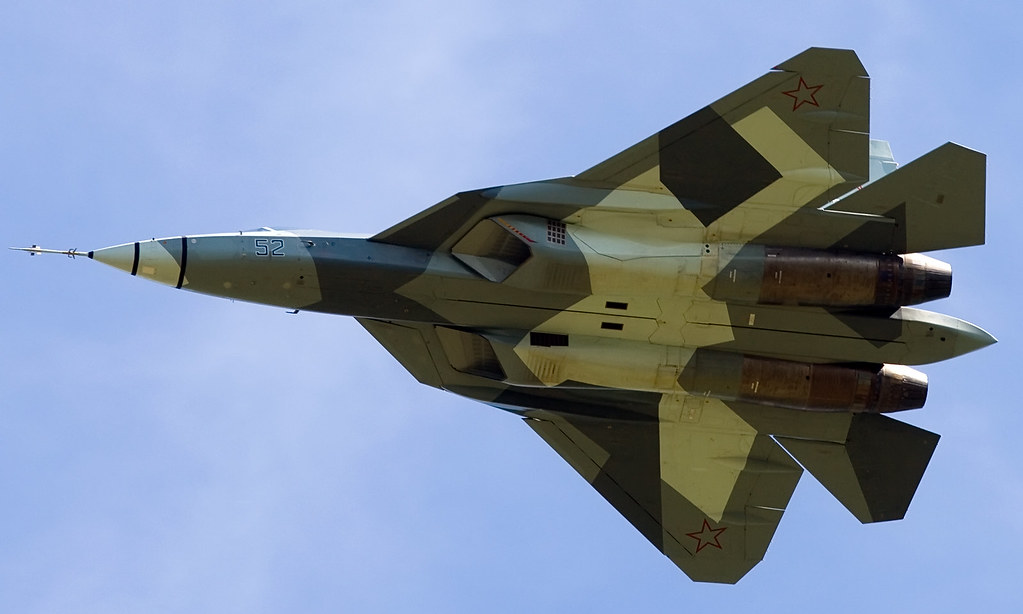
Rear facing radar!!!1!1111
An asembled segment of the tail with the same color of the radom and the nice “caution, radiation” warning sign…
Its a radar?
Most likely, now, any confirmation about it?
Those LERXes sure can droop low.
Almost makes it look like an F-35-style intake from that angle.
I think somebody here said it only function was as slats, im almost sure these LERXs can act as canards, and slats, otherwise why should they need such incidence?
Let me be the prophet of doom…
That missile will become in a complete failure, and at the end will be used as a propelled dumb bomb, to their save facing.
Cheers
The 117 canopy was all framed, do you really buy the single-piece-stealth canopy tale, right?
Same for the S-duct, the 117 did not have any holy S-duct .
All the stealth thing is quite relative, you can reach the requirement in one way or another…this is why the F-35 underneath surface is not flat at all.
And this is why all the new “stealth” designs are more and more rounded.
Quite apart from the fact that, as Sintra points out, I doubt anybody here is in a position to make a reliable quantitative (rather than qualitative) comparison of RCS for these aircraft, you risk comparing apples to oranges in the first place. There is a lot about certain relevant aspects of the T-50 that may well change before it enters production – are the current airframes the equivalent of the X-35, F-35AA-1 or F-35AF-1 in terms of development progress? We have no way to be sure, so any quantitative assessment at this time is pretty much void from the word go.
If these charts are real, i think russians did quite good job, seems to show the rear lobe RCS values
🙂
http://fox511.livejournal.com/90728.html
It’s just me, or the engine’s pods have been “flattened”?
While we are in the missile debate.
I found an outdated article, but never the less very interesting from “Constant Peg”That proved to be a very important test. “In 1987 we had the AIM-9P, which was designed to reject flares, and when we used US flares against it would ignore them and go straight for the target. We had the Soviet flares – they were dirty, and none of them looked the same – and the AIM-9P said ‘I love that flare’.
they do not know how it operate hense they do not know exactly how to counter it?
What is he talking about, that every flare was different each other?
If that’s true, no wonder why the system was successful, and probably still is.
Why?
Both Su-35S and Pak-Fa has a number of different ‘testbed’.
If the W-bays was the Su-47, Pak-Fa testbed. what is the problem with that?
Because is hard to believe they would use a demonstrator to test something for another program…and use that demonstrator, with all its structural issues and limitations to test ideas for the T-50 program, ok, the SU-35 is a derivative of the Flanker, a well proven design..but the SU-47?
This is why I believe the bomb bay was something of the T-50 that was added in the su-47 program.
– different intakes and seemingly different exhausts.
Also a faceted nose
I remember having seen a mock up of a faceted Su-47 on a desk of a russian aerospace designer/representative?.
Now the big question is, has been the 47 design considered with a faceted version? adding LO features?
And if the answer is ‘yes’, then why?
The other good question is , Is the Berkut still being tested?
And another nice question is, Was the Berkut used as T-50 testbed?, or the T-50s technologies were tested in the Berkut program?
I believe the Su-47 was never used as a PAKFA testbed, is ridiculous, because both designs, parameters, and objectives are completely different, I believe the Berkut program added some PAKFA technologies (as the bomb bay doors), for the Berkut program, not for the T-50 one.

Obviously it wouldn’t be flying on it’s own. And I was thinking more of the Tu-22 rather than the Tu-160. It could launch a barrage of LR AAM’s at enemy formations and act as a command platform for fighter groups.
I believe this is not needed, what Russia AF needs is a long range interceptor, something that could take B-52s at 2000-3000 km, and could patrol 3000km offshore, i believe this can be done with a version of the Su-34 (less armor, more fuel and drop tanks), adapted with R-33s.
Of course with the proper fuel refueling infrastructure.
Stuffing a lot of missiles in one place is OK for point defense missions, but then, for point defense a big aircraft is a dead bird.
So you get the Tu-160, a poorly maneuverable aircraft…for point defense…good luck with that.
For interception stuffing a lot of missiles in one place wont work at all, because you need to cut every possible corridor the target is taking or could take, for this you need many planes, small ones, and distribute all your AAMs in a larger area.
So the Tu-160 as ‘missiler’ is pointless.
To me the Irbis will be the best radar out there, even better than any AESA…if the T-50 is carrying an AESA radar, is because the industrial support for new technologies and the small size of its radome.
Is bad idea to have a big plane like the B-1 acting as an interceptor, interception depends a lot on numbers, so having many small planes…and missiles in different places gives you a better result than having a single big aircraft with many missiles in one place.
JF-7 is an old 1980s design
1970’s…
JF-7 is still a interesting, capable and practical design.
Of cause in the end, you may simply prefer a classic 1970-era ground attacking tactics
Must agree, wonder why a ground attack version of Mig-29 was never thought.