 lukos
lukosEODAS shares sensors with Sniper XR which is 640×480 FPA.
A 180deg hemisphere contains four 90deg sectors but you have multiplied the sensor size by 16.. Why?
Yeah okay, I should have multiplied by 2 each way but I’ve since found out that the DAS doesn’t use a 640×480 aperture anyway, so your source is wrong. I’m also yet to see any mention anywhere of DDM-NG performing the feats managed by DAS.
lukosIf my aunt had balls, she’d be my uncle.
Moreover, she’d cease to be my aunt, i.e. EODAS with telescopic optics would no longer be as effective a MAWS.
What’s the point? Nobody doubts that if necessary, NG would be perfectly capable of developing something along the lines of AN/AAS-42 or PIRATE – whether they’d do so on the basis of EODAS or a bespoke development is rather moot.
Which ever way you look at it though, EODAS is not a substitute for a proper IRST and will never become one without giving up its advantages.
You’ve obviously not read what I wrote properly. I was suggesting using DAS algorithms with optics for a frontal IRST system. BIO mentioned something about a 360 degree system however.
http://forum.keypublishing.com/showthread.php?134882-F-35-News-Multimedia-amp-Discussion-thread-(2015)-Take-two&p=2226438#post2226438
http://insidedefense.com/login-redirect-no-cookie?n=168117&destination=node/168117
DAS still offers very useful detection ranges well above other passive 360deg systems and well into the BVR field. EOTS also provides the ability to change IRST angles to those well beyond traditional systems, without the aircraft changing direction.
Those videos were shot from aircraft at high altitude against missiles also at high altitude, i.e. above the vast majority of the water vapour in the lower troposphere that is primarily responsible for atmospheric IR attenuation.
Negative, it gains track as soon as it breaks the horizon, therefore the LOS must pass through the lower atmosphere.
See? That’s all I was saying – so why did you object in the first place?
Not really, it was described as a WVR only system in the first place, which it clearly isn’t. Hell of a difference between 25-30nmi and WVR. Very big when you consider that no verified combat kill shot has ever taken place outside 21.6nmi. even on a closing head-on target.
Ok – so what WAS your beef with what I said?
See above.
25nm against an afterburning aircraft (with both sensor and target at altitude) is perfectly reasonable IMHO, but in such circumstances even the early 1980s Soviet IRST on the basic Su-27 got twice that, and PIRATE would probably at least double that performance again.
Allegedly PIRATE can detect aircraft 80nmi away under optimal conditions and probably a large aircraft too, but 30-50nmi is more realistic. Also offers target locking for missiles at long to short ranges. Su-35 system quotes 50km head-on.
http://www.knaapo.ru/media/eng/about/production/military/su-35/su-35_buklet_eng.pdf
Which again begs the question of what we are arguing about anyway. I originally pointed out that EODAS is NOT a spherical coverage IRST, because it does not have the range and would lose the wide instantaneous FoV required for its intended task if modified to rectify the range deficiency – and you now appear to agree. Why did you first dispute my comments then??
Well it kind of is a spherical IRST, it just lack the range of some of newer systems with optics. The original argument stemmed from a debate about whether it was just WVR, we’ve actually already been around this loop once if you remember.
So to clarify, no it isn’t just WVR, or anything like it, but it likely isn’t as long range as dedicated frontal IRST systems either.
Much like many of the more advanced of the capabilities advertised for EODAS. I don’t see a major difference in that regard.[/QUOTE]
lukosOh true but the problem is many engineers don’t want to project manage and when you’re talking about a 15 years project many costs aren’t under the direct control of the project. Big ‘what if’ wrt DEW. I guess ultimately they could end up on all aircraft rendering missiles useless and firing 360deg but people have been promising DEW for a long time.
lukosI know Gripen and F-35 are fighters. Supersonic, too. Hawk isn’t so what’s your point? That Sweden could get ~250 trainers instead of 60 Gripen? That Norway could get ~750 trainers instead of 52 F-35?
Okay T-50 then. My point is that if we judged everything on cost alone, all airforces would have supersonic trainers, yet they don’t.
lukosAs opposed to speed & altitude, the F-35’s regular ‘streamers’ are due primarily to separated shear layer development and BL separation (without reattachment), specific to the F-35’s airfoil and apparent even in S&L flight and good weather.
It would be interesting to *see* the airfoil vortex shedding frequency of all three F-35 variants flying together, to ascertain which streams the most and where (including multiple vortices shedding @ different AoA).
I wonder is it anything to do with the light positions on the wing tips. They really don’t look like a BL could stay attached over them.


lukosA Hawk is one quarter the cost of a Gripen.
lukosSurprisingly few large defence projects are ever on time or to budget. I’d struggle to name one.
lukosIt’ll could be useful against AAMs too. Against aircraft? Possibly at close range and the ability to direct the shot rather than firing straight ahead would give more flexibility than guns, even if the damage is slower.
lukosLukps, as usual you are getting confused. Fish eye from DDM-NG has a plane array.
Curved IRST could match the curvature of a plane, but NVM
Explain.
lukos:confused: What is “unstealthy IR sensor” and how is the “stealthy one” different?
In being stealthy. Flush with skin for a start, unlike DDM-NG.
http://www.mbda-systems.com/mediagallery/files/ddm-ng_datasheet-1424428103.pdf
Stealthy integration of sensors is a major issue on both the F-35 and F-22, documentary on it somewhere. In fact stealthy integration of sensors on Taranis could well be the reason the BAE Replica keeps being seen (testing sensor stealth on a known RCS object).
DDM-NG

Basically nailed to a 2×4.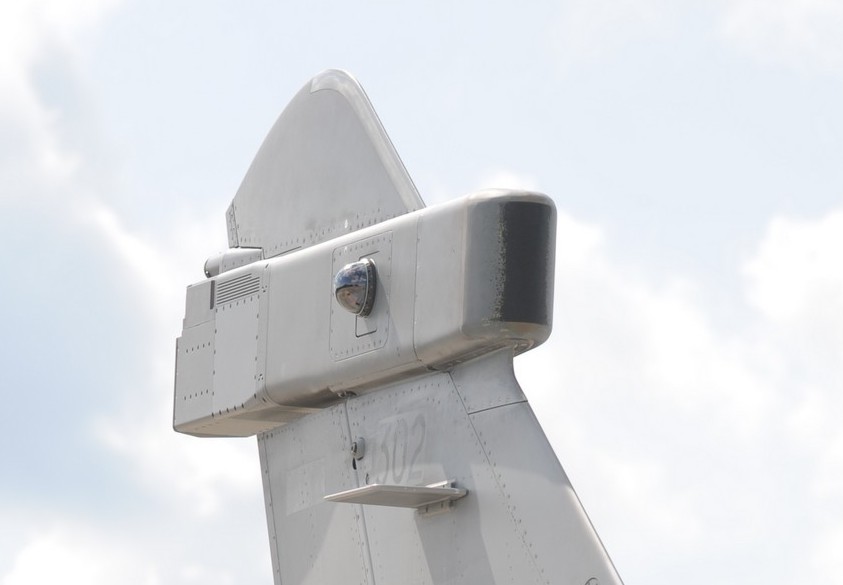
See under chine line.

Not an F-35, but same deal.
Now stop trolling just for the sake of it.
lukosNope, again. (fisherman’s tale of course)
Rubbish.
http://www.mbda-systems.com/mediagallery/files/ddm-ng_datasheet-1424428103.pdf
lukosThe point is that I have.. And it doesn’t look too good for EODAS which is 640×480 25um pitch sensor.
I won’t mention the DDM-NG because I was unable to find it on public domain and cannot assess the classification of such piece of information.Anyway, I cannot see how the DDM-NG “is not programmed with the sensitivity” to filter out false alarms or has a back-end with less computing power if it’s de facto more modern and uses newer technology than EODAS.
Firstly DAS apertures only cover ~90deg each (95deg I think), so even assuming your figure is true (NG give no details and 640×480 + EODAS returns no hits except on this forum), that’s roughly equivalent to a 2560×1920 array covering a 180deg hemisphere. So effectively about 4 times the pixel resolution halloweene mentions.
The rest of your assertion is also false. The fact remains that DDM-NG doesn’t have the ability to do anything other than missile warning right now and the Rafale has no HMD, so it would be much more difficult to usefully present and action the information even if it did.
lukosIts a purely business/economic decision. There is likely to be a decent sized market for F-16 and possibly F-15 IRST upgrade and at the moment Lockheed pretty much has a monopoly. Northrop Grumman does not have a scanning IRST in its portfolio, so much like the lightning pod they have formed a partnership with someone that does have a highly capable product in the category.
Seems sensible.
lukosSo, you want to argue that the Minotaur rocket has a completely different plume and haze than your ballistic missile? 🙂
Or maybe, just maybe they are all similar and the haze looks different because it’s a different spectrum in the first place…
In that picture yes, you are not observing the same thing, or from the same angle. You are likely seeing an affect of the plume interacting with the ionosphere or something like that, hence why it’s so much bigger than the DAS ballistic missile, even with 10x zoom on the latter. The DAS missile is also being tracked through 800nmi of atmosphere, not some atmosphere and a lot of space/vacuum. It’s painfully obvious just looking at them that they are not the same thing.
Yep, all explained here. You conveniently forgot to link this part.
http://www.spacearchive.info/vafbview.htm
Lighting conditions have a tremendous effect on launch visibility. Daylight launches are visible for distances from 10 to more than 195 statute miles (16 to more than 314 km) while those at night are often visible for more than 300 statute miles (483 km).
Twilight launches are often the most impressive. If the conditions are right, the Sun is below the observer’s horizon and sunlight illuminates the vehicle’s contrail and exhaust plume, creating a display visible for distances of several hundred miles.
This time exposure is a good example of the distance from which twilight launches are sometimes visible. It shows the fourth stage exhaust plume from a Minotaur rocket more than 1,500 statute miles (2,414 kilometers) away. Lift-off occurred long after sunset and the ground was in darkness, but the missile had climbed high enough to be illuminated by sunlight when the webmaster took this photo from Ventura County, California.
So you have the sun illuminating the exhaust contrails, not the same as tracking the original IR source at that range!
You’re also looking at solid fuel vs liquid fuel:
https://en.wikipedia.org/wiki/Falcon_9
https://en.wikipedia.org/wiki/Minotaur_(rocket_family)
The visibility of Vandenberg launches varies with the type of launch vehicle and is the result of the type of propellant used and the amount burned during a given unit of time.
Pound for pound, solid fuel radiates much more light when it burns than does liquid fuel. When solid fuel burns, it is so bright it resembles a road flare. Solid fuel also produces a continuous smoke trail during the entire burn time. Liquid fuel engines, however, produce a much fainter flame. It can be so faint that it is almost invisible in daylight. Unlike solid fuel rocket motors, liquid fuel engines do not continuously produce a smoke trail. Instead, they briefly leave a vapor trail when they pass through the stratosphere between 33,000 to 38,000 feet (10,058 to 11,582 M).
Whole lot of detail you omitted for convenience.
lukosMay be ask ONERA to help with curved IR sensors?
You mean unstealthy ones, with worse resolution that only detect missiles? Who’d want them?


 Sign In







