 Erkokite
Hehehehe !
I counted the RCS approximately and even the PAK-FAs 400 km detecting radar sees this kinds object only at 18 km..OLS-35 max at 90 km ( when rockets exposed to it..now they aren’t so maybe 50 km ). See the chart I drew..the foe is at 400 km..this higher maneuver needs that the airplane is already airborne loitering.
Utter silliness, especially considering that you are carrying external stores.
ErkokiteYou have no understanding…upright seating position at 9 gs already causes 9 times the head weight load to the neck…in reclined ( more than F-16 ) there is practically none. Colonel Stabb endured 46 Gs in test environment..and he was aged doctor.
This was not sustained force. It was only for an instant. Also, if you would like the aircraft to be stealthy, you will need internal bays. As for getting in a gunfight with an F-22, I should point out that modern fighter aircraft are designed for 9 to 11 g’s of sustained force along the vertical axis. One cannot say the same about the antique aircraft you are using for your inspiration. Your aircraft would simply come apart if it tried to turn like this.
Your aircraft is:
1. Too small and too lacking in thrust to carry a meaningful payload
2. Not structurally sound
3. Not capable of sustained supersonic flight due to lack of suitable nozzle on turbofan engine
4. Not stealthy due to external carriage of weapons
5. Likely incapable of powering even the meager APG-67 radar you would like to fit to it.
6. Not controllable in supersonic flight even if it was capable of supersonic flight due to lack of hydraulically or electrically actuated controls
ErkokiteSpeed won’t kill ya..it is the sudden stop ?!
Do you mean the compressibility ?
No. Force on a wing/airfoil/control surface increases with the square of velocity. Hence the need for hydraulic, pneumatic, or electrically actuated control surfaces. These add weight. Another problem that you will run into is that the PW engine you’re using will probably not be able to supply the required electrical power to the radar. And you still have yet to address the fact that the engine you are using will not be able to produce thrust at supersonic speeds. You need a convergent divergent nozzle for this. Which adds weight.
No it is 100% mathematics..selected engine ( PW535F-E ) on GM-1 burns 107 times less fuel on full thrust than for instance J-20 does on AB.
I would need to see a source for this. It does not sound even a little believable.
ErkokiteEasy now Paralay. You could give Topspeed some very bad ideas.. Let him focus on his super duper 6:th gen fighter and that stealth aircraft carrier instead.
Actually, I think it’s quite inspired.

ErkokiteI disagree that the UAE fighter selection would (or even should) be based purely on performance. The UAE already operates the F-16 blk 60, which is likely very similar to the new variant Lockheed is offering. This means that the UAE already has the infrastructure in place to support the aircraft- spares are available, maintenance crew and pilots are trained, etc… You have to look at Total Life Cycle Cost- would it make more sense for the UAE to buy a whole new aircraft and duplicate all the infrastructure already in place for a similar aircraft that they are already operating? I don’t think so. The F-16 blk 60 and Rafale are probably close enough in performance (kinematics aside where the Rafale is clearly superior) that it would make more sense to buy the cheaper, easier option. I could not see justifying a Rafale purchase over the F-16 when they are already operating the F-16. It simply wouldn’t make any sense.
ErkokiteNo I wasn’t going to resurrect the Scorpion. I just figure their aim was bright.
Idea is t keep this really simple…and the nozzles aren’t anything like in Raptor.
In what way are they different? You are still talking about rectangular thrust vectored nozzles…
I was thinking suntin like the RATO rockets in F-104…but instead of providing 578 kN they just provide 6 kN each for a minute or two. Really easy patented invention with fast “strap on” locking can only be used once ( weight each 90-120 kg )…but both have an ignition button of their own..and can be used separately. Definitely the rockets would only extent this kites envelope to supersonic at high with initial speed of around mach 1 with turbofan.
There is a 95% chance this will never be built. I might do a flying model just to see how well that lay out performs…I might also need some serious help in defining the shape/foil/washout etc for the wing/lifting surface. I could also build small balsamodels to see how they glide ( 1/20 scale etc ).
Being really small and weighing just 1500-1800 kilos empty this should not be insanely costly as the big fighter jet projects are. BD-10 project was made with just 60 mio USD back in 1980ies ( and that teached a big lesson for all of us ).
The BD-10 was a deathtrap. It was also not a fighter with the associated weight of weapons, fuel, avionics, ejection seat, etc…
ErkokiteI hear you…..so the only option is to close the air intakes for supersonic flight with the rockets and shut the PW535F and use it only to loiter and ground attack duties and to gain altitude to go fast with rockets.
I like Scorpion…maybe I team up with the polish aviation industry to get this going.
Thanks for the comments..this keeps me focused better..I seem to loose focus and concentration while working on this till 2 o’clock in the morning.
To the exhaust nozzles…this has even stealth thrust vectoring..originally I wanted to make VTOL…but had to settle for STOL since the engine power is no longer adequate with this “inhalator engine”.
You are only seeing half of this AC now since I am concealing all details that make this actually work…for certain reasons mentioned here earlier.
The main point in this is the massive drag reduction by cutting the size down considerably..then is the simple wing and diminutive engine/pilot pod that keeps the weight down…I have hard time figuring how to make this heavier than 1500 kilos empty. Almost definitely this can carry 3500 kg payload…I mean Mtow 5000 kg. This needs about 7-8 kN to go 950-1000 km/h without external load..which makes it possible to fly 2 hours perhaps even longer…and go high as 18-20 km..to start the rocket engines..see what I mean..this can almost go to the moon this little thing with 170 kg/m2 wingloading and almost nonexistent frontal drag.
– – – Updated – – –
That is where you are wrong..this has all air intakes, and 2 bays for small mach 4 AAMs, ****load of fuel and state of the art avionics.
Me -163 was 25% bigger than this..this beats Me-163 on both rocket power and turbofan power alone. Only drawback is that this flies even shorter time on rocket power than Me-163..but when it does it goes 3 times faster.
The size alone indicates that in comparison using the scale factor this GM needs only 11 kN to go 1130 km/h ( top speed of Komet and 17 kN out put ).
The PZL-30 was cancelled, and has no chance of coming back.
Rectangular nozzles lead to a loss in engine efficiency. Also, thrust vectoring nozzles are quite heavy. As for the rocket engine, you need to factor into account the size of oxidizer tanks, not just fuel tanks. And in particular, you will need the safety mechanisms required for preventing a large explosion during any mishap due to the presence of oxidizer onboard. Really, honestly, you should get rid of the rocket idea. I also think you are greatly underestimating the size and weight required for avionics and weapons stores.
ErkokiteThat is the common understanding as we know it right now.
My rocket assisted supersonic jump to supercruise mode with commercial PW535F might be new to many. It might need special tuning for the inlets to access higher acceleration for the airflow.
😉
I almost entirely certain that this will not work. The PW500 series engines have a bypass ratio much too large for supersonic flight, even when they are “jumped” there using rockets. As you increase in mach number, the optimally efficient bypass ratio drops. At some point, you really lose the ability to produce a meaningful amount of thrust with a high bypass engine. I also think you are greatly overestimating the drop in drag in the supersonic regime.
More importantly, supersonic aircraft by necessity always have variable convergent divergent exhaust nozzles, which this engine lacks. It is not possible to achieve supersonic flight without this feature, as for an engine to produce thrust, it needs to have a exhaust velocity greater than the aircraft velocity (as I recall at least), and for a turbine engine to produce the required M > 1.0 exhaust velocity, a de-laval type nozzle is required.
I would strongly advise you to give this line of thinking up- it’s not tenable for quite a few reasons.
Also, you may find this interesting.
[ATTACH=CONFIG]215619[/ATTACH]
It’s the PZL-230F Skorpion. It’s a subsonic, ground attack aircraft though. It was never completed.
ErkokiteMy advice? Skip the rockets and go for a more powerful turbofan engine. You can get get 25-50 kN of thrust out of a small turbofan such as the honeywell f125 used on the F-CK-1 fighter, the non afterburning version of which weighs 536 kg, which is about what your rocket engines would weigh together, without even accounting for the weight of the extra jet engine you added. Even still- when you take into account the weight of missiles, guns, avionics, fuel, airframe (especially one incorporating stealthy materials), landing gear, etc… you should probably even go for two of these to get any sort of meaningful performance.
You need some sort of persistence for any air to air engagement. Rockets don’t have that and basically just add weight.
You can’t take a folland gnat and strap any sort of meaningful payload on it- modern radar, armaments and avionics would weigh it down.
The best you could do is something like this, I think:
http://en.wikipedia.org/wiki/AIDC_F-CK-1_Ching-kuo
or
http://en.wikipedia.org/wiki/HAL_Tejas
If you’re looking for stealth you would need need internal weapons. I would advise simply going for a reduced RCS rather than true stealth with semi-conformal carriage of weapons that are creatively hidden from most observing angles.
ErkokiteRussia certainly has produced more ramjet products. and presumbly exported 5000 BVR AAMs in last 20 years. highly illogical that missile with identical weight claiming so much range. and how does Gripen operate such weopon effectively?. Sukhoi certainly needs that 400km range radar.
Als that spending example that $10b spent in less than two years on one project. It is not like spreading money over 20 year project. where it become obsolete during implementation. Most of EU projects have this problem. see Galileo.
I think that the reason that the Irbis E has such high range is more of a side effect of the need to detect VLO aircraft at a useful range, not to engage targets at this range. Also- there is a difference between “detection” and “tracking.” You need the latter to determine a firing fix.
Also, are you sure a large missile like the RVV-BD/SD is meant for engaging fighters? I thought similar, large non ramjet missiles like the AIM-54 were at a disadvantage against quickly maneuvering fighter sized targets and were typically more effective against tankers and AWACS.
I would also like to point you to this image on APA here: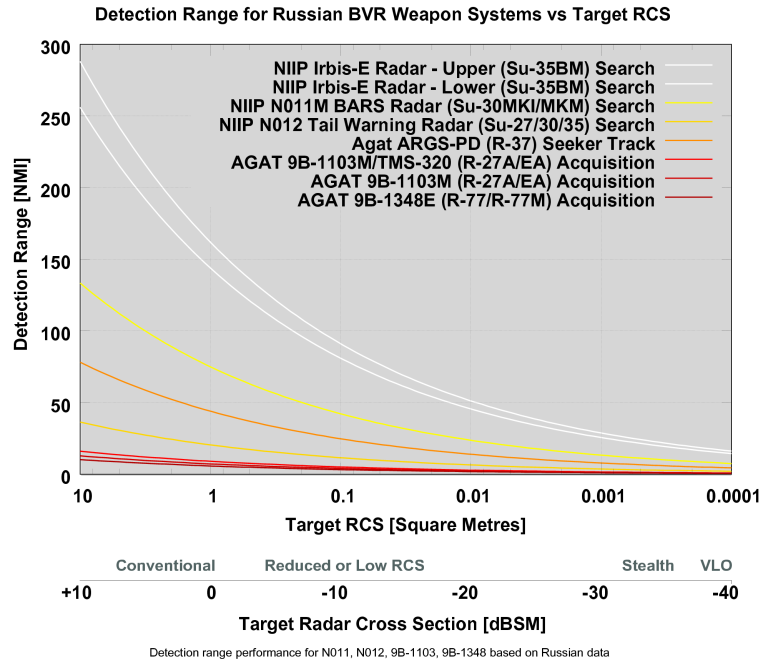
This gives a 150 nmi (280 km) *detection* range against a 1 m^2 rcs target, which I think would fit the RCS of the Rafale while both carrying Meteor and MICA missiles (drop tanks would add to this). However, in a cleaner configuration, the Rafale RCS may be as low as 0.01 to 0.1 m^2 depending on the angle of the Rafale relative to the Su-35. So we are really looking at a potentially much lower range than the 400 km you are providing. Also at 400 km, what would be the NEZ of the missile in question? If the Rafale detects the incoming missile, it will have *plenty* of time to evade if it is actually launched from that range.
And if you really want to bring yet to be deployed systems into the mix (such as RVV-SD/BD), you could just as easily bring the next generation SPECTRA EW system into the discussion- GaN TR elements and a fully digital channelized design would likely make it very possible for the Rafale to detect LPI signals emitted by the Irbis radar. I would bet with very reasonable certainty that detection and classification of LPI signals were part of the next gen SPECTRA requirements.
Take into account the radar equation:
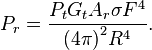
A radar system will have twice the R value (distance from emitter to receiver) and a factor of 0.01 m^2 to 1+ m^2 to overcome vs an ESM suite since the radar signal actually has to bounce off the target and return all the way back to the emitter. That’s a factor of ~1/10th to 1/1600th (!!!) of the amount of power required for the ESM suite to detect the emitted signal vs a radar. So were I a Su-35 pilot, I would be *very* careful about emitting when there are Rafales (or F-16 b60’s or F-35’s or F-22’s with similarly advanced ESM suites) present. Likewise, a Rafale pilot may have to do the same vs a Khibny equipped Su-35 (although perhaps to a lesser extent, as I doubt Khibny is a solid state GaN digital receiver).
So I think it would turn into a cat and mouse fight- the Rafale has an advantage in missiles and RCS and EW, and the Su-35 has an advantage in range and radar power outside of the merge. In a dogfight, I think the Rafale’s *possibly* lower wing loading, higher thrust/weight, and greater structural load tolerance *may* give it an advantage in a sustained turning fight, but the Su-35’s thrust vectoring and better HOBS missiles would likely dispense of the Rafale very quickly otherwise- so I would probably give the WVR advantage to the Su-35 unless the Rafale pilot is very careful. BVR could go either way depending upon the scenario.
ErkokiteThe Indian display verifies that the plane is not intended to change at all as we have already assumed so.
The patents indicate that the intakes shield the craft from centimeter range EM only and not milimeter range.
The intakes are to stay as they are apparently according to the patern and some IR reducing measures exist.
I am not sure if that is good.
Millimeter range is pretty heavily attenuated in the atmosphere I think. Someone correct me if I’m wrong.
ErkokiteIt varies with the aspect the aircraft is viewed at, the frequency of the radar, and the load of pods and weapons on the aircraft. And actual numbers are usually not advertised.
Erkokite-The Israeli military is developing a large, classified unmanned air vehicle (UAV) with features consistent with stealthy aircraft designs, according to a knowledgable source.
The secret project involves a “fairly large” UAV in development by Israel Aerospace Industries (IAI), the maker of the non-stealthy Heron and Eitan (which is called the Heron TP for export) UAVs, the source says.
http://www.flightglobal.com/news/articles/israel-working-on-low-observable-uav-379564/
Israel always makes the most interesting stuff. It will be very interesting to see how this pans out.
ErkokiteWhat is the 2nd image?
ErkokiteThe F-35 does not use “coating” type RAM. It is part of the composite structure of the F-35. It’s called Fibermat.
http://www.military.com/features/0,15240,215074,00.html
I missed this gem in that AFA article.
You read that right, the F-35’s RCS gets BETTER over time, not worse through normal use.
LM has come up with a very good solution to address the weight issues of the F-35, but it would require new structural and flight testing. For now they are limiting it to non load-bearing structures because no new testing would be needed. It’s called CNRP.
I see this innovation helping LM with post F-35 more than helping the F-35 program directly as they can start with a clean-sheet design and not have to retest for a retrofit.
To give you an idea of how it stacks up against CFRP, steel, titanium, etc.
It’s fascinating that they are using CN in their composites. However, I should point out to you that the figure given in your table is likely a theoretical value for long unbroken filaments of the stuff. Short tubes in a composite will not approach this value.


 Sign In







