datafuser
http://history.state.gov/historicaldocuments/frus1964-68v10/d146
146. National Intelligence Estimate1
Washington, November 17, 1966.
NIE 11–3–66
SOVIET STRATEGIC AIR AND MISSILE DEFENSES
The Problem
To estimate the strength and capabilities of Soviet strategic air and missile defense forces through mid-1968, and general trends in these forces through 1976.
Conclusions
A. The Soviet leaders give a higher priority to strategic defenses than does the US; they allocate about equal resources to their strategic attack and their strategic defense forces. The Soviet object in building their strategic defenses is to contribute to deterrence and to foreign policy support, and to limit the damage the US could inflict on the USSR. The Soviets will continue to emphasize strategic defense throughout the next 10 years, and will pursue their efforts to meet the changing US threat. They will seek, through both offensive and defensive programs, to improve their strategic position relative to that of the US. (Paras. l-5)
B. The Soviets have steadily improved their strategic defenses against aerodynamic vehicles over the last decade, by upgrading their air surveillance system and by developing and deploying both manned interceptors and surface-to-air missile (SAM) systems. Through these systems they have achieved a formidable capability against subsonic and low-supersonic aircraft attempting to penetrate at medium and high altitudes to principal target areas. Current systems are progressively less effective against higher performance aircraft, standoff weapons, and low-altitude penetrations. At present, Soviet strategic air defenses have virtually no effectiveness at altitudes below about 1,000 feet.2 (Paras. 10–16, 20–22, 29–32)
C. The Soviets will be deploying over the next few years improved air surveillance radars, air defense communications and control systems, and defensive weapon systems with capabilities against aero-dynamic vehicles. They are now deploying an interceptor with improved low-altitude capabilities. We believe they will also deploy new interceptors with a better capability to defend against standoff weapons and higher performance aircraft. Although we think the Soviets will continue to work on the problem of defense against penetrations below 1,000 feet, we do not expect any system with such capabilities to be operational before about 1970. (Paras. 17–19, 23–28, 38)
datafuserThe Assistant Chief of Staff, Intelligence, USAF believed in 1963 that chances of Soviet bombers reaching North American targets would be 300/750, which is 40%.
http://history.state.gov/historicaldocuments/frus1961-63v08/d130#fnref6
130. National Intelligence Estimate1
Washington, March 22, 1963.
NIE 11-4-63
SOVIET MILITARY CAPABILITIES AND POLICIES, 1962-1967
(snip)
The Assistant Chief of Staff, Intelligence, USAF, does not consider that this paragraph accurately reflects the capability of the USSR to put aircraft over North America on two-way missions. He believes that with due consideration of all relevant factors, such as number of aircraft in Long Range Aviation, numbers of aircraft tanker configured and peak availability rate, the Soviets could commit about 750 aircraft to initial two-way attacks on North America. From this number committed, about 300 bombers could reach North American targets.
datafuserThe F-6 Skyrays offered to India could have been armed with AIM-7 Sparrow III missiles!
http://history.state.gov/historicaldocuments/frus1964-68v25/d42
42. Memorandum From the Deputy Assistant Secretary of Defense for International Security Affairs (Solbert) to Secretary of Defense McNamara1
Washington, May 6, 1964.
SUBJECT
Long Term Military Assistance for India
1. Discussions with the Indians. We will be reviewing the Indian Five-Year Defense Plan with the Indian experts on May 11–15 and with Defense Minister Chavan on May 19–21.
2. General Approach. The main purpose of these discussions will be to persuade the Indians to revise their Plan downward. At the same time we will review the FY 65 program with the Indians. We also plan to be forthcoming (on a credit sales or grant basis) on certain specific items which we can agree are reasonable and have a high priority, such as aircraft as discussed below, which might be funded subsequent to FY 65. While this is a deviation from the JCS recommendation (Tab A)2 that we should not make any commitments beyond the FY 65 plan until the Indians revise their Plan, it seems a desirable step to evidence our good faith in the current negotiations.
3. Military Assistance Credit Sales. We would hope that during the meeting with Minister Chavan we might be sufficiently forthcoming in the credit sales area to arrive at a Memorandum of Understanding to be signed by yourself and the Minister on an initial sales package using FY 64, and possibly FY 65, money to finance the credit terms. We anticipate that the major portion of credit sales which could be agreed upon at this time would be in the area of defense production machinery but might also include such items as vehicles, tanks, materials handling equipment, communications equipment, raw materials and road construction equipment. We understand that the Indians consider defense production as a most important field.
In the longer run, upon agreement as to a more reasonable Indian Plan, a military assistance sales program can be established for India involving both cash and credit sales. This could provide over a 5-year period an annual credit line of $35–$50 million, repayable over a 5 to 10 year period at an interest rate not exceeding 5% as the initial U.S. negotiating position. Henry Kuss has in mind for consideration later some of the items in the Indian Plan such as transport aircraft (C–130s), supersonic aircraft (such as F–104s), and possibly Hawk missiles. While we may come to some of these items for India some day, they are not presently justified by the Chicom threat and their excessive expense is inconsistent with our pressures for reduction of Indian defense spending and our support of the Indian economic program.
We plan at present to aim for a credit sales program for FY 64, and possibly FY 65, covering low cost but high priority items and not discuss at this time the above-mentioned more expensive items.
4. Air Defense Aircraft. As you recall, when Ambassador Bowles was here it was agreed that we would discuss with the Indians the capability, cost, and availability of F–6A and F–5 aircraft and offer to assist in development of the HF–24. Since the Ambassador has returned to India, he has reverted to his original position that supplying several squadrons of F–104s is the only method to achieve his objective of minimizing Soviet influence in the Indian Air Force. In our judgment, and that of State, supplying F–104s to India in the present time frame will cause serious problems with the Pakistanis and is not presently required by the Chicom threat (though there is now increasing evidence that the Chicoms have some MIG 21s).
Accordingly, I recommend that F–104s not be offered to the Indians on any basis at present, though this would not necessarily preclude some future cash or credit sales arrangement if our efforts involving the HF–24 are not successful. In lieu thereof I recommend that we offer as alternatives F–6A aircraft on a grant aid basis or F–5 aircraft on a grant aid or credit sales basis, along with the assistance on the HF–24, as discussed below.3
While we will make every effort to persuade the Indians to accept our F–6A or F–5 aircraft, along with development of the HF–24, the general feeling of the Country Team in India is that this aircraft package will be unacceptable to the Indians. If this turns out to be the case, we can consider possible alternatives during Chavan’s discussions with you. One alternative, proposed by the State Department, is for the U.S. to say to the Indians that if, after an examination of technical feasibility, the UK and the U.S. agree with India to collaborate in the production of the HF–24, and if this collaboration fails to produce a supersonic interceptor adequate to meet the Chicom threat, at such time as this failure is determined the U.S. will assist in finding other means to meet the Indian need for supersonic aircraft. I regard this as a commitment to make available to the Indians, on a credit or cash purchase basis, a Mach 2 aircraft some two or three years from now if the HF–24 project fails. While this proposition has some merit, it is an extremely vague commitment and I recommend we defer any action on such a statement to the Indians pending our assessment of the Indian experts’ reactions to the presently proposed aircraft package.4
HF–24. Our exploration of the feasibility of assisting the Indians with the development of an engine for the HF–24 has been held up because the Indians have not granted permission for the US–UK team to visit the plant in India. The Embassy in New Delhi believes this is because of current negotiations with the UAR for an engine. The Indians have, however, offered to send drawings of the airframe to Rolls Royce in London. The project still seems feasible, and accordingly we will suggest to the Indians when they are in Washington that they permit a team of US–UK personnel to visit India as soon as possible to study the problems of adapting the HF–24 airframe to the Rolls Royce engine and the problems of manufacturing the aircraft and engine in India.
5. Sparrow. I understand that the Navy has as of this date determined that the Sparrow missile should not be released to India. So far Sparrow III, which we have been considering giving to India for the F–6A, has not been given to any other country (including NATO), and the Navy feels that release would result in serious risk of compromising Sparrow III–6B which is used on our first line fighters. (We do have clearance on Sidewinder.)
Peter Solbert
1 Source: Washington National Records Center, RG 330, OSD Files: FRC 69 A 7425, India 091.3 MSP. Secret. Received in the Office of the Secretary of Defense on May 7 at 10:52 a.m.
2 Not found attached. The attachment was apparently a draft of the memorandum dealing with air defense aircraft for India that the JCS sent to McNamara as JCSM-396–64 on May 8. (Ibid., India 452)
3 McNamara initialed his approval on May 8.
4 McNamara initialed his approval on May 8.
datafuserAnother find.
http://history.state.gov/historicaldocuments/frus1964-68v25/d48
48. Memorandum From Robert Komer of the National Security Council Staff to the President’s Special Assistant for National Security Affairs (Bundy)1
Washington, May 27, 1964.
Mac—
While Bob McNamara is dead right that F–104s are too rich for India’s blood (and that F–5 is far better suited than F–104 to most of our indigent clients), I suspect he’d agree that issue really turns on political grounds:
1. Indians are determined to get supersonics somewhere, most likely MIGs. To have a fighting chance of pre-empting them we have to offer something they think comparable.
2. All of us except Bowles feel that India is already so signed on to MIG deal that it couldn’t back out now. Thus odds are we’d get the political credit for being forthcoming without really having to give. All-important here is not to make Indians feel they’re second-class citizens, i.e. they can’t have F–104s when Paks already have them.
3. True, F–104s are wasteful but they need involve no extra out-of-pocket cost to us. We’d merely substitute 104s for other credit items. Since Indians are going to waste money on supersonics anyway why not let it flow back to us?
4. While pre-empting MIG production isn’t absolutely crucial, it is a sensitive sector. More important, since Indians are passionate about 104s (Chavan was simply afraid to raise it with Bob), it would put capstone on a highly successful Pentagon exercise in which we’ve brought Indians a long way.
5. Soviets are picking up too many options we let drop—Bokaro, VOA transmitter, supersonics, etc. An F–104 offer is about only big gesture we have currently available—at a crucial time of indecision following Nehru’s death.
On all these scores, I’d argue for a package proposal of: (a) F–6As as interim help; (b) all-out help on HF–24; (c) if this doesn’t pan out, 2–3 squadrons of F–104s a few years from now—all predicated on India not going ahead with MIGs (except rounding out one squadron they have). I’ll bet this offer (which probably wouldn’t be taken up) would produce enough real political plus to justify the military loss.2 And Paks, though mighty unhappy, couldn’t complain too much; they’re getting F–104s too, and they’d face supersonics in any case—better our 104s than a lot more MIGs.3
R.W. Komer 4
1 Source: Johnson Library, National Security File, Country File, India, Vol. II, Cables, 4/64–6/64. Secret.
2 Bundy sent a copy of this memorandum to McNamara with a covering note that reads, in part: “Bob—While I know how flinthearted you are on fancy birds for the underdeveloped, let me try out on you the political side of the case. Here’s a note to me from Bob Komer, which I find quite persuasive.” (Ibid., Vol. II, Memos and Miscellaneous, 4/64–6/64)
3 Foreign Minister Bhutto called McConaughy in on May 26 and stated that AYUB had instructed him to stress the mounting Pakistani concern over reports of the likelihood of increased U.S. military assistance to India. Bhutto said that if the Indian threat to Pakistan was enhanced by such assistance, Pakistan would be forced to reduce its involvement in “free world concerns and interests in Asia” and concentrate on the preservation of its own vital national interests. (Telegram 2293 from Karachi, May 26; National Archives and Records Administration, RG 59, Central Files 1964–66, DEF 19–3 US–INDIA)
4 Printed from a copy that bears this typed signature.
datafuserThe US Ambassador to India also suggested supplying F-104s to India in 1964
http://history.state.gov/historicaldocuments/frus1964-68v25/d66
66. Letter From the Ambassador to India (Bowles) to the President’s Special Assistant for National Security Affairs (Bundy)1
New Delhi, July 18, 1964.
(snip)
For the time being this is about all we can expect to accomplish here within our present authority. However, to establish the optimum tactical position a further step is essential, i.e., well in advance of Chavan’s visit to the USSR we should casually establish the fact that if the GOI had chosen to follow a different course, we would have been prepared to provide India with a comprehensive and fully adequate Air Force defense program including some arrangement for F–104s.
With a little elbow room and a few well placed but hazy conversations, I believe I can establish the impression that the present situation was India’s deliberate choice. This may help persuade the Indians to keep their present air defense dealings with the Soviets in a low key; above all it will prepare the ground first with the Indian Government and later, if necessary, with key members of the Indian press when the announcement comes that the Pakistanis are getting their additional squadron of F–104s.
datafusergreat find datafuser! Never knew that the US actually looked at supplying the IAF with F6A and helping with the HF-24 program..had the Indians agreed, the future of the HF-24 Marut may have been very different thanks to the engine issue that never let it reach its full potential.
Thanks, for me the most interesting one is that the US thought about approaching Germany for suitable engines for the HF-24.
“and if necessary, Germany to review the availability of the engine with the Germans”
What engine types did the Germans have at that time?
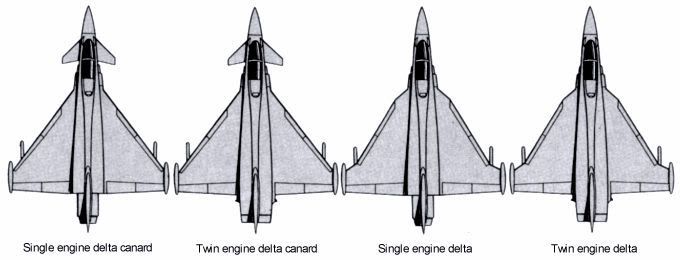
datafuserIt was in 1992 and the studies were conducted by Eurofighter under the designation N/EFA (New European Fighter Aircraft). 7 different configurations were reportedly considered four of them are visible in the image below.
Is the original document where you got the image available online?
datafuserYes, as I recall there were various configurations studied and one was to delete the canards and adopt a pure delta with a cranked leading edge. There was even an image floating about that had a similar line drawn side by side comparison of the configurations proposed.
I certainly wasn’t suggesting that datafuser was trying to deliberately mislead anyone, just that other posters seemed to be running with the assumption that these were actually derivatives of the Typhoon.
Well, I should have said those three configurations are very loosely based on the Typhoon – all three have a ‘twin engine, single vertical tail” configuration as well as two wingtip pods seen on the Typhoon.
The industrial arrangement – two major (UK & Germany) and two minor (Italy & Spain) partners – for producing 620 of these imaginary aircraft is exactly the same as the Typhoon’s.
datafuserStating the bleedin obvious politics and economics play a part
If by keeping the production lines in nations plural the ‘Tempest’ (I still prefer ‘Kamikaze’) can be made by
Not having a vertical stabiliser
TVC
Divertless inlet
LERXs
more RAM and RASH (are there any hotspots as yet untreated?)
Two seats*
Stealthy munitions**
AESA
next iteration of DASSThen it’d make an ace UAV controller
* One crew to monitor the UAVs
** To get signature reduction without major structural changes for internal bays. I assume (and is assumption) that the reason that the likes SCALP and SDB have had treatment and AAMs have not is that the requirement for speed means a huge IR signature from exhaust and airframe heating and so radar shaping and treatment would be an expensive and easily countered waste of time.
Flight International reported on 9 July 2002 that four companies of the Eurofighter consortium agreed in May 2001 to do a 12-month concept definition study for a future derivative.
I guess they had already studied the pros and cons of changing the Typhoon’s aerodynamic shape 10 years ago.
datafuserConformal weapons bays like silent eagle and KF-X ?
Where have you heard or read that the KF-X is to have conformal weapon bays?
datafuserIsraeli briefly considered buying 75 B-66s (some of them for spares) in early 1965.
http://history.state.gov/historicaldocuments/frus1964-68v18/d163
163. Telegram From the Embassy in Israel to the Department of State1
Tel Aviv, February 27, 1965, midnight.
1057. For the President, Rusk and McNamara. Personal from Harriman.
Part I.
Fourth meeting with Eshkol today moved up closer to broad meeting of minds, though it hard going.2
While Israelis still hard keep bargaining till we concede as much as possible, they finally got down to brass tacks after emotional session yesterday when they first saw our terms in cold print. (Eshkol said no risk of their disclosing this draft since it much too damaging to Israel.) Komer later told Peres no agreement possible unless all our desiderata met.
Then at fourth session I laid it on line about only alternative to US/Israeli agreement, precisely as outlined in Sections II and V of Presidential instruction. I made clear consequences to Israel and US if Jordan lost to West because US decided against arms deal in light Israeli opposition or because Israelis fiddled while Rome burned. Asked immediate answer.
While Prime Minister was shaken, he said heart of matter was what US could provide Israel. He appreciated proposed major change US policy to direct sales to Israel as well as Arabs, but how could he convince his Cabinet? He couldn’t say that he agreed to actual US sales to Jordan, which would promptly be publicized by Arabs and then seized upon by his political foes, in return for generalized and secret promise US in principle agreed to unspecified direct sales to Israel at some future date—and this only in return for series of Israeli undertakings which could be political dynamite for him. He urged we forget about other US requests, and focus on central problem of precisely how US could concretely demonstrate this change in policy simultaneously with Jordan arms sale.
Eshkol reviewed deterioration Israel’s deterrent posture since Washington intelligence talks almost year ago, citing new USSR/Egypt arms deal, new specter of coordinated Arab action through Unified Arab Command, and cancellation German/Israel arms agreement. This created two acute problems as how Israel’s increased security needs to be met and how he could bring his Cabinet and electorate along with him if he did what President Johnson requested.
To meet security need, Israel must have hardware—planes and tanks. He couldn’t go to his Cabinet and get even their tacit support of US arms sales to Jordan (however friendly an enemy) without showing them Israel could get its hands on hardware too.
Since a deterrent balance was essential, Israel’s first need was bombers to create counter-threat to Soviet Badgers and IL–28’s in UAR, Iraqi, Syrian hands. What Israel would really like was US Phantom, but he realized this impossible. Next he would buy Mirage IV, but with electronics it cost $5 million per copy. So Israel had decided best bet was old 1954 model B–66, which it understood US now phasing out. Since Israel’s resources were so limited, would we let Israel buy 75 of these at cheapest second hand price ? (Peres had told Komer in morning that reason for 75 was that US spare parts production had ceased; so Israelis would cannibalize some for spare parts.) Peres noted B–66 good for conventional payload.
Second was Israel’s need for tanks, which had been fully agreed in previous Washington talks. Now Bonn had backed out. He must tell Cabinet that at least Israel’s previously accepted tanks needs would be met regardless, especially since threat of US tanks in Jordan must now be added to that from Soviet tanks in Arab hands.
Even if he agreed that the US should sell $50 million in arms to Jordan, we must also see his political problem. He couldn’t say merely that the US sold tanks to Jordan because this was better than Soviet tanks in Jordan. So there must be some public “conjunction” between what US sold Israel and US sold Jordan. When it came out that we had made arms sale to Jordan, he must be able to tell his public we were going sell arms to Israel too. Once it became known that we were selling tanks to Jordan he must be able say we were doing same for Israel. Finally, because of new deterioration Israel’s security position he must at least be able to say US would sell surplus B–66 planes to Israel too. He couldn’t meet his acute political problem without some such coordinated disclosure. Part II follows.
Barbour
1 Source: National Archives and Records Administration, RG 59, Central Files 1964–66, DEF 12–5 ISR. Secret; Flash; Exdis/Tan. Received at 5:26 p.m.
2 A more detailed account of the meeting was transmitted in telegram 1091 from Tel Aviv, March 2, supplemented by a memorandum of conversation drafted on March 19. (Both ibid., POL 7 US/HARRIMAN)
datafuserI read about the F-22 data link issues earlier, wasn’t there some compability problem with the Link-16 system?
I guess it has been worked out by now?
If the F-22 has a ‘receive only’ Link-16 terminal, I guess there will be no problem.
datafuserHow would the F-22 operate with F-15C ‘golden eagles’?
What would be the best tactics to take on any intruders?
The best tactics would be for the AESA F-15C, who cannot hide from enemy radar, to ‘illuminate’ targets & ‘broadcast’ target info to the silent F-22A.
The AESA F-15C may end up as a missile sponge too.
datafuserOne would expect F-22s to use tactics similar to those used to hunt tigers.
An F-22 beats the brush to flush the “tiger” out of concealment, while his wingman waits to ambush any targets when they emerge.
VLO F-22 vs non-VLO gen 4 jets will not be a challenge unless the number of non-VLO airplanes greatly exceeds the number of missiles carried by the F-22s.
VLO vs VLO will be interesting as opponents in passive on-board sensor mode could fly past each other without knowing the other was present. Such an encounter could become a contest between off-board sensors.
Well, the F-22 beating the brush will get a volley of missiles.
datafuserVLO airframe and a higher operational speed.
What value does the VLO airframe offer when the VLO fighter is forced to emit RF energy to find opposing fighters who remain passive, ready to fire passive imaging BVR missiles by using ESM and IRST?


 Sign In