Haven’t got a clue – but that is a Sampo combine at the far end, used for trials and research in agricultural crops!
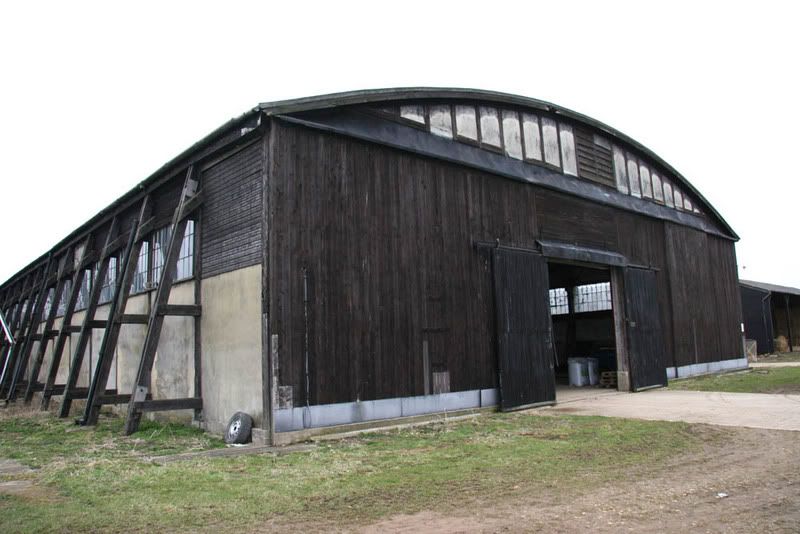
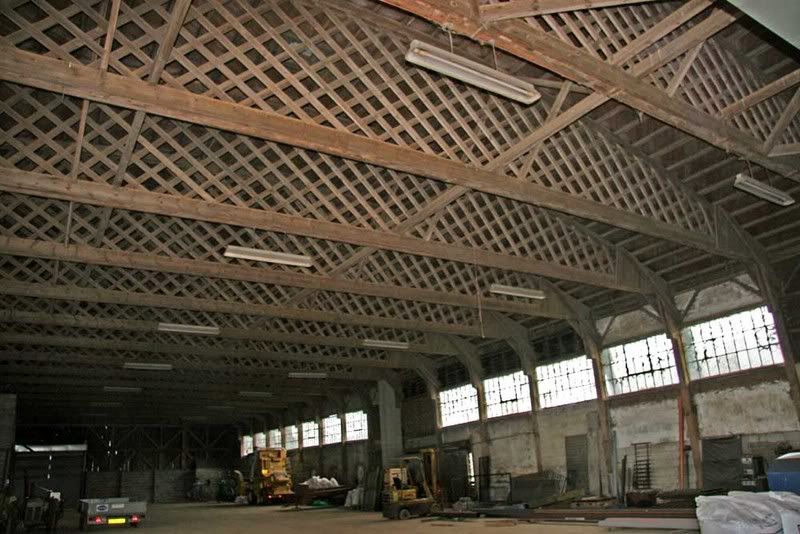
It was a WW1 airfield and the surviving hangar does indeed these days sit within a farm which forms part of an agricultural station run by a University.
Here’s one I photographed that still survives and you’ve not mentioned this location in the thread so far – guess where:)


I’ve seen some of his extensive collection of Douglas piston transport photos for sale at aero jumbles so it seems some at least ended up with a dealer.
Will you be bringing your nose;)
Moggy,
Another interesting Gallic oddity but your pic is of a Breguet Deux Ponts / Sahara and not a Hurel Dubois.
Regards
Tim
I think that a Gloster Meteor (T7?) was adapted for snow blowing at Kemble years ago and the airframe eventually ended up on a scrapyard a few miles from Long Marston.
…………….. There is an ex- Lufthansa Connie outside, which I was told didn’t belong to Kermit. ………………….
Actually its a Starliner that was originally part of Lufthansa’s fleet but years later served with Air Venturers and was an occasional visitor to Gatwick. She spent many years more recently stored at Sanford with Maurice Roundy and amazingly was ferried into Fantasy of Flight after years of inactivity. I well recall photographing her in the UK and at Sanford and never believed she would fly again – how wrong I was. She is I gather only on loan for 5 years – see here: http://www.starliner.net/
Tim
I seem to recall the Broussard was blown into the Shack’s prop?
Tim
Very good! Do they think the ‘INDIAN NAVY’ lettering on the Firefly is big enough?:eek: Did you shoot the Sea Hawk and the world’s sole surviving Short Sealand?
Adrian,
World’s sole surviving Sealand – what gave you that impression? :confused: At least two others survive in preservation 06662 (once G-AKLS) is in Belgrade and G-AKLW (which restoration is coming along nicely with the help of some Bombardier apprentices) in the UFTM museum on the outskirts of Belfast:)
Tim
When i helped move it to Bletchley park, many years ago it had lots of metal corrosion in it. We held the wings on to the fuselarge with 10mm steel rod. It was then ordered of site!
When I last saw it at its present location it sported a kind of jury strut between the u/c legs that, due to the positioning, gave the airframe the appearance of an axled fixed u/c and may be an indication of fragility or maybe just a precaution against storm damage as it was an outdoor exhibit. This feature isn’t evident in the eBay pics due to the angle at which they’re taken so I’m not sure if that strut is still in situ.
A-B’s massive “FAA Fixed Wing Aircraft Since 1946” which gives a detailed history of all airframes makes no reference to this example serving with any Sqdn.
Tim
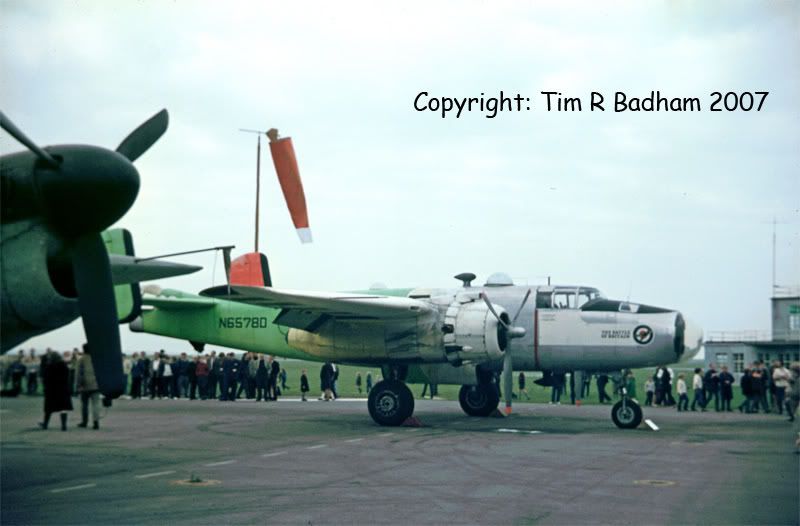
The camera ship used for the Battle of Britain film is the same B-25 as shown in Janie’s contribution. Here’s a picture I took of it at Bovingdon in the UK in October 1968 after filming had been completed. It is NOT the machine used by Aces High as the camera ship for Memphis.

Tim
Lee,
I didn’t know that it had period(s) without the periscope when with the RNHF, I think all my photos of it were with the peri fitted – you live and learn. Personally I miss the old girl on the circuit as she represented an aspect that is under-represented – the hard worked conversion trainers. Wouldn’t it be great if an ex-Ethiopian Firefly trainer with the raised rear cockpit could on the circuit. If only one of those now (still?) in S.A. could be resurrected. Maybe one day as per the Spitfire trainers that benefit the “warbird” movement – something different but with practical benefits.
Tim
………………. The wreckage of WG655, on the other hand, was sold and ended up in the US where substantial parts of her were rebuilt to form the new “WG655”. The only discernable external difference being the different wheels (disc brakes as opposed to bag brakes) and the retractable tailwheel (the T.20 having a fixed installation normally)…………….
Lee,
Surely the most discernible difference in the rebuilt “WG655” is the lack of the instructor’s periscope and its gantry which was an original feature that distinguished 655 (when with the RNHF) from all other surviving T.20s?
Tim
Adrian,
The glider is probably a type XG-001 designed by Philippine Aeronautics Training School and the national Science Development Board. It was built out of native timber and was a two seater.
The Aircraft bottom right marked XT-001 is a locally copied derivative of the SIAI-Marchetti SF-260MP with modified cockpit and wingtips. It was built by the Self-Reliance Development Wing of the Philippine Air Force and the prototype was believed to be modified from an actual SF-260MP airframe of which 32 were purchased by the PAF. The XT-001 is a 3 seater. Your phot is of an example the scheme of which seems to match the prototype.
Not sure re the other two, though the first seems to resemble a Corben.
Regards
Tim