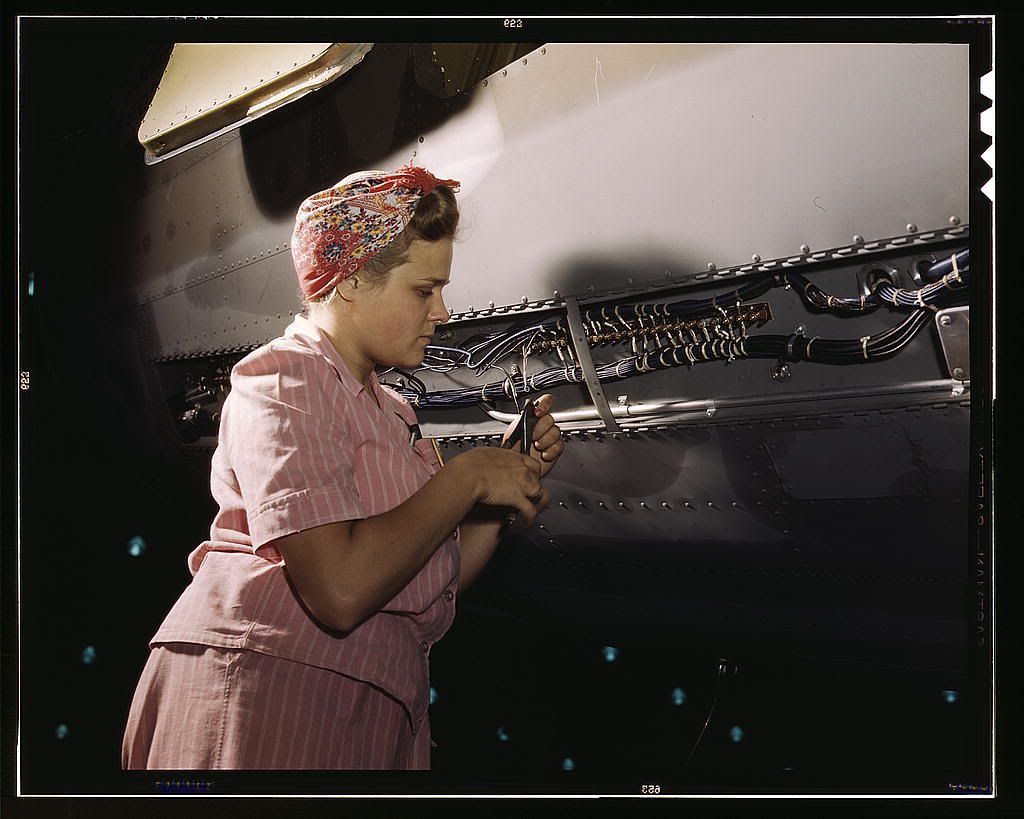
A few more, since you all seem to enjoy them.


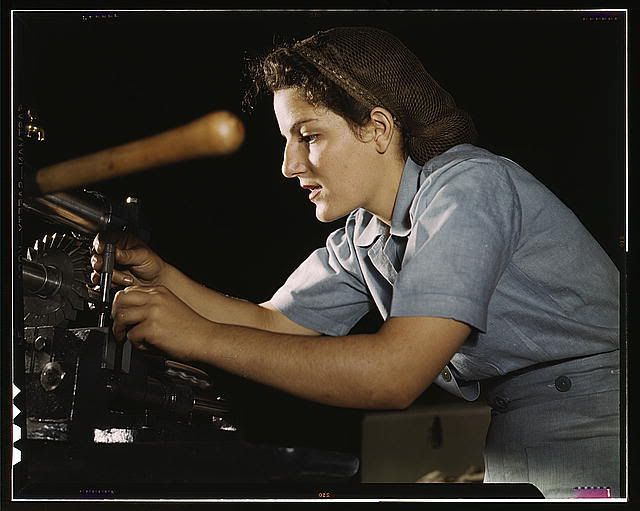
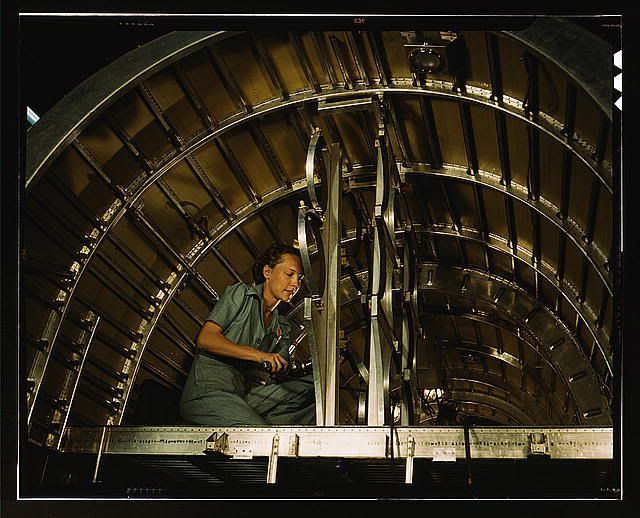
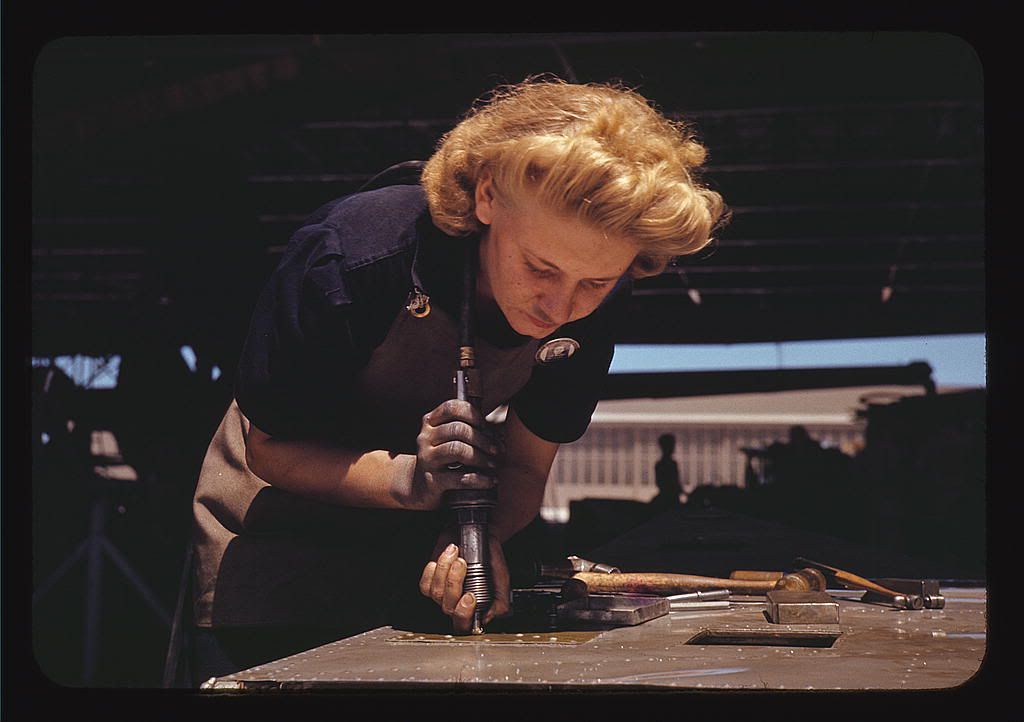
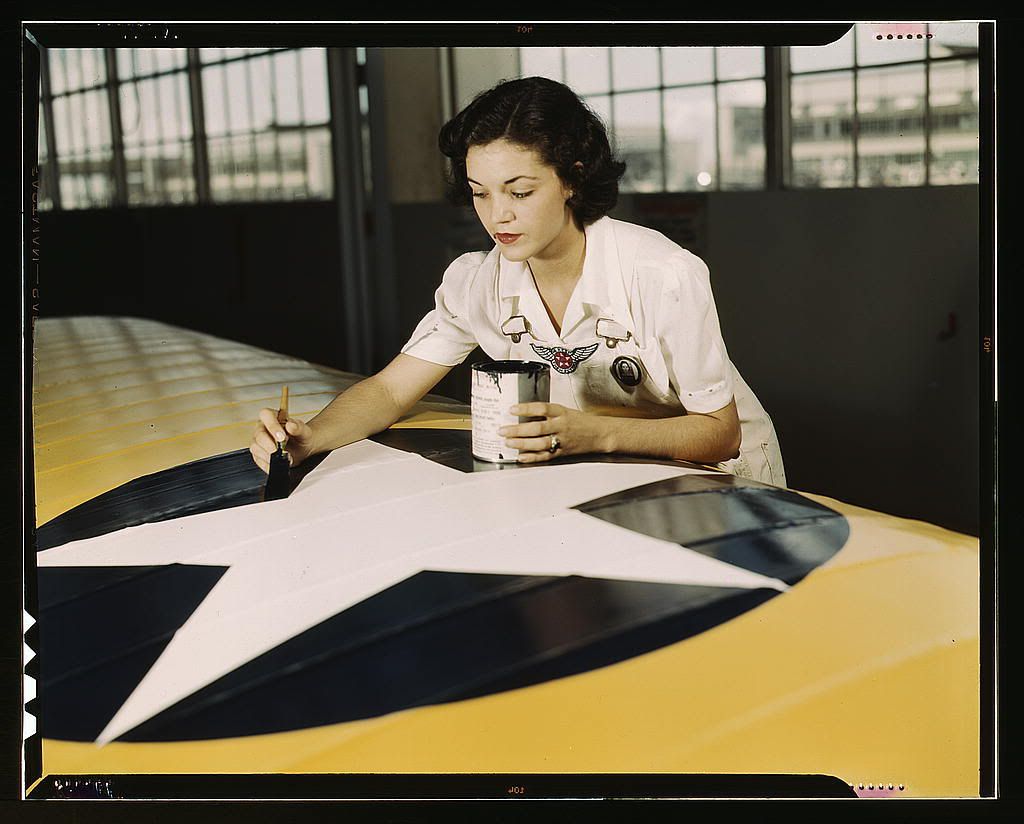
Here is one with a caption right from 1942 (original picture caption) you can almost feel the writer wanted to add “even”:
With careful Douglas training, women do accurate electrical assembly and installation work, Douglas Aircraft Company, Long Beach, Calif.

When you consider that the pictures were almost certainly shot with one of these: http://graflex.org/speed-graphic/ you begin to see why so much care was taken – not like deleting all your bad pics today, every exposure was an odyssey in itself!
As for how the negs will age… I’ve scanned and printed plates made prior to 1916… How much will we lose to data decaying with digital?
Adrian
The problems with storing digital picture files, will will be a huge problem for any historic field in the future. Not only will unreadable DC’s be discarded by the users (even if the data can be recovered, the majority will accept the loss, rather than paying for the recovery), but the printed pictures do not retain their quality (at least for the majority of our current printing processes).
Of course we will have the official photographs and whatever collections that are made to a professional standard, but the amateure pictures will not be so dependable.
The hight of war production would also have been the best time for advertisements.
With all the contracts flying around, you had to get your name out there, so the decision makers knew about you. War is not as bad for business as it might sound.
For civilian products, the marked became smaller, so they had even more reason to advertise their wares. If you buy one bar of soap this month, make sure its X brand.
Is there any possibility of posting a few of the adds?
Great to see non production stills from the BoB movie.
Im still waiting for the remaining HA.1112 to appear in formation at legends.
In todays world, propellers have to be within certain limits to be straightened out. I´m not sure what the exact limits are. I´ve seen props that are bent outside the limits and were cast away, and I was thinking to myself “well…..all I need to get this right is a hammer and an anvil”:diablo: True, they were bent, but not to a great extend.
What they did in wartime is anybodies guess, but metal behaves much the same now as it did 60 years ago. Severly bent blades would most probably have been sent to the scrapyard!
I just love that statement…….
Good luck with the Spit Tangmere…..
Lets hope the £8.000 does not reflect the buyers full economy, so we can look forward to another fully restored Hurricane, maybe even airworthy.
Oh, by the way, will it be at……….nevermind.
Maybe not just the film stock, all the photos nicely lit, careful composition etc. The ‘Ugly Bettys’ no doubt also kept out of sight!
Yes, even if the project had the air of a social document, they wanted to document it nicely, maybe even rose tinted.
I have seen documentary films from the aircraft factories of that time and I can confirm, that those ladies looks like any other fitter after a long shift, knackered and dirty.
I will post the pilot pictures later today, they are mostly styled like breitling adds.
Just look at the depth of colour and “Life” in those shots. Digital just doesn’t do it. (Even though I’m a total convert to digital and will never go back!)
I imagine they were on a large format camera of course.
Anyway, post more, they are superb.
From the collection:
“The 965 images from the OWI are color transparencies in sizes up to 4×5 inches. These photographs focus on industrial facilities and women employees, railroads, aviation training, and other aspects of the mobilization effort for World War II.
The images here seem to be 4×5 inches KodaK (as can be made out on the edge of some pictures).
Colour pictures from that age just have a certain feel to them. Maybe digi-cameras will soon be able to truely emulate the effect.
Making the B-17.


The final result.

Was it “Rosy the Riveter” on the US campaign stuff?
These are great shots, very studio like.
The pictures were taken by official government photographers.
“Photographers working for the U.S. government’s Farm Security Administration (FSA) and later the Office of War Information (OWI) between 1939 and 1944 made approximately 1,600 color photographs that depict life in the United States, including Puerto Rico and the Virgin Islands. The pictures focus on rural areas and farm labor, as well as aspects of World War II mobilization, including factories, railroads, aviation training, and women working. “
And yes, it was “Rosy the riveter”.
Here is another batch.


Nice to see the German women could more that serve huge beers 😀
I used to work with a guy, who had a rivet-gun like that (in the 1990’s). Big darn thing.
Why don’t you link directly to the pictures, rather than the website?
Anyway I remembered something and found this:
“8. 44-61748 B-29A-45-BN IT’S HAWG WILD American Air Museum, Imperial War Museum, Duxford, England. Aircraft assigned to the 307th Bomb Wing, Kadena AB, Okinawa in March 1952. Flew 105 combat missions over North Korea. Sent to China Lake as a target in November 1956. Donated to the Imperial War Museum by the US Navy in 1979. Recovered from China Lake on November 16, 1979 after being made flyable and flown to Tucson, Arizona for further restoration by Aero Services. On February 16, 1980, the aircraft was flown to Flint, Missouri. On March 2, 1980, the aircraft arrived at Duxford via Loring, Maine; Gander, Newfoundland; Sondestrom Fjord, Greenland; Keflavik, Iceland; and Mildenhall, UK. Severe corrosion was found in the bomb bay area requiring extensive repairs. Exterior was eventually repainted in its wartime configuration and the aircraft was fully restored. On permanent indoor display.
Although that might have been awhile back.

Can anyone identify this one?
Oh, sorry, “Trim Wheel” 😮
Vulcan Bird of Prey?