Thank you Bloodnok:)What I was going to say…With the company I go to the Waterjet uses a 1.5mm tip so every rivet hole centre will get pierced.It then can be drilled out oversized to whatever rivet is needed.
With the formers all we do is just take off the sharp edge lightly with a sander to give a nice radius.
Here is a nice vid of using shrinkers/stretchers.. http://www.youtube.com/watch?v=GvaFtmAzxNk
Absolute gold mine of info here in this thread..Here is Rhino at it,s best..From a good friend of mine overseas.. http://spitfire3d.com/wing.html
We use primarily ProDesktop which is a students version of ProEngineer and Solidworks for our 3D work.Found IGES works best for importing/exporting between the two..
it all depends what you are doing..In some cases CAD is superior to the two as in laying out geometry for jigs,frame assemblies etc.For parts assemblies 3D is king.
With Solidworks you have the ability to use it to design sheetmetal developments and fold/unfold virtually.It doesn,t like complex splines though like we use in Aircraft frames.For that Catia is king.
Some more 3D goodness here.. http://3dspitfires.blogspot.com/search?updated-max=2010-04-09T14%3A20%3A00-07%3A00&max-results=7
Must be the soundtrack…
Try to describe the process
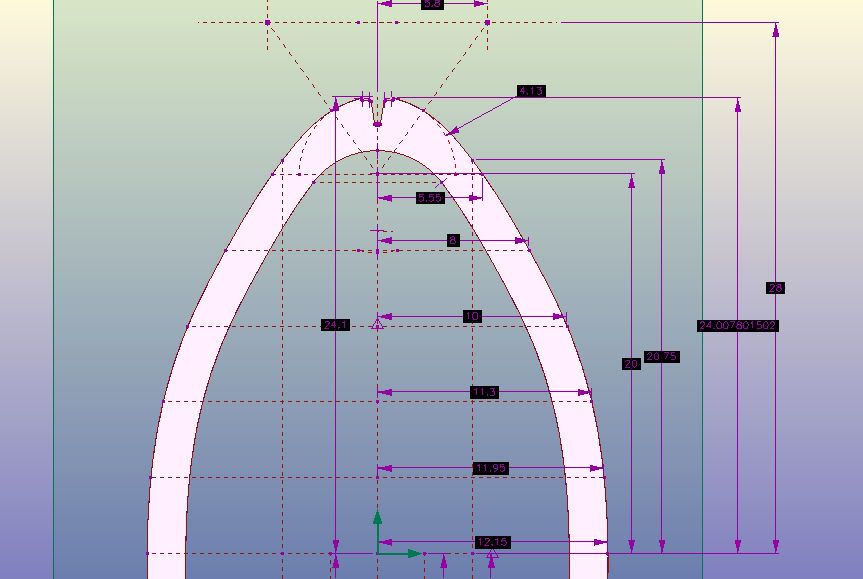
3D sketch on frontal workplane-convert to DXF-name it “frame former”-offset line to give inside flange line..Lightening hole centres cut to .25″-delete all other lines
Copy sketch-rename it Alli Blank-offset line to give flange thickness + bend allowance-square off all corners from the flange foldline out to cutline-insert lightening holes full size-rivet hole centres added.
Formers go to Lazer cutters.Scale 1:1 in mm
Ali blanks go to waterjet cutters.Scale 1:1 in mm
When received back in workshop,relieve edge slightly on all flange fold edges on formers.
Alli blanks,polish all edges..
Cut precision washers that have .25″ center hole and outer diameter to suit lightening holes.Must be same thickness as alli blank material..
Sandwich alli blank between two formers with washers in lightening holes.
Insert .25″ Dia bolts with large penny washers on outside formers.
Using clamps and vice clamp material tight.Start hammerforming edge starting from one end to the other.I usually do it in three stages to prevent work hardening the metal.Use a tinmans mallet or curved bit of wood to form tight radius’s.When finished gently prise apart..straighten with stretchers/shrinkers..Inspect for cracks and give to Heat Treatment to re harden.
Phew..
Appolagies as this will be a quick reply as I,m getting ready for a FlyIn here..
with aircraft alli there is aircraft grade material already in annealed condition.So not to reinvent the wheel here is a vid we did up ages ago..In it shows hammerforming Spitfire frames,the formers are Lazer cut and the aluminium blanks waterjet cut. http://www.youtube.com/watch?v=M7rXV4tdwvo
Try not to put it all onto one drawing..You might have up to half a dozen drawings per one frame..With the Spitfire you have waterlines every 4 inches above and below the fuselage datum line.These measurements can go into a table on a separate sheet.On the main sheet you just have “Notes” of the more technical views..For instance..For view “A”..See sheet 3.
Either that or have the stack of drawings on CD in DXF format.DXF is great as it can translate into many different drawing programs or CNC machinery..For example,Lazer cutters for frame formers or Waterjet cutting for the aluminum blanks.
Good on them for getting their backsides and creating them.Love full scale warbirds but also know the effort in creating a scale replica from scratch.Designing the plane,marking out sheet,cutting,drilling,deburring,folding,shaping aircraft sheetmetal is an artform no matter what the size..
what would you say to Terry Kronk about his 80% Fw190 as it is all 100% home designed and built. http://www.homebuiltairplanes.com/forums/warbirds-warbird-replicas/625-focke-wulf-190-80-scale.html
Author
Posts
Viewing 15 posts - 1,021 through 1,035 (of 2,288 total)


 Sign In