Hi Ed.
I don’t believe there was adhesive bonding of any metal components, whether to other metal or wood, in the Venom. As far a materials and processes, I don’t believe there was anything different to the Vampire. Below is an extract from the Sea Venom FAW.53 General and Technical. It refers to riveted structure, and illustrations typically show representations of rivets or fastener holes. There may have been issues with the fuselage in the tropics although at least DH had moved on from casein.
The Vampire had a range of fatigue lifes on items – from 600 hours to 1200 hours. I would be surprised if the Venoms were much different – especially as, if I recall correctly, the Kiwi Venoms in the Tropics were FB.4s, which had a lot of commonality with the Vampire. Even the FAW.53 had some major structural elements still with single-seat Vampire part numbers. Several of the life-limited items were steel, including those with 600 hrs. Some were aluminium alloy, including the lower spar cap. As much as the material itself, geometry is critical for fatigue. The main wing attachment fittings (steel) were redesigned with a more generous radius to improve fatigue life. The lower spar cap had a big problem where four skin panels met over the cap each with a fastener in it – four holes too close together. At least one of the fasteners was a PK screw – with self cutting threads that are really good for starting cracks!
life-
Ah! I can answer regarding AM’s 28th March 2018 post, item 2, and petshop pete’s Control Unit Type 89 Ref No : 10LB/90.
I look at this thread from time to time, and spot some great items!
The pair of boxes are for the IFF Mk.III. As British units, this is the R.3121 system. Below is a listing for the Vampire FB.9, and image from PN – the boxes are bottom right. The relative arrangement in the Vampire as a type is unusual; standard arrangement is side-by-side, and has a standard bracket which seems to be the one in AM’s image.
AM, do you still have your pair? If available and prepared to send down-under, my idea for destination is ‘loose’ at the moment. I need to do more research for Camden Museum’s Lincoln Mk.30 cockpit/nose section, which needs the Mk.III boxes for the Navigator’s position: I found within the collection a pair of the American version – BC units made by Philco – but I’m not sure if the aircraft should be fitted with the British or American units… or maybe it could be either. We have some loose pages out of a parts book showing the British units, but I don’t know if the pages are from the Lincoln B.2 or the Mk.30 – the pages just aren’t marked with an AP or AAP number.
My Vampire Mk.30 panel is fitted with US Navy units instead of the Philco units it should have! The US Navy units have unsightly conducting anti-static touch pads!
I hope these details are not considered as excessive thread drift!



Worth having a look, if only for the photographs : – )
Good shot of the LH cockpit area. Shows the u/c retraction lever with the finger-pull over-ride. Our Rhodesian aircraft has that mod, but the only paperwork we can find for it is Swiss (or Trainer).
Hi Dave. Emails received. Tied up at the moment! Many thanks – will get back to you.
The photos below show the one 5/16″ pipe and UN thread connector that I have – fitted to the C-2 Rate of Climb that came with one of the panels, and the original plumbing/ AGS fittings. Have since googled for American fittings – only found ‘barb’-type AN fittings.


Hi Mark.
Is this light brown ring around the edges a seal and that is on the exterior? Then it would be an inward opening door? If so, it would not be a door for usual access, perhaps, but instead for emergency use. Also it looks like it wouldn’t be very flush with the surrounds, therefore either a comparatively low speed aircraft or goes on the airframe where aerodynamic smoothness is not important.

My blind flying panels are progressing fairly well – photos attached and my notes on mods etc are on my blog: http://vhjet.com/nickos-blog/. I am now turning my attention to the plumbing.
Does anyone know if there are standard pitot/static connectors with 5/16″ plain tube and 3/8″ BSP (I think) thread? I need a couple of these for an ASI. I can’t find such a thing in the Brown Brothers catalog, although they do have this one that illustrates what I am after:

My alternative is to rob a couple from a spare Machmeter, but not keen on that! I gather from looking at several that some are probably specific to individual indicator p/ns and they also come in different lengths.
I’m also after the same for American gauges – ASI, Altimeter & RoC – but more like 3/8″ UN, not 7/16″ shown above.. Perhaps I will find some MS part-number – not sure if the Americans used something similar to AGS838 fittings, or flexible tubing with wire.
Thanks.
Good sleuthing!
Thanks to Bazv!
Hi Ed. I have one reference from 1943 with references to obsolete gauges for training including some for Southampton and Seagull (as opposed to Seagull V which is listed in the current section), but unfortunately not the fuel gauges for these aircraft.
Attached is an extract from a 1934 text that describes the ‘Korect’ fuel gauge system that seems to match what you have. The text refers to Smiths under the electric fuel gauge section on page 19; who knows if Smiths made the Korect system or a gauge/pump pair that seems to match.
Great. I thought of the Auster III before, but discarded that pretty quickly. AOP 9 makes sense.
I just googled some and see that the two screws on the instrument panel that I commented on are actually for the mag switches.
Cheers.
Hi Ed. For the photos, at the moment I’m having plenty of luck just using my ‘snipping tool’ to get images on to my clipboard, and then just paste them directly into my posts. I don’t think this used to work for me, but I’m happy about it while it works!
Also, what is the radio type (lower right)?
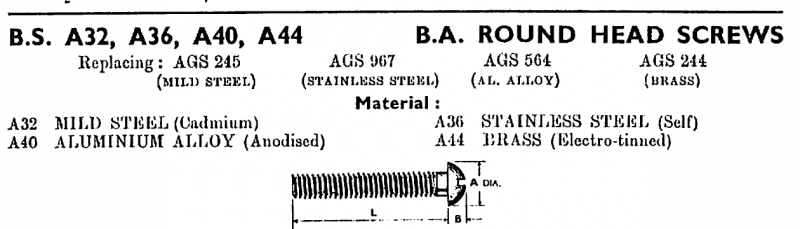
AP.1086 Section 28S refers to brass screws as ‘tin-coated’.
Going off the Brown Brothers catalogue: