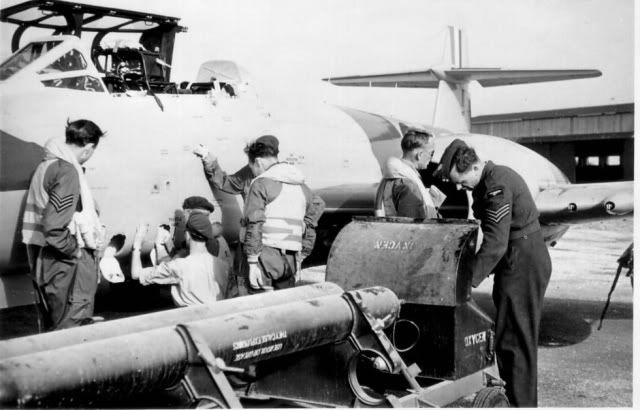
Brings back memories, used to hang over the fence at Lympne when Silver City first started about 1948?. In 1949 I worked for a few months in the Met Office and have a vivid memory of three Freighters returning from Le Touquet one evening in formation, and doing the classic break and landing.
Wonderful old bikes as well, I had a 350 Matchless. Afraid those days will never return.
BSAA1947 is right, take off was always on mains. Once safely climbing away the switch to outers was made. If the underwing drop tanks were used then the fuel from them had to be transferred to the outers once those tanks were low enough and this could take a couple of bites.
The fuel lines ran along the main spar and the cocks protruded through a small bulkhead between the two seats. The navs seat simply consisted of a cushion against this bulkhead with a seat cushion on the forward end of the bomb bay. The pilot sat on a proper seat mounted on the bomb bay, several inches forward and above this level. This meant that if the pilot needed to operate the fuel cocks, he had to take his left hand off the engine controls to hold the stick, and grope blindly behind himself with his right hand to locate the fuel cocks.
Ergonomics had not been invented when the Mossie was! To operate the undercarriage involved a similar manouevre with the lever well over towards the navs side. My pilot, being short, had to duck below the coaming to achieve this and we always had a little jink.

Not having had the benifit of reading the article, I’ll lob in my twopennorth anyway.
I had understood the accident was due to mishandling the fuel system on the Mossie. Having inadvertently stopped both engines on a Mossie due to the same, I had always thought it due to inexperience on the part of the Navigator.
Because of the awkward position of the fuel cocks and gauges, pilots generally trained their navigators to operate the fuel system, but AFAIK this was not officially sanctioned.
I believe that Gibson took a staff nav, who did not have Mossie experience, and so they got themselves in a muddle.
I would only feel safe to fly in it if they did the flight on one engine.
Then there would be no flight as it would not have enough urge to become airborne.
In any case it is so awfully, awfully uncomfortable, what with the noise, vibration and cramped conditions.
How about three stripes
Many thanks SpitPhil for the Meatbox pics.
To answer Pagens point about training. I went through the NF OCU late 1951 to early 1952 and missiles etc were never mentioned. The AI Mk 10 then in use had quite a limited range, about 6 miles on another Mosquito and perhaps 10 on a Lincoln. But range could be seriously compromised by ground returns so the fighter needed ideally to be flying at a lower level than the target, to aim the radar down flooded the screens and made picking out the target much more difficult.
If you are interested I wrote the attached for the mossie.org website. The first two sections cover my training and then AI Mk 10
http://www.mossie.org/stories/Peter_Verney_2.htm
Very well done to all concerned.
Looking at published pics, it occurred to me that the elevators looked to be in the full up position when the trim tab was missing.
I’ll push in my tuppence worth.
AI Mk10 was just coming into general use at the time but tactics were only just being devised. In any case the coverage of Mk 10 would preclude satisfactory interceptions of fast head on targets, which were also well below. It was much easier for the pilot to chase the jet flame, and as has already been stated, misjudge the range. Rawnsley and Wrights book “Night Fighter” covers the subject excellently.
It is difficult I guess for the layman to comprehend the difficulties faced by the nav/rad. He was not looking at a TV type display, but two screens which had to be cross interpreted.
There is also the question of captaincy, also discussed here, and pilots were most definitely in charge. It was very difficult for many to accept orders from a nav/rad to do things which seemed to be against reason.
I hate watching that type of display. I was at Mildenhall when an American trainer (forget what type) failed to pull out of a loop, entered at too low a level :(.
Having endured over enthusiastic pilots trying out their aeros resulting in inverted spins in both the Mosquito and the Meteor, I realise how narrow the margin between success and failure can be :eek::o. Luckily for this coward sufficient height was available. :D:D
I hate watching that type of display. I was at Mildenhall when an American trainer (forget what type) failed to pull out of a loop, entered at too low a level :(.
Having endured over enthusiastic pilots trying out their aeros resulting in inverted spins in both the Mosquito and the Meteor, I realise how narrow the margin between success and failure can be :eek::o. Luckily for this coward sufficient height was available. :D:D
Yes, the Meatbox looks very sad, I am puzzled as to why it is wearing 39 sqdn pyramids.
I would say certainly, although I have no experience. Look at the sight on a Lee Enfield rifle and see how the aiming point has to be raised against the distance scale, if they knew how to do that, then with aircraft it was a piece of p1ss. Bullet drop was known and allowed for when the first cannon were cast in Sussex.