 SpudmanWP
#2 tells you a direction to look.
#3 tells you exactly where the F-22 is.
#4 tells you where he is, what direction he is heading and at what speed.
SpudmanWPThe possible need for spoilers (which are already installed) were for the C, not the B.
SpudmanWPThe grounding was reported in the F-35 News Thread.
SpudmanWPRead up on Package Q for an idea of what an all VLO force could do vs what a 4th gen force did. Considering PQ was not against SAMs (and no modern double-digit ones at that) and fighters, an all VLO force would have an even greater impact against a SAM/Fighter combo.
SpudmanWPWhat about ESM? ESM only needs to pick up emissions, while radar has to send out emissions and RECEIVE them back. If a radar can see a target at 100 NM, an ESM may “hear” that radar over 200 NM away.
Not only does the ESM have to “receive” the radar signal, but also:
1. Recognize it as such.
2. Intercept enough of it in order to get a bearing to the F-22.
3. Get even more of it in order to get a 3D positional fix.
4. Be painted long enough in order to get a vector to the F-22 in order to use your own AAMs against it.
A break in any of the above and you will not be able to prosecute a missile shot against the F-22. There is also the issue of networking to deal with. While you may “intercept” the radar from the F-22 going active 150nm away, you will never hear from the F-22 that is only 50nm away that got updated with your position.
SpudmanWPModern IRST can see an approaching fighter from about 30-50nm away. This is well short of what the latest radar/AAMs can do. The IRST has a LONG way to go before it supplants radar as the primary sensor for A2A engagements.
SpudmanWPLPI is an official term and “harder to intercept” is not (and therefore can mean anything).
SpudmanWPSorry about the old image. My goal was to visually number the hardpoints, not state their capability (note the Alarm missiles on #3/4).
SpudmanWPI labled it for ya

SpudmanWPBREAKING: F-35 flight tests may resume next week
By Stephen Trimble on August 9, 2011 10:46 AM
A valve malfunction caused the F-35 grounding order last week. The Honeywell integrated power package (IPP) pulls in outside air to start-up, then switches to engine bleed air after the propulsion system comes online. The valve that switches the flow from inducted to bleed air didn’t work, forcing highly compressed air to build up behind the valve until it essentially backfired. Ground tests may resume as early as tomorrow and flight tests could start again next week.
That information comes from Australian journalists who were briefed yesterday in Canberra by Lockheed Martin vice president Tom Burbage. Their news articles have not been posted yet, so there are no links to share.
As of yesterday, the joint program office in Arlington, Virginia, remained in communications black-out mode.
http://www.flightglobal.com/blogs/the-dewline/2011/08/breaking-f-35-flight-tests-may.html
SpudmanWPI thought that it was McDonnell Douglas’ engineer and not NG’s who had suggested the so called “Pelican tail” (like a rotating V tail) for the X-32 instead of the LM X-35 like standard configuration. Initially that was chosen but later management changed it back to a standard X-35 like configuration.
You’re right. What threw me was the whole Pelikan (correct spelling) Tail vs “Four Post” tail. Since the X-32 was a delta I was figuring it had to be the X-35. I re-watched the video and double checked the transcripts to find it. They were speaking of the final F-32 design, not the X-32 delta.
NARRATOR: An engineering team led by Dennis Muilenburg must come up with a new tail design that will work on a reconfigured fighter. The conventional choice is called a four poster for its four control surfaces, the tail design for all modern U.S. fighters, including Lockheed’s Raptor and its proposed JSF fighter.
But there is an experimental alternative, a novel two-post tail with just two angled control surfaces. The Pelikan tail is named after its inventor, an engineer inherited from McDonnell Douglas, Ralph Pelikan. He argues its merits.
RALPH PELIKAN (Engineer, The Boeing Company): Sure I understand you’re all nervous about this new concept. I think it can be done.
NARRATOR: Proponents of the Pelikan tail argue that the design is less visible to enemy radar. In other words, it has a smaller stealth signature. For Boeing, this is an important plus, since Lockheed is the originator and acknowledged master of stealth technology.
FRED MAY: We can’t afford to have any question at all over our signature and whether we leave a signature.
MARK MAGNUSSEN: I don’t think that we really know enough about the Pelikan tail. We think we can make it work, but how much effort is ahead of us to make it work?
NARRATOR: Those supporting the traditional four post tail argue it’s a known quantity. The word on the street is that the JSF program managers favor it for the same reason.
DENNIS MUILENBURG: There’s a slight benefit, from a strategy standpoint, that we can negate a perceived Lockheed advantage by going to a four poster. On the other hand we end up looking like the follower with two teams that have the same design.
FRED MAY: I vote for the Pelikan tail. I think we’ve got to bite the bullet and go there.
RICK REZABEK: I guess maybe I’m still more conservative than Fred, and I would stick with the four poster and try and get the signature to work with the airplane with the four poster.
NARRATOR: The room is deeply divided. In the end, Muilenburg must break the tie.
DENNIS MUILENBURG: Now, I’ve been a four poster fan up until about an hour ago, all right? I think we can beat the pants off Lockheed when it comes to working weight, handling qualities and aerodynamics. Whether its real or not, they’re perceived to have a signature advantage, so we need to do something to our configuration that will give us a signature advantage. I think the Pelikan tail does that. All right?
NARRATOR: Feeling pressure to make a bold choice, Muilenburg chooses the Pelikan tail.
DENNIS MUILENBURG: So we’re going to go with the Pelikan tail. We’ve got some unknowns, we’re nervous about some things, so lets go figure out how to make it work.
NARRATOR: But just days later, after Frank Statkus and senior management review the choices, Boeing changes its mind. Concerned about weight and performance, it commits to the more conservative four post tail.
DENNIS MUILENBURG: The four poster is a little safer way to go, so I was a little torn from a personal standpoint. But when we stood back and looked at the data, I think we made the right decision.
NARRATOR: Boeing radically changes the wing and tail design, which gives the proposed fighter a fresh new look. The new plane is projected to be 1,500 pounds lighter and more agile.
But it’s too late to incorporate the design changes into Boeing’s two test planes, now eight months into assembly. Instead, the company will submit the new configuration with its final proposal. By testing the new design in simulations and wind tunnels, and flight testing the old design, Boeing believes it can prove the soundness of its approach.
SpudmanWPActually, if you look at the JSF documentary(PBS Battle of the X-Planes), it was when Northrop Grumman joined the LM team that the talk of a V-Tail emerged (from their prior YF-23 work). There is a spot in the film where they decide to go with a V-Tail one day, and later reverse and go with a conventional tail (with vertical & horizontal surfaces).
SpudmanWPHere is a 3-way of the final Boeing design. They had to dump the delta because of performance issues related to updated specs. It was not MD’s fault.
Btw, the 1st down-select was a paper one. Once planes started to fly, the truth came out (Boeing’s gas ingestion issues and it’s looks did not help either).

SpudmanWPIf you look at what Boeing was proposing (the standard wing, not the X-32 delta), it still had the tilting bomb bay and lack of center hardpoint.
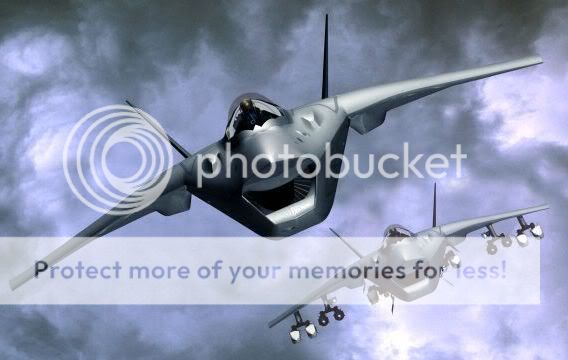
SpudmanWPYou might want to check you planes again. The X-32 had a smaller, tilting bomb bay, & no center hardpoint. I have never seen it’s loadout, so I am not sure of it’s wing-hardpoint specs.


 Sign In







