 over G
But I think it seems more promising
Very high and canted wing (losing effective lift, God knows why chinese did it), boxy fuselage, crude fuselage topology conventional delta with relative big wing area, canards, close engine assembling, limiting complex compossed manouvres-combinations for it TVC system
vs
Blended wing, generating full lift, fuselage heavily based on lift body concept, complex surface topology, Levcons, having the balls to stuff the bomb bay at the same level of the wing…
Nope, the J-20 is based on old concepts, this plane is somewhat outdated
more mature than the T-50
You are being driven by appareances, beware, this plane is already painted and looking nice, as the Yf-22 or the x-35 were….
Hint:
The f-35 can’t do any kind of aerobatics yet….unlike the T-50
over GI don’t want to rain on anybodys parade but..
Are we sure this J-20 is cleared for flight testing and not just highspeed taxi trials like we witness with Pak-Fa?
I’m confused here, I don’t really know if any modern program did use an airframe with engines, controls, and pilotable, just for highspeed taxi trials.
This is why I think russians are hidding things, a complete prototipe just for taxi trials? aerobaticts after just 15 tests??
They will reveal their next prototype this year, but I think this ‘T-50-2’ was flying more than 6 months already.
And of course, chinese can hide their things as well.
over G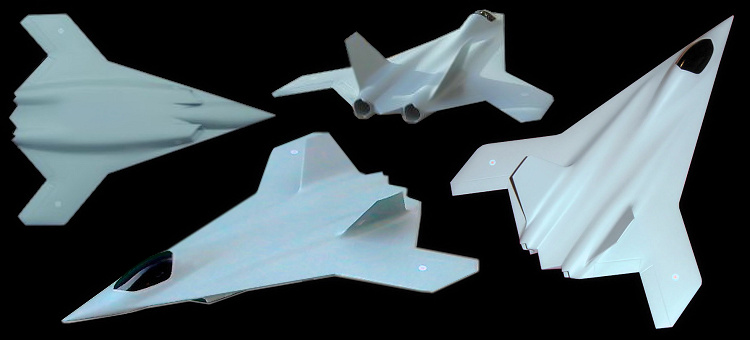
Nice one, what is this?
over GDisagree with opinion that J-20 intakes are too small. I think intakes are adequate to provide enough mass flow to engines in any flight regime, whether low speeds high AOA or high Mach numbers. Otherwise you are indirectly saying that Chinese engineers screwed up doing simple calculations of equation of continuity. 🙂 After all that when seeing the J-20 I wouldnt dare to say it will be a bad supercruiser bcs it could also be the best one.
These intakes seem to be narrowed in their width but are taller due to shaping front fuselage “chines“, compare them with diamond like F-22 intakes.
Well, i’m saying they are just designing the thing without any SC requirement, f-22/pakfa intakes are larger, not just because it cross area, but because the real area is increased due the sweept of their leading edge intakes, they are actually much larger than they look.
Let’s remember the JSF concept never required any SC capability, and early JSF concepts had basically the same J-20 basic configuration, boxy fuselage with canard-delta layout.
Yes they are taller, but it cross area, and real area are still small IMVHO, of course.
I don’t know if the DSI concept is compatible with SC requirement, since all Boeing’s F/A-XX concepts have conventional intakes without DSI.
This is of course what I think,I know we don’t really know a lot about this plane, and I know that on this I may be wrong, so is just a humble opinion.
over GBear in mind that they’re probably bigger than they look, since there is no diverter gap.
The sweept angle of the intake is negative, like the 35’s one, so unlike the T-50/F-22 intake, the intake’s area is definitivelly smaller, add to this the diverter, and you actually get a even smaller intake area.
IMVHO, this plane is not designed for SC, of course i may be wrong.
over GVery low degree of detailed design. This thing is just crude.
The more I look at it the more it slides towards “X” on my personal “X – Y – serial” scale.Btw, I think the intakes are too small.
Me too, probably is not designed for supercruiser? :confused:
Can we compare the aspect/area of it intakes with the F-22,35 and pakfa?, I think the 35 ones are actually larger, relative with it aspect, and supossed power output (?).
So at the end is an scaled up F-35…probably a successful F-35?, with the right configuration (canard-delta), without the worries of a lift fan.
Happy New Year, BTW 🙂
over GIt then seems quite logical to design the JXX as a bigger missile ship than the F-22
I would be cautious claiming this, because such big weapon’s bay so far away from the center of the main wing would be troublesome for it handling and aerodynamic balance, IMO it bomb bay won’t be that big, so probably is not a striker, just a heavy fighter, or interceptor.
Or probably is a striker 😀
which would suggest a takeoff weight in the 75,000-80,000-lb. class
This is quite a lot, it looks heavy, but not that heavy, never liked the comments from this Mr Sweetman guy…in addition of his clear bias and boring comments based on popular beliefs, he is quite sensationalist.
think the F-23 had clever internal arrangements
If we could give a trophy for ‘the best bomb bay designed for a 5th gen fighter’ the winner should be the PAKFA, although I’s still trying to figure out how the structure is.
over GNeed to watch it take off video! must see how fast is its take off climb rate.
over GIMO the key feature to know if this plane will be successful or not is it weight.
And right now, it looks heavy
I recall saying in the pakfa thread that russians had better to design (IMHO) a delta wing for a medium/light airframe, and this is confirmed, since the pakfa is ‘smaller’ than the su-27 (said by its test pilot)
I recall that if russians wanted to design a heavy class fighter , they better had to go with the su-27 wing, later I found that diagram for a clearly heavier fighter with f-22’s like intakes, faceted flanker nose, and su-27 wings.
It was logic
the J-20 has a delta and seems to be a heavy plane…
Is not a good sign IMO
Anyways let’s wait and see, people here is so much worried for the stealth thing, and probably some chinese engineers are thinking that this plane is doomed from the beginning because more mundane factors (ie, real life)
Of course, if the program is aiming a fighter
over GOf most interest is the stealth shaping, which is considerably better than that seen in the Russian T-50 PAK-FA prototypes and in the F-35 Joint Strike Fighter. The Chinese design appears to be largely built around the stealth shaping design rules employed in the F-22A Raptor.
Wonder when people will end this raptor fetish and realize that the raptor’s ‘design rules’ are actually outdated
Just like this J-20, while is magnificent and a great step for China, is based on outdated concepts.
For example, LEVCONS (T-50) are more advanced than the delta canard concept (J-20) and this one is more advanced than conventional tail (F-22)
People get surprised because new planes are more curved, but with the advent of new RAM shaping has become less and less practical, people are blind and can’t really analyze, seriously, check the 1-2 page on this board, there you get the JSF early prototype, much less curvy than the final F-35 (looking much like the F22!, surprise!)…which topology is less advanced? the demonstrator of the final design?
Both Raptor and this J-20 are based on outdated concepts
Both the Pakfa and the F-35 are based on more advanced concepts (although aiming different performances)
Even the F/A-XX is more curvy, and it ventral structure is not flat, look much like the Pakfa…guess the Raptor is a more advanced concept..right?

over GThank you, this can confirm my suspects that the s-duct thing is/was more a flow/hydrodynamic inlet design , rather than a LO measure, this can confirm my other suspects, that the F22 has probably a first generation DSI, with the Typhoon, Rafale and other planes using a mix of this concept with CARET controls, the persistence of the s duct on either LO or non LO aircraft was always bugged me, and such concept was explored also in the 144 and berkut, I always have thought that the s-duct had nothing to do with the stealth thing.
Is probably the true reason why the 22 has a max speed of only M1.8
over Gbased on what has been written on the physical attributes of a stealth aircraft..
Hahaha
Go and read a physics book, lazy
over GThe J-20 is definitivelly above the F22/T-50 on complexity and ambition, is below the T-50/pakfa on practicity.
Let’s see how this program goes 🙂 , waiting for it first flight
Pure aesthetically, I think the T-50 has a better looking nose
over GI think people are a bit overexcited over this plane, the fact that it fuselage has a quite simple lift surface, the fact that this plane does need canted wings and ventral fins says more than having a brand new single piece bubble canopy.
Same for the F22, the fact that is 5 tons overweight, has a huge tails, conventional controls and boring layout, says more than having a shinny paint or cool looking pictures
This program is just starting, we will see how it does perform.
over GBetter one:
Is a beautiful aircraft 🙂
Let’s see how it perform, I still think is a heavy class fighter, the comparison with the F23 is not fair, IMO, this airframe is a compact long structure, while the 23 is basically a flying wing with it fuselage upside down…
The chief designer of the J-14 sneered at the aerodynamics of of PAK_FA during a interview and claim his design to be much more advanced.
To tell the truth, while this is a beautiful plane, the PAKFA has way more advanced aerodynamics, seriously the topology of the T-50 beats every 5th gen plane out there, most likely it LEVCONS are it canards, it small fins are enough for it control, and has shown good flight ability in such short time, while the J-20 need some measures to keep it directional stability (like these fins and the canted wing)
Pakfa ‘true wings’ are very small, leaving most of it lift generation for it lift body, while J-20’s must need very big wings with with a very conventional body that seems does not generate a lot of lift.
In all , both are beautiful planes with some new concepts added, unlike the F22, for example, and much like the F23 ( just in the concept of innovating something)



 Sign In








