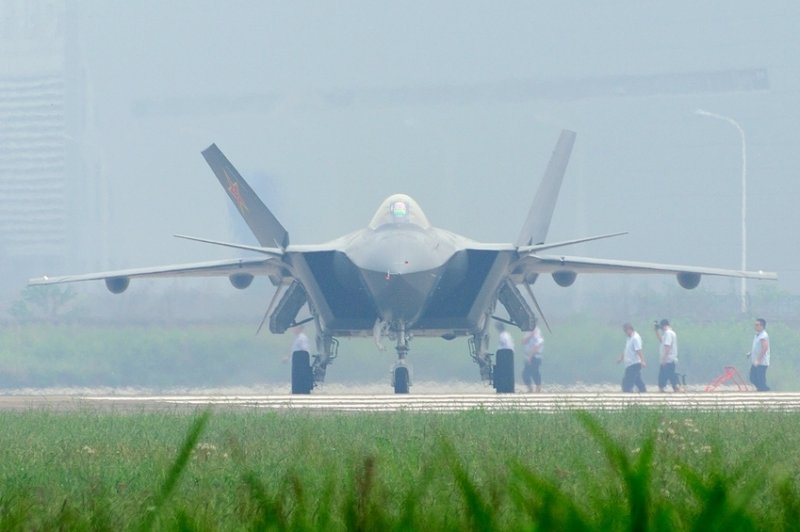
33,000 lb engines are not impressive for a 2027 jet. WS-10G which currently powers J-20 prototypes are around 32,000 lb.
So? what’s the different? why they are different?
Flanker’s canards are mainly for balancing the weight of PESA/AESA whereas J-20’s canards are mainly for maneuvering.
The yellow one is called J-15, Chinese Version SU-33, which is as long as J-20. So you guys can stop the debate now.
Can I ask, if the turning performance is depend on nothing but the L/W, what are the strake wing and canard for?
J-20’s canards are much bigger than J-15 / Su-33’s canards, plus they are squary rather than triangulary :rolleyes:
One new pic.
Poor J-20, must feel all left out after J-31 come to play.
They aren’t even in the same class. J-31 is J-10 replacement. J-20 is J-11 replacement.
look how long those bottom bays are compared to the side bays
compare them with the F-22 where they are almost the same
must mean the J-20 was intended to carry large heavy weapons internally to begin with. strike fighter not air superiority.
F-22 was designed in the 1980s when radar guided air to air missiles had around 70 km range and were much smaller than they are today. Hence F-22’s main weapons bays which carry AMRAAMs are not that much bigger than its side weapons bays that carry IR seekers. On the contrary, J-20 was designed in the 2000s when radar guided air to air have much longer range and are much bigger. PL-21 is ramjet powered with a range of about 200 km and is much bigger than AMRAAM. This is why J-20’s main weapons bays are much bigger than its side weapons bays which carry PL-10 IR seekers.
F-22 blueprints were all destroyed at the request of the Department of Defense. At this point, it would be easier and less costly to develop a twin engined version of the F-35.
In my opinion J-20 doesn’t look very proportional. Wingspan is exceptionally short for a plane this long.
just commenting on one thing here and I’m not saying anyone is really guilty of it, but I’ve seen the claim that SAC managed to design this aircraft based on the information they hacked from Lockheed everywhere on the internet.
If anyone has seriously followed SAC’s struggles in developing J-11B, J-15 and J-16, they would have less confidence in SAC’s copying abilities. China has had Su-27s for 20 years and all of the technical documentations and production line for Su-27s for 16 years and they’ve only barely managed to deliver J-11B into service for about 2 years. And based on J-11B performance in the past year, it’s hard for me to call this project a success. And that’s when they’ve got all the blue prints, production tooling, Russian produced parts. And somehow, some people believe SAC can just somehow magically reproduce an aircraft just relying on data they hacked from Lockheed Martin despite have totally different engines, aircraft material, design objectives and electronics.
Also, even though CAC and SAC are competitors within AVIC-1, they are still cooperative in the sense that they do share designs. For example, SAC is said to have been fairly involved with the J-20 project.
Politics run deeper than what is reported in the media. The Democratic party shares similar ideologies with China’s Communist party. I wouldn’t be surprise if there’s quite a bit of under the table deals between China and the US.

the resemblance to the F-35 is stunning..just the F-22 style vertical fins and the the twin engines make it look a bit different..
I second that. Wonder how much AVIC paid LM for F-35 blueprints? 😮
Su-27 has a relaxed stability design like F-16 does, which required the use of FBW. This gives it better agility than F-15. With LERX, Su-27 is like a twin-engined F-16, having better aerodynamics than F-15.
Anyway we digress…really hope to see more of this aircraft. 🙂 Btw something that gets me thinking about both J-20 and J-31. Shouldn’t they have IRST to help better opose the american 5th gens? Nothing of the like is obvious on both , but perhaps not yet since they are only prototypes as of now. What do you think , will the J-20 and J-31 have IRST?
I believe they do have retractable IRST which get deployed when the distance to a target is near enough.
Simply since it is a common term used here so often. Regarding the usual stupid Lavi-J-10 discussion I think at least by know no-one would call it a “copy” anymore, but since – at least officially – a licence was only granted for the Su-27SK to be build as the J-11, these latest J-15 and J-16 are more or less “copys” … maybe the term “reverse enginered” types would be better.
Deino
early designs of J-10 were identical to Lavi. only in the later stages was the design altered to fit an AL-31 engine
“I doubt lockheed-martin would network anything sensitive in a position where it can be “hacked” through the internet.”
This is why the Lockmart hacking incident is so embarrassing.
Off on other forums, we already have the J-31’s specifications; it’s about 11.5 meters in wingspan; announced by the ******* trucking company!
Wing loading on the J-31 is likely going to be less than on the F-22 and more than the F-35; it’s the low-end aspect of the J-20/J-31 mix.
If it’s wingspan is really 11.5 meters, then its engines cannot be derived from WS-10 / 15 but rather from the smaller WS-13. It has the same shape as F-35 but is instead twin-engined so if its engines are WS-10 sized then its wingspan should be over 13.5 meters.
Comparing the J-31 to the J-20 from the front, it appears J-31’s wingspan is quite a bit longer than J-20’s 12.88 meters, and therefore would be used primarily in the air to air role whereas J-20 would primarily be used in the strike role.


this probably means J-10s will be up for sale soon for exports! 😮
It is likely J-10As would be exported. J-10Bs are too advanced to be replaced anytime soon.
Looks like a twin-engined F-35 to me, with a much wider wingspan. Could be a J-10 replacement.