 DaveF68
RR299 was painted dayglo stripes and silver when retired to Shawbury from 3 CAACU.
It was photographed in this scheme (in colour) in 1963 – or at least the rear half of it was. In 1961, it had been in the ‘old’ training scheme of silver and yellow bands.
DaveF68The curator who bought the Beau was a proper aeroplane enthusiast (Indeed IIRC he left to go to the EAA at Oshkosh). He was also someone who would correspond with people! He was responsible for them getting P1127(RAF) XV277 as well.
Unfortunately, his successor was a ‘social historian’ with no experience or ‘feel’ for aviation. In addition, the feeling I got after that was that there was little enthusiasm for ‘military’ aircraft.
Then came the great white bird…..
DaveF68and the other traded with Norway,
Does anyone actually know WHAT it was swapped for? It all seems a bit murky, and people change the subject when the question is asked!
DaveF68I think it boils down to insurance for the boss…
Is it not an EU ruling on pilots over a certain age not being licensed for twin engined operations?
DaveF68Plenty of photos out and about on these – off the top of my head I can think of pics of Jean Batten’s Gull, Fox Moth, Ford Trimotor, Percivals etc. Unfortunately, most I know of are in books so are copyrighted.
DaveF68There has been a Press Release made and as a Journo I am sure that you have read it. The Press Release was precise and truthful, and believe me, if there was any variation on that, I would know.
Any link to that Relase Omega?
DaveF68There has been a Press Release made and as a Journo I am sure that you have read it. The Press Release was precise and truthful, and believe me, if there was any variation on that, I would know.
Any link to that Relase Omega?
DaveF68I really would like …. book leads.
Very good publication is:
http://www.amazon.co.uk/Auster-History-Aircraft-British-Military/dp/0954560566
DaveF68Its interesting that you say that as I thought much the same about the colour. However the museum are pretty certain that it has not been repainted since they acquired it in ’31. If it had been quickly touched up prior to delivery to the museum using basic stock paint at an RAF station, possibly Felixstowe, what colours might have been available?
Pre-war roundel (bright) Blue would be the most obvious candidate.
Interestingly, looking at B+W period pictures of S1596, the rear (blue) rudder stripe is the same tone as the fuselage.

http://www.raf.mod.uk/downloads/wallpapers/1920s_1930s/s6b1024.jpg
Compare to this S5, and the leading stripe is close to the tone of the top of the fuselage – and to the roundel
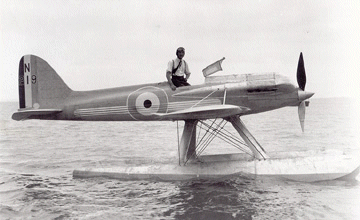
Which is what you would expect,as the order of the rudder stripes changed in September 1930.
Taking on board that the film types commonly used in the 20s and 30s rendered blues as lighter and greyer than they were in reality, maybe the colour IS genuine? Were the S6s painted in the then roundel blue colour?
DaveF68The current ‘blue’ appears to be post war RAF Roundel blue
DaveF68No crosswind, all control surfaces are neutral and angle looks OK to me.
Could it be a slow flypast or go-around?
DaveF68The bird of prey thing really seems to have been a Hawker (company or MoS) thing though.
In one of the links (also a modelling page) posted by DaveF86, there is an admission by someone that he may have been responsible for the Eagle name being related to the TSR-2 becoming a popular myth today.I really don’t see how it fits with the naming policy (or lack of!) of the day
Joe has been researching the TSR2 for a lot of years, and probably has seen more about it than anyone else. His ascertation of ‘Eagle’ was based on a conversation with one of the project team, and was the first time he had heard a ‘favoured’ name.
If you take Harrier as an example of how a name evolves. According to F K Mason, the name for a possible P1127 RAF was originally suggested in 1961. He put forward a list of names including Hawk, Harrier, Kestrel and Heron. Sir Sidney Camm favoured ‘Harrier’. He felt that Hawk could be confused with Seahawk and Heron had been used before on a Hawker design (as well as being a De Havilland name) – Mason says Camm evidently forgot there had been a previous Harrier. Camm also felt Kestrel was a Rolls Royce name.
In 1963, Kestrel was chosen for the Tripartite P1127 (and is probably appropriate for a hovering aeroplane). Harrier was retained as a name for the P1154.
When the P1154 was cancelled, and the P1127 (RAF) was ordered, it was given a ‘new’ name – Harrier. An apocrophal tale tells that this was deliberately not ‘Kestrel GR2’ so that HMG could claim it was a new aircraft and not have to pay any royalties to those who funded the Kestrel (Germany & the US).
Names are authorised by the then Air Council/Board from a list supplied by what would now be called the Project team.
As to post war policy, in Gordon Wainsborough-White’s book ‘Names with Wings’ he reveals that a 1951 Memo confirms the Air Council make the decison, and also states that previous traditions, including alliterative naming of fighters, was considered unneccessarily restrictive, and that in future each name should be considered on it’s own merits
‘Names with wings’ also gives some alternatives, from researched sources, for some of the aircraft discussed.
A 1952 memo notes that they should move away from town names for Bombers as town names were placid and stodgy. Avro wanted ‘Ottowa’ for the Vulcan and ‘ HP ‘London’ or ‘Hostile’ for the Victor. The Chief of the Air Staff wanted a ‘V’ class to follow on from Valiant. The Civil Service rep thought descriptive names should apply.
Other names considered included:
Avro – Andover,Argus, Arcturus, Atalanta, Arthur, Attiles
HP -London, Edinburgh, Hamilton, Hertford, harwell, Hostile
for other types:
VC10 – Victoria (Favoured by CiC Transport Command), Venture, Voyager, Viceroy, Windsor, Warwick, Winchester, Upavon, Valentia, Van Dyke (!!!!), with Vickers suggesting Weybridge. Sir Geoffrey Tuttle was the AVM who suggested ‘just calling it VC10″)
Nimrod – Plymouth, Osprey, Cormorant, Trenchard, Drake, Slessor, Albatross were all proposed. Mr Wandsborough-White reveals that he himself suggested ‘Nimrod’ to Lord Shackleton.
Andover – Abingdon, Tramp, Aden, Arab
It’s all fascinating stuff!!
DaveF68VC-10 in an interesting one. the designation is the Vickers post war sequential one – VC-1 was the Viking, VC-2 the Viscount, VC-7 was the final form of what is also known as the V-1000, VC-9 the Vanguard.
The then chairman of Vickers later stated that, when it came to the VC-10, Vickers just got tired of finding new names.
When the RAF bought some, a number of names were suggested, but it was decided to just keep it as VC-10 on the suggestionof one of the Air Marshalls on the committee. A comment was also made that this would ‘please BOAC’.
DaveF68Interesting, if slightly depressing, topic!
Re the Ta152, I think the Smithsonian have at least part of one in storage…I could be mistaken though.
They do, Werk No 150003. They also have parts of a Betty (and there are a few of those in jungles as well!)
DaveF68I have discussed the extend of Crown Copyright with MOD Directorate of Intellectual Property Rights Copyright Unit (DIPR-CC). Currently the wording of what constitutes CC material is, that the content should have been made as part of the creators official duty.
However, in the states during WWII everything created by servicemen while on duty, is a work of the United States Federal Government and thus now in public domain.
DIPR-CC was unable to inform me, if this US style wording was used for material produced by British servicemen during WWII.
Since the nation was at war, Im inclined to think that it was. Placing all material produced while serving under Crown Copyright. But its nothing I have been able to get clarified.
Don’t disagree, but the point is that some of the material in IWM or RAFM posession wasn’t taken by Servicemen, but by Press photographers or private individuals


 Sign In







