A Naval Flying Flea experiment… Thirties vintage… USA, perhaps?
The A-26 is a fast and maneuverable airplane. Very big difference between the DC-3. That’s the point.
However, Douglas aircraft, generally are “over-engineered” – and the FAA statement seems to support this. Mr. Basler’s relative success would appear to bear this out, no?
In a former life I was a program(me) manager on the wing attachment bits for both DC 10/MD-11 ‘s and similar-sized Boeing aircraft. the Douglas piece consisted of two huge Alcoa forgings Huck-bolted together with a shear plate in-between. The Boeing part was a “simple” machined Alcoa forging…
So, for long life – my money’s on Douglas. If one has the requisite altitude & velocity , I have no problem with the idea of an aerobatic Gooney.
As an aside, I had a Brit colleague, ex-Hatfield, who felt that G. deH should have ended up in the Old Bailey for the Comet windows.
Where’s John? :confused:
Thanks, Zulu Romeo… wonderful to see so many airworthy!
Okay, so she appears to be RCAF 23231 – Milberry and the City of Palmdale differ in details of service…
Listed by the California site as a NAA Sabre – but that’s typical.
Built 3 August 1954,
TOS 3 September, Service w/ 413 and 422 Sqn. RCAF
SOS – 1960
Registered N231X 1972
Registered N91FS 1982
Donated to Airpark – 1998
N91FS is likely a Canadair Sabre Mk. 5 – after SOS RCAF, many Sabres were purchased by Flight Systems for drone conversion and chase plane duties.
I’ll pore through Larry Milberry’s book to find her history, if you like?
You haven’t. No need for apologies.
Moggy
Moderator
Amen.
Francisco – there are a great many truly decent enthusiasts here – sometimes it takes time to sift through the Bravo Sierra, but in the end, the majority of us are here to learn more about our obsession. This thread was just FINE, in my humble opinion.
Keep coming back!:cool:
That IS snow in the photo, I’m guessing? π
Has this one stumped the assembled experts or is it just a lack of interest?
Not being an expert on anything, here – and certainly lacking in much GenAv knowledge – I was thinking European… perhaps Italian or French – but I couldn’t find anything that had such “crude” rectangular tail-booms. Generally, those Latin blokes tend towards the sensual curves, eh? π
It looks like it has an American-style “flat-four” engine, rather than a Gypsy/Renault-type inverted inline – so it could be US, or even South American?
Next one-
Latecoere 550? Early one? Later ones had “normal” cowlings.
No it’s the Gaullaudet Pursuit. PW.4
John
John, what’s the background on this one? I see it never got past the static load testing stage – but who were these Gaullaudet chaps?
I’ve resisted the temptation to post an image of another avion FranΓ§ais – so have a go with this.
Damned time-zones! Pobjoy Niagaras… Cool! π
Truly a beaut, that model… Greeks bearing gifts to us all, eh? π
I thought the mid-upper sitting on the fuselage mock-up was a Martin.
As I recall, CWH had restored a Frazer-Nash turret, because Andy Mynarski actually flew in a British-built Lanc – and the “purists” wanted to insert it into FM213. I remember MUCH discussion over this… Messrs. Sobering, Randall & Etheridge would be the ones to say definitively (if they’re still with us?)
In the end, CWH used a Martin for many reasons:
a. It is the correct turret for FM213
b. The modification costs in time & material to insert the F-N were absurd – if the aircraft was to fly that year.
c. The Martin profile uses less fuel – a BIG consideration when running an aircraft with four thirsty Merlins.
Now, this was about 1986… and I haven’t visited Mount Hope since 2000, when I moved to the Ottawa area – so you may indeed be correct.

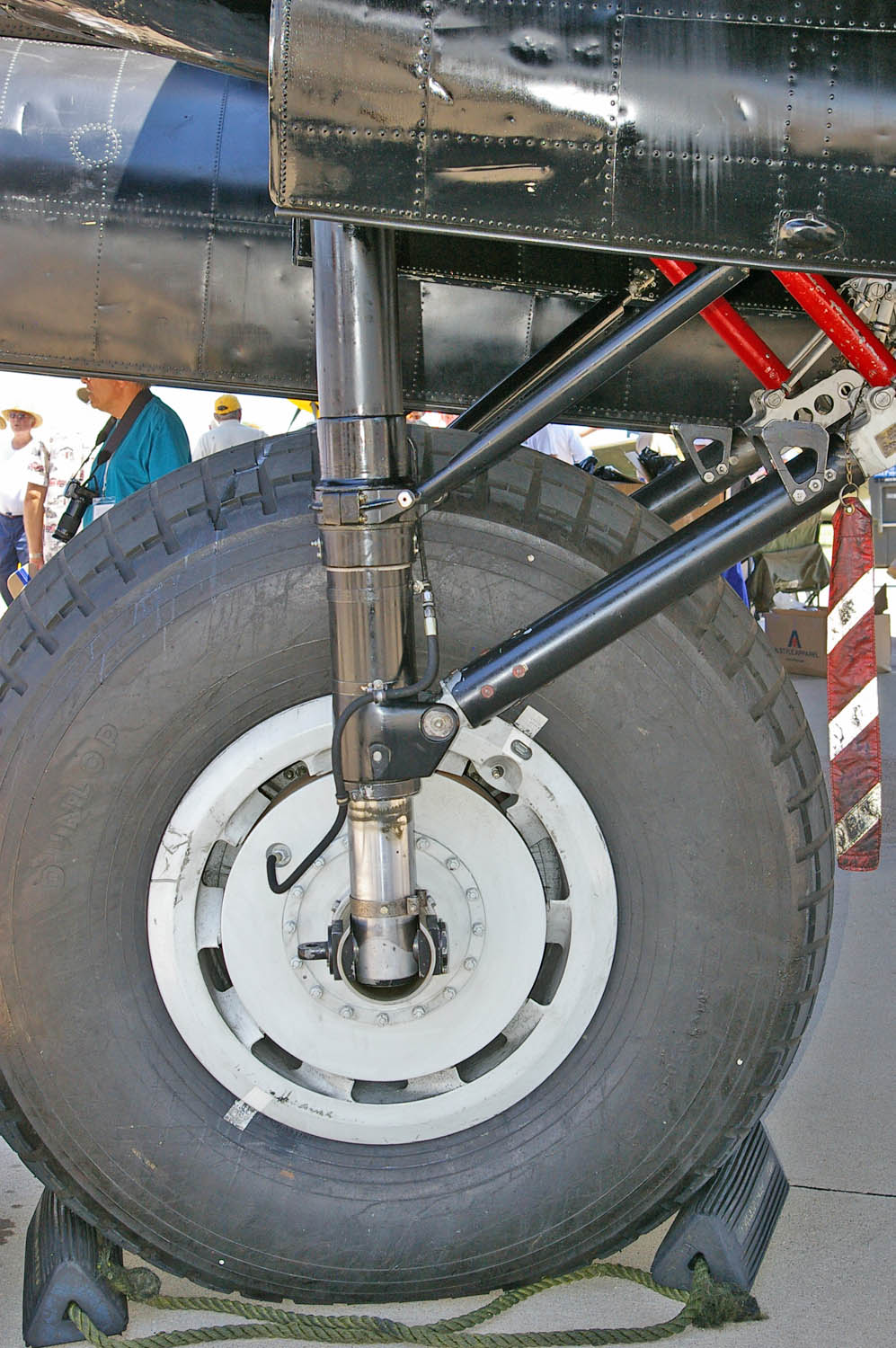
For the undercart quibblers:
Apologies for size… it shows the detail, however. You’ll note the angle of the dangle, herein?