 pagen01
I can’t view your pic (this PC), but there are two thin fuel vent pipes that run down the trough between the engines, they terminate between the jet pipes, the stb’d ones are usually hidden by a flat ECM plate, and similar with the port ones on some aircraft. The jet pipes vary between 200 and 300 series engines, which may answer your second query?
pagen01Excellent info and pics on the Christchurch wing of DH there Dave, I should also mention that W.A.Tamblin was that divisions’ chief designer and he essentially turned the D.H.110 from ‘technology demonstrator’, to a service prototype and production aircraft.
Jock Elliott was the chief test-pilot for DH Christchurch.
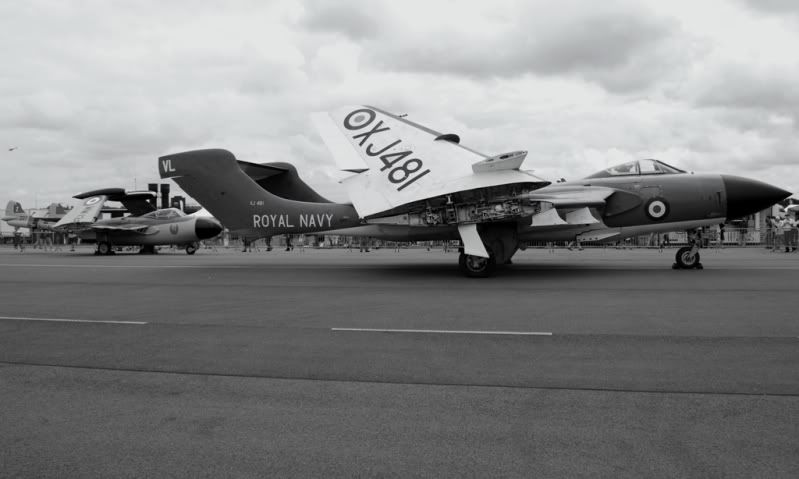
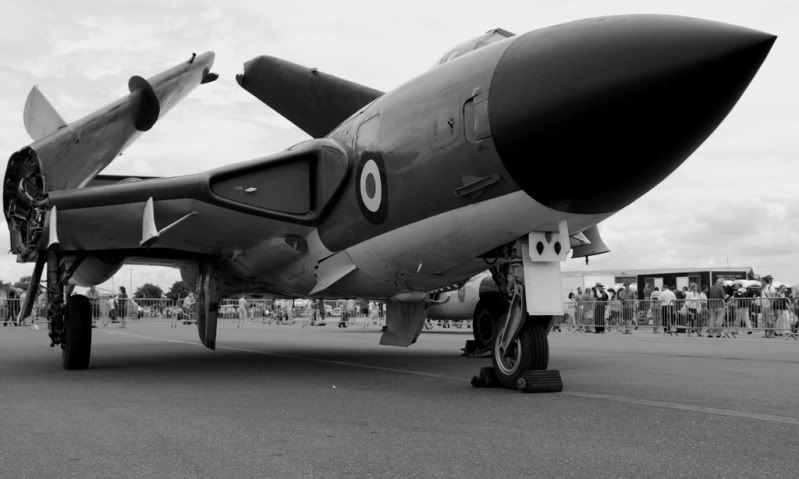
This is one of only two FAW.1s preserved (the penultimate pre-production aircraft), XJ481 at Yeovilton.
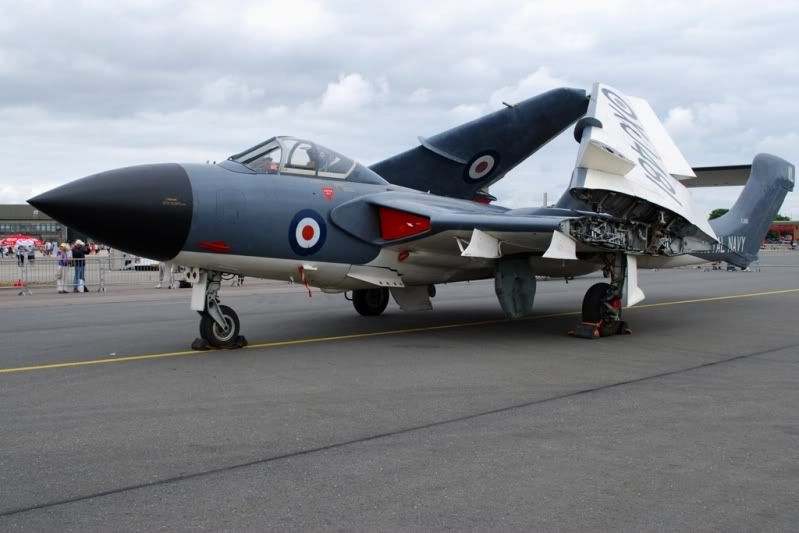

And FAW.2 XP924 at Yeovilton.

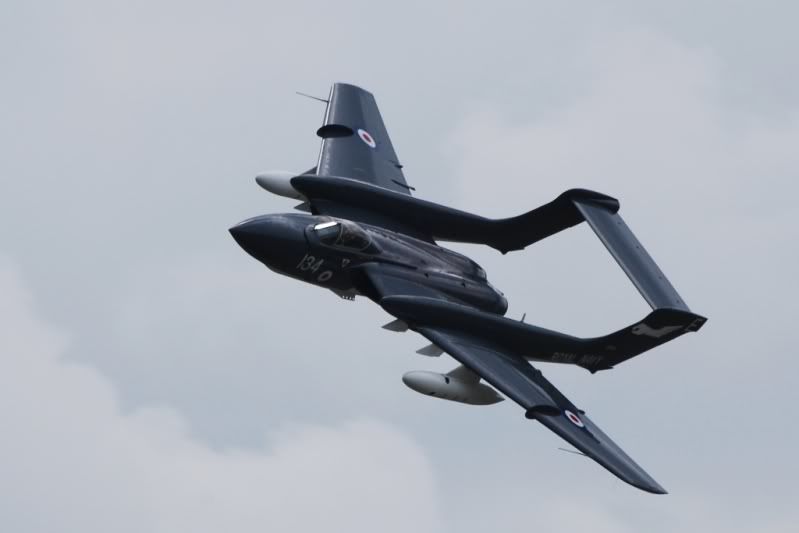

BTW please feel free to add pictures or stories, I’ve just polished of the last bit of my Vixen cake!
pagen01This goes against mine and the threads grain really, but the brand new Airbus A400M (RAFs future transport) is currently flying circuits at Cardiff Airport, quite a sight and sound, and a very impressive climb performance!
pagen01The Bristol Belvedere always struck me as one of those types that the RAF had to opertae because someone Briritish had built it!
It was derived from the Bristol 173 which in simplistic terms was the tandem version of the Sycamore, it was powered by two Leonides Major piston engines, the 192 Belvedere being powered by Napier Gazelle turbines of course. I believe it was the Avpin starter system that was the potential cause of a sudden fire in the upper cockpit area.
Also worth remembering that the US were heavily involved with tandem helicopter layouts at the time of Bristols’ efforts, especially the company Pisecki which became Vertol and eventually taken over by Boeing to become Boeing Vertol – which brings us neatly to their Chinook.
pagen01Simply stunning Elliott, many thanks for sharing!:)
It looks a super and well mixed show.
pagen01The latter points about deletion of guns/cannons from XF828 and retaining gun bays in all Sea Vixens are incorrect.
Thanks for that detailled info XF828 (sounds like you would know!), I have had to be necesarily brief with the D.H.110 story here.
I certainly didn’t mean that XF828 didn’t have the cannons, so I will have to rewrite or clarify that bit, I do mean that the decision to go with a non gun armed production fighter was made at about that time.
I think I’m correct in saying that all three 110s either had fitted, or had provision of, the cannon, indeed WG236 had three cannon/dummies fitted when it crashed. XF828 has been pictured with both a three and a four gun fitment.
I can’t be certain as I’m away from my sources & APs, but I thought that the production machines did retain the gun bay mounting structure (possibly wrong term?) complete with the distinct four cutouts under the main cabin floor, the high pressure air bottles and airbrake were fitted in the rear of that space, and the rocket cells in the front.
Hi Ben, thanks for your words (good to see you back), it is a cracking shot and would love to know the source!
pagen01Hatfield to Christchurch – Rebirth Of a Naval Fighter
During mid 1953 it was realised by the Admiralty that they were woefully lacking in a new all weather fighter design to replace the already outdated D.H.112 Sea Venom design then entering service, the Fairey N.14/48 had somehow lapsed and various DH.116 ‘Super Venom’ projects were becoming outdated. In late 1952 Specification N.139D was issued on behalf of the Navy calling for an all weather and low-level attack aircraft, suddenly the 110 was back in favour with their lordships, it had been originally designed for the earlier part of the role, was now well established through flight testing, and an airframe was immediately available.
WG240 was now set aside for minor FAA and carrier trials work and gained the then current Extra Dark Sea Grey and Sky finish, and more crucially redesigned and strengthened wings. It first flew in the new ‘naval’ layout on the 17 June 1953, again in the hands of Cunningham and Fairbrother, this wa sthe types first flight since the
In the following June it first flew with an all moving ‘all flying’ tailplane, becoming the first British type to be so equipped. The aircraft was also progressively modified to trial the various complex powered control & feel systems then being introduced aswel as differing wing modifications, such as drooped cambered leading edges and fences, to assist with low speed and approach handling, and Dunlop anti-skid braking – all vital for FAA use. Although the second 110 was used for Admiralty trials apart from the addition of longer stroke undercarriage units it was not navalised in any respect, however it did carry out ADDLs at RNAS Ford before conducting touch and go’s on HMS Albion with DH Christchurch’s chief test-pilot, Lt Cdr Jock Elliot in September 1954.
A semi navalised prototype was ordered in the short term, it wouldn’t feature folding wings, but did have the hooks and strengthened undercarriage to allow full stop and catapult take offs from a carrier. It was ordered in February 1954 and by late the same year the naval 110 became known as the Mk.20, this strangely (or perhaps still a hope for an RAF production version) reflected the then in vogue designation system whereby a naval version of an RAF production aircraft was commenced at 20, ie the Sea Venom FAW.20 being the FAA version of the RAF Venom NF.2.
The whole naval D.H.110 programme had now been transferred to Christchurch, Dorset, where W.A.Tamblin, the DH chief designer for that site, became responsible for detail changes to the new prototype and production aircraft. It was from there that the new prototype, XF828 designated the Mk.20X, made its first flight on 20 June 1955 at the hands of Jock Elliot and John Allen.
The aircraft itself still looked pretty much the same as before, however it was now becoming an integrated weapons system and a far more complex beast, especially in regard of hydraulic control systems. The added powered nose wheel steering and ‘Maxeret’ braking, were novel features at the time, it also had provision for cannon fitment (as did the previous aircraft), all production Sea Vixens retained the gun mounting structure. The British GEC AI.18 radar was chosen for production aircraft, and the dark, cramped, operators compartment required by its dim and twin screen display would become an issue for service observers.
The aircraft was powered by the service representative 11,230 Ib Avon RA28s, and introduced for the first time the distinctive ‘V’ windscreen layout, this replacing the completely frameless moulded affair of the first two aircraft.
It performed the first carrier arrested landings and catapault take-offs of the type from HMS Ark Royal in April 1956, at the hands of Cdr S.G.Orr of the Naval Test Sqn, A&AEE, based at Boscombe Down. At the same time he was also performing the same task with the Supermarine N.113, which of course went on to serve alongside the Sea Vixen as the Scimitar. XF828 also went on to test fire de Havilland Blue Jay (later Firestreak) guided missiles and conduct inflight refuelling trials.
Both remaining DH.110s would go on to serve as valuable naval research aircraft, WG240 made its last of 440 flights when it landed at Christchurch in May 1957, it ended up at Arbroath and Manadon with the RN Maintenance Schools before being broken up in 1965. XF828 made its last and 575th flight on 14th October 1959 when it arrived at RAE Bedford, before it was transferred to the School of Aircraft Handling at RNAS Culdrose, and finally perishing on the fire ground there by 1978.
Aside from John Derry and John Cunningham, Ron Clear, John Wilson, Chris Capper, Wg Cdr P.Barlow and Mr R. Horsley were all regular pilots of the D.H.110.
Sea Vixen For Service
Meanwhile procurement of the DH.110 Mk.20 proper had taken place to spec 139.P in early 1955. Rather than ordering prototypes it was felt that there would be much less delays to the programme if the first nine aircraft (XJ474-‘482) served as pre-production examples, each one testing a different facet of the designs’ functions, for example ‘476 tested radar and weapons. The Ferranti integrated weapons, instrumentation, and sighting systems, and guided missile armament, the guns/cannons being entirely deleted, were firsts for a British combat aircraft.
Indeed XJ474, the first Sea Vixen, was infact the first fully fully navalised aircraft in the 110 series (complete with hydraulic folding wings and radome), it made its first flight from Christchurch on 20th March 1957, the aircraft officially became the Sea Vixen FAW.1 in the same month.
The history of the Sea Vixen in Royal Navy service is well known, it entered front-line service in July 1959, trialling with 700Y flight and serving with 766, 890, 892, 893, and 899 Squadrons until January 1972. RNAS Yeovilton was the sole land base and became synonymous with the Sea Vixen, while the type served on HMS Centaur, Ark Royal, Victorious, and Eagle. It was operated in two main versions the FAW.1 and latter the FAW.2 which featured boom extensions with increased fuel capacity, and the more capable Red Top missile, replacing the original Firestreaks, while the internal retractable rocket weapon packs were deleted, and production of aircraft latter moved from Christchurch to Chester.
Some aircraft went on to work with FRADU, Flight Refuelling Ltd at Tarrant Rushton, and some of the research establishments, notably at Boscombe Down and Llanbedr.
In hindsight the aircraft was brilliant achievement for a British carrier based fighter, when it first joined the FAA in 1959 it gave it, very briefly, a capability in one airframe that no other naval air arm possessed, indeed it was on a par with RAF equipment of the time. It had the weapons and control integration and it offered a variety of roles from interceptor, reconnaissance, nuclear strike, buddy tanker aircraft. It was a tough airframe with superb handling, it wasn’t supersonic in level flight, but its transonic performance and handling was excellent, and even recently this was used in its favour when XP924 provided combat training for current RAF Typhoons. The Vixen had a notable accident rate in service, it is hard to fully attribute this to the design, as it entered service in a period of rapid understanding of operating large jet aircraft off carriers, however it had overly complex fuel and electrical systems, and at first poor observer emergency egress sequencing (until introduction of command ejection), which didn’t help matters. The accident rate certainly declined in the latter years of service.
However it must also be remembered that the McDonnell Douglas F-4 Phantom had already flown in early 1958 (only a year after XJ474) and was about to enter US service in late 1960. This was a far superior aircraft, in performance, crew layout, role diversity, and more, it truly elevated expectations of what carrier based combat aircraft could achieve.
In hindsight it is easy to be harsh about the Vixens timing into service, but it was a victim of indecision, having been cancelled entirely by the RN in the late 1940s, the RAF in the early 1950s before finally being taken up by the Navy again in the mid 1950s. The problems that de Havilland were having in that dangerous and fast moving period certainly didn’t help either, they were witnessing awful tragedies befall some of their high speed designs, namely with the 108 and Comet, the D.H.110 wasn’t imune from this with structural weakness in the outboard wing structures, and the poor crew layout counting against it in RAF service. In theory the Sea Vixen should have been ready for service in 1953, but even if it had it wouldn’t have been the complex integrated weapon and radar interceptor that it had become by 1959, which in itself provided the RN with a tremendous stepping stone to the next generation of aircraft.
Thankfully Sea Vixen XP924 still serves as a flying reminder of this great British aircraft.
Below, Sea Vixen FAW.2 in action (unkown source)
pagen01Nice find, certainly appears to be the same as the items in this pic of Mawgan towers’ VCR c.44.
pagen01Are there any recent external pics of ‘194?
pagen01More discussion, though no clear conclusion, here:
http://warbirdsforum.com/showthread.php?t=4576
Not a lot of sense being spoken there, the only thing of value being the Shark pilots’ account of testing.
SteveP puts if quite snappily, at a very basic level why persist with two types in the same role, and the associated spares support etc (at a premium on a carrier) that entails, when one design was more reliable and dependable than the other.
pagen01That’s superb work! Maybe Tangmeres’ grip was reunited with it?
pagen01Thanks for your reply Peter, it seems then that the threat of rockets and missiles was put in low order in the early post-war years, which seems surprising given the damage that they actually caused the UK during the late war period.
pagen01Re your 2nd para of post #8, the Admiralty were nothing to do with these types at inception, but I would agree that it seems unlikely that the construction element was that important, though in actuality quickly patching up a Stringbag during battle must have had a small advantage.
Possibly the Swordfish/TSR.II was in too much demand for re-equiping the FAA sqns to be considered being offered to the RCAF/RCN at that time, though obviously later on it was used well in Canadian service.
JDK raises good questions about overseas licence producing of British types in another post.
I do get the impression that the AM didn’t really know what to do with the Shark, a couple of different specs and orders were later raised, it seems in an attempt to justify production and a use for it in service. Production was in small batches at first and many later examples were delivered straight into storage. Maybe passing on the type to Canada was convenient, with their services benefiting from the Pegasus powered examples.
pagen01Did the FAA just prefer Fairey products? Blackburn didn’t have any success with the FAA in the period of the Shark to the Buccaneer.
There’s very little proof for this, as I mentioned above the Air Ministry came up with the S.15/33 requirement that both the Shark and Swordfish fulfilled, it was pre the Admiralty control of the Fleet Air Arm (May 1939).
Both Fairey and Blackburn were always renowned for their carrier based and FAA related designs, each was as successful as the other in obtaining orders, though each were as capable as coming up with rapidly obsolete designs aswel.
The Blackburn order for Skuas and Rocs was a major success at the time of issue, and shows little favouritism in favour of Fairey. As it happened they became obsolete very quickly, the Fulmar wasn’t hugely successful either but the Firefly became more and more successful (due in part to RR Griffon success).
pagen01Excellent report and pics of a seldom seen collection, thanks HP81.
I’m particularly interested in the Meteors so merci Spitphil for posting your lovely shots of them while in service.


 Sign In







