 MConrads
Thanks Santi.
Once NFR-90 died Spanish Navy started de F-100 program that in its early stages had strong resemblance with some of the NFR-90 designs.
It even comes better. This (final) APAR version of the F-100 strongly resembles the Baseline Design of the NFR-90.

Here is the evolution at a glance: http://i32.photobucket.com/albums/d28/MConrads/SFFG-100LVARODEBAZN00.jpg
The early F-100 appears to feature Smart-S on the forward mast and Smart-L aft – although I could be wrong?
Possible since the original plan for the F-100 as a replacement for the Gearings called for a more ASW than AAW oriented design. However the Spanish, Dutch and Germans very soon after the cancelation of the NFR-90 project formed the Trilateral Frigate Agreement for the common development of their future ships and that agreement already called for a AAW optimized design. What I want to say is: It might be something else completely :-))
Actual F-100 has 133.2 m at waterline and 146.7 m overall.
Perhaps that´s where the error comes from than.
If anybody has any more, please let me know.
Regards.
MConradsHi TinWing,
thanks for answering my request. Is their a chance that you could reproduce the hole article here? Or at least share any more information from it?
If I take the baseline design with a waterline length of 133m I calculate an overall length of 143,24m. That would be very much in line with the real life F124 and LCF classes and even make much more sense considering the given displacement of 5,400t.
But who the f@+* gives the waterline lengths anyway? :-))
Regards.
MConradsHi Santi,
thanks for the great picture. It has shares strong similarities with the Baseline Design. Any info given with the pic in Friedmann´s book?
Regards.
MConradsSummery of above mentioned article:
“Beginning in the 80s of the last century, eight NATO navies agreed that a common maritime weapon system would be possible despite their different requirements and ideas. The necessity arose due to the growing cost of modern weapon systems and the increasing strain on defence budgets. Britain, Canada, France, Germany, Italy, the Netherlands, Spain and the United States agreed to develop and build a joint frigate for the tasks and challenges of the 1990s.
The goal that all parties had in mind was the common financing, development and manufacturing or purchasing of larger quantities as part of a common frigate programme.
As a first step, a pre-feasibility study was commissioned in 1981, in which 132 companies from nine nations were involved. The results of the study said that the efforts for development and construction of a joint frigate successfully were promising and carried no special risks in itself. The study concluded that the demands of the navies could be met with a ship of about 3,500 tonnes displacement, and that both the platform and the system architecture could be made with sufficient flexibility for different equipment, weapons and sensors.
Now it was back in the hands of the eight participating nations to agree on a binding common agreement on the basis of that study. This led to the Memorandum of Understanding (MOU) “Feasibility Study of a NATO Frigate Replacement for the 1990s “. This feasibility study included the questions of work share, cost-sharing and the financial balance between the partners. In principle however as little money as possible should flow between nations. The scope of work for the study included the design of the ship. The idea was that although most wanted an identical ship design, the ships should also have enough space and weight for specific national needs.
The study was concluded in October 1985, less than 18 months after the signing of the MOU. The result of the 10,000 pages strong study was very positive and promising. The concept study closed with no fewer than 18 different design variants for multipurpose frigates of about 4,400 to 5,000 tons displacement. The number of different design variants included the various national needs for their own equipment.
Two more years passed, until all the political and administrative avenues for further work at the NFR 90 were paved. The last signatures for the new MOU “Project Definition Phase” were signed, in January 1988. The conclusion of a corresponding contract with the industry again took a year. The aim of the definition phase was to draw up rough specifications and a reliable cost framework for the follow-up phases. Both should serve the partners as a basis for their decision on further participation in the programme. Fine specifications and a binding building contract would not be necessary until the planned detailed design phase began which would have been agreed upon in a separate new MOU afterwards.
Due to those delays interest faded in many participating nations. German that was a driving force at the beginning of the definition phase decided in 1987 to build four frigates of the F123 class on its own, reducing the planned numbers of NFR-90 frigates from 8 (7) to 4.
The most intensely fought technical subject initially was the question of the future anti-air weapons system. There were two candidates to choose from:
o The US- industry dominated NAAWS (NATO AAW system) and
o The mainly European system called FAMS (Family of Anti-Air Missile System).
Both systems were still in a very early stage of development. It was foreseeable however that there would be mayor differences that would have significant influence on the ship’s design. USA, Canada, Germany and the Netherlands had decided early for NAAWS. France and Italy were firmly connected with FAMS, while Britain and Spain were still undecided. The bottom line was that in order to cover this disagreement the design would need to come in at least two versions.
In addition, there were a number of national variants in which different equipment needs of individual nations came to bear. Germany, for example required that the ship had sufficient weight and space reserves to integrate a planned towed sonar array; France and Italy wanted to use their own designed and build SSM while Britain was very keen on CIWS due to their recent experiences in the Falkland’s conflict. However these national variants endangered the success of the overall project in no way. Other outstanding issues that were more or less passionately debated at the time concerned the following areas:
o 4 or 5 decks
o Crew numbers
o CODAG or CODOG propulsion system
o Acoustic signature
o Application of shock standards
o Weight reserves
o Longitude stability of the ship
During the Baseline Review in Hamburg in September 1989 the representatives from eight defence ministries were presented a design for the NFR 90, which found the basic consent of all parties. Of the presented alternatives the PMO recommended that the so-called “Baseline Ship” should serve as basis for the further work in the next phase: The”Detailed Design Phase”.
The presented Baseline Ship was a 4-deck vessel with three islands and the following main details:
o Length: 130.0 m
o Width: 15.9 m
o Draft: 4.8 m
o Displacement: 5,400 tons
o Drive power: 30,200 kW
o Speed: 28 knots
o Range: 5,000 nm
o Electrical power: 4 x 1,200 kW
o Crew max.: 230 soldiers
At this stage the construction of 59 frigates was planned. The price for a frigate, of course depending on the respective equipment variations, was in the magnitude of 350 million ECU. This corresponded to 730 million DM in 1989 currency value (about 365 million € today). At the end of the baseline review it was agreed that in a transitional phase, in which the definition results should be evaluated and the political decisions of individual nations should have been prepared and submitted, the project was to continue and outstanding design issues should be attended.
This transitional phase never came. Shortly after the Baseline Review France, Britain and Italy surprising declared their withdrawing from the program. The remaining nations soon followed. The hole program was finally terminated in January 1990.
Chronology:
1979 founding of the Project Group 27 (PG/27) with CA, FR, GE, IT, NL, UK, US
1980 adoption of the draft NATO Staff Target (ONST) for a joint Frigate
1981/1982 implementing the Pre-feasibility Study for the NFR 90, SP candidate
1983 adoption of the NATO Staff Target
1984 signing of the MOU for Feasibility Study
1985 completion of the final report of the Feasibility Study
1987 signing of the MOU for the definition phase NFR 90
1988 conclusion of the contract with the ISS on the implementation of the definition phase
1989 Baseline Review in Hamburg (Sept.)
Abandonment FR, IT and UK from the program (Oct.)
GE and SP exit from the program (Dec.)
1990 termination of the programme by CA, and US, NL (Jan.)
The plan, but not implemented:
1991 completion of the definition phase
1992-1999 Fine specification, design and construction of the FOC (First of Class)
1996-2004 construction of the four German frigates NFR 90″
MConradsHi,
interesting how you have placed CV-90’s in the davits of the German vessel, I wasn’t aware that Germany had any of these assult vessels
No, sadly we don´t operate them. But since that was a fictional German version I thought I could indulge myself. Besides it fits my personal version of the F125.
He’s shown what looks like RAM where the builders show VLS, but I think he should be allowed a bit of artistic licence.
Thanks. Besides if that would really be build for the German Navy RAM would be the choice since my guess it that the vls cells depicted aren´t mk-41s but rather the Umkohto ones.
Easy, extend the box mounting and cover the anchor winchs over or move them altogether. The Barrel does however present a problem as it would bury into the waves in a rough sea. Again I can only offer the thought of the Stealth 127mm gun.
Extanding the box mounting is the way to go. Problem is that this would require a “redesign” (strange word for a ship that isn´t really fully designed yet:-)) since moving the mounting forward would also move the below decks arrangement and the weight of the hole system forward.
Still I wouln´d worry about the barrel since it is still way behind the bow. BTW the stealth gun you mentioned has an even longer barel than the older version of the gun:-))
Regards
MConradsHi;
MConrads: Mate as always nice work, but you made a booboo with the Perth Class mate.
Our old DDG’s didn’t have both the Ikara system and CIWS at the same time and only two vessels (HMAS’s Hobart and Brisbane) ever had the CIWS system fitted- Brisbane did two tours in the gulf where as Hobart only did one.
I’ve included a pic HMAS Perth which shows the Ikara system and its location (in yellow) and where the CIWS system was install on the class (in red).
I was waiting for that one:-)) At least according to my Combat Fleets 1993 edition for a very brief time (from the top of my head I think it was six months) one or both of the CIWIS equipped ships still carried the Ikara system. Just imagine the drawing repersents that timeframe:-)))
Glad you looked so close:-)
Regards.
MConradsHi,
By the way, (hope this wouldnt bee too much offtopic) I have heard that the German navy tested the finnish Jurmo type of small assault boat (similar in size to the Strb90) and atleast in here it was reported that the bundesmarine was statisfied with the type and found it comparable to bigger vessels.
By bigger vessels they were refering to the CB-90. All I could find is that the test with FGS Frankfurt a.M. were satisfactory. If a procurement will spring from it or those test were merely to see if Finnish forces could operate from the type 702 EGVs in a European Battle Group I simply don´t know.
Regards.
MConradsHi,
“I am looking forward to lot’s of nice pictures ;-)”
Well you should have them all by now. Nice to be back (though it is only on weekends through my office connection:-((
“Perhaps one day this is the first German flattop?”
My thoughts exactly:-))
“which explains that that deck is intended for multiple roles, & one use is as a backup helideck in the event of the lift being unusable.”
like this:
“being able to take 155mm arty”
Yeah, however I tried to place a 127mm gun on the bow and it somehow was too big. Perhaps it needs to be slightly redesigned for that.
“You can wheel helicopters straight out of the hangar onto it.”
That is the only real weakness I can spot. It only has one lift.
“Damn, you’re good!”
Thanks a lot. I just wished that TKMS would be that forthcoming with material for all their designs.
Regards.
MConradsI am flattered. Always like to be missed.
BTW. Any suggestions about making the shipbucket more easy to use?
Regards
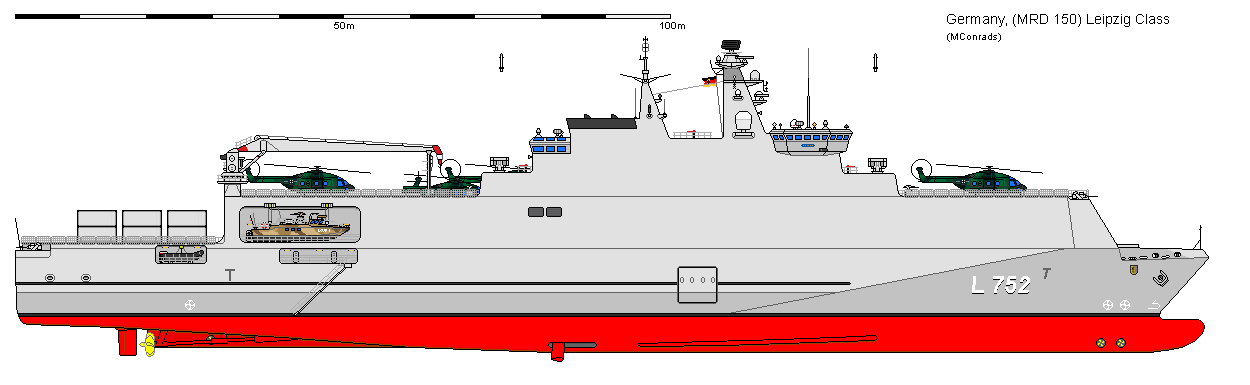
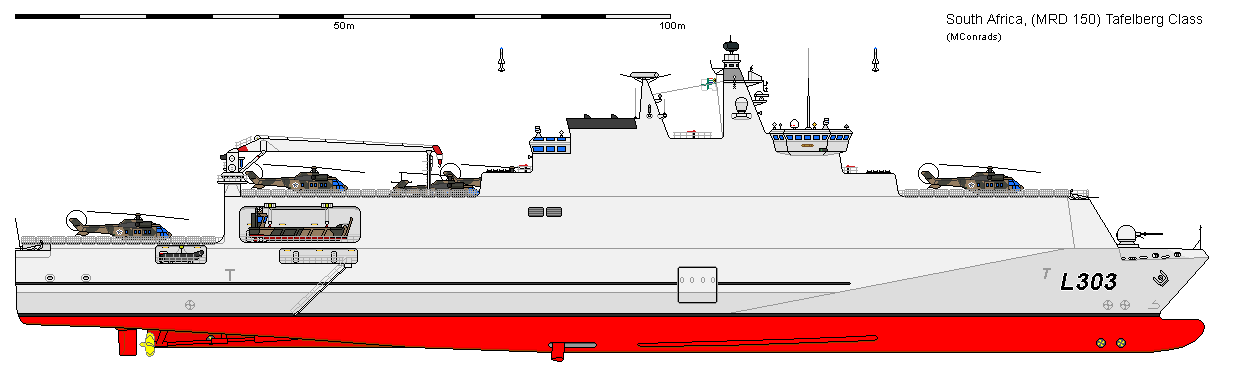
MConradsHi,
just finished my take at the MRD 150.
Enjoy & Regards.
MConradsHi,
The RAN is still pushing for two hangars, but I don’t think thats really possible without a wider hull, which suggest an expensive redesign, costing much $ and invalidating the reasons the F100 was chosen.
I am no engineer but I don´t think that the hull needs to be wider to accommodate two helicopters. Compare the width of the F100 with that of the F124 that has two hangars.

Problem is (as you can see here) that the space next to the single hangar is occupied. Some of that would need to be relocated somewhere (meaning redesign! Don´t know how big an impact that would have on the overall design though). MihoshiK proposed to lengthen the forward part of the rear superstructure and putting the boats on top of that (yea, even more top weight!). Suggestions?

Regards.
MConradsTake a look at this thread:
http://www.whatifmodelers.com/forum//index.php?showtopic=15355&hl=type+19
Regards.
MConradsHi,
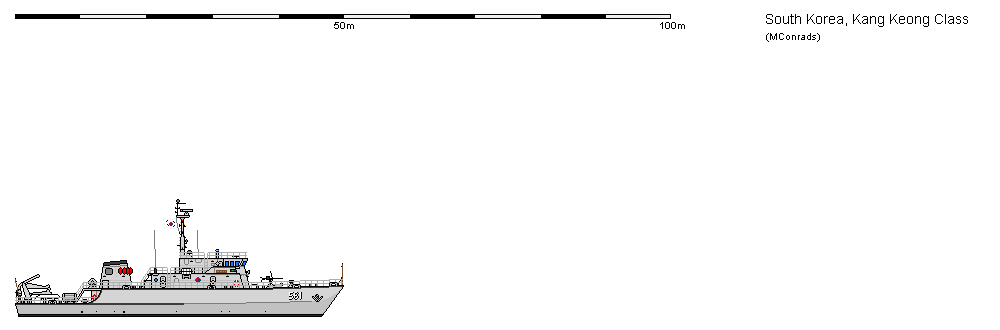
ok since nobody is really interested in those older drawings, here are some more Lerici derivatives: both modern South Korean MCMVs. Since pictures are scars I hope I got them right. If someone spots any mistake, please let me know:

Regards.
MConradsHi,
I said it before and I gladly say it again. That is a superb detailed and wonderful drawing. Greatly done.
I´ll mail you some pics of that Indian ship.
Regards.
MConradsGlad you don´t mind:-))
Let´s start off with some German build MCMVs than. First is the former mine sweeper MS343 Hameln class of which 5 were recently converted to mine hunters MJ333 and 5 to mine drone control boats for the Troika simulated mine sweeping system (depicted):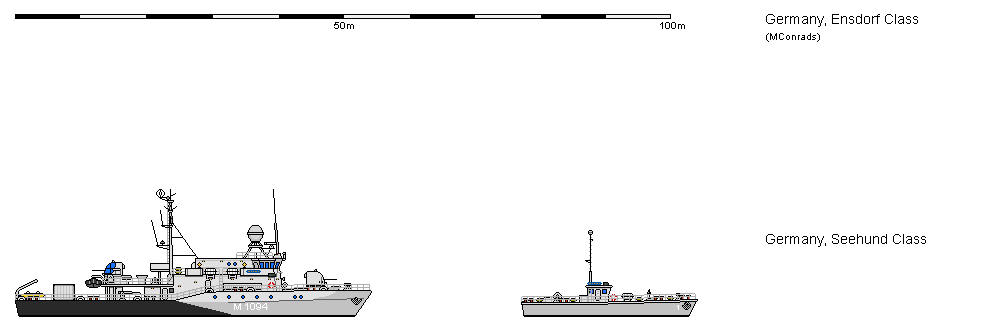
Next is the mine hunter MJ332 Frankenthal class of which two were sold to the UAE, four will be converted to serve as for missions of the naval protection forces from 2008 onwards and one will be converted to serve as clearance diver employment platform. It is depicted here with the planned but canceled “mine hunting 2000” remote operated SWATH drone called Seepferd (see horse). Actually those would have operated with the above mentioned converted MJ333 class: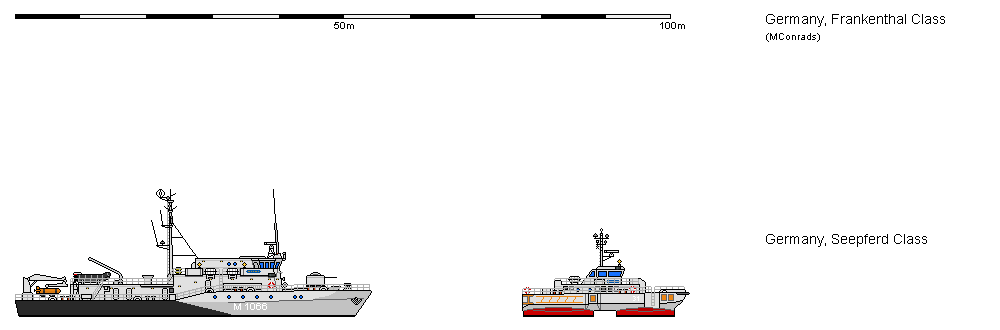
http://s90.photobucket.com/albums/k279/shipbucket/?action=view¤t=UAEMHCFrankenthal_1.gif
And sadly the only export success for this unique modular design, the Turkish MHV-54 Alanya class: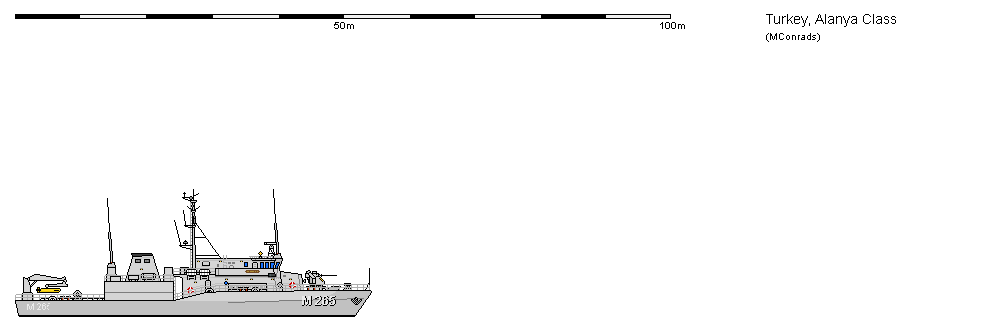
Enjoy.
BTW. if someone has a decent line drawing of the USN Osprey or some nice shots of Singapores Bedok class (especially from the rear section) I´d greatly appreciate that.
Regards.


 Sign In







