PLA-MKII
Engineer not, but turbofan engines were part of my studies
in any case, I can only talk about data I’m given. I haven’t access to classified data on the WS-13 but considering what we’ve been given (wiki, for what it’s worth) one can draw some logical conclusions.
Now, if wiki is wrong, the conclusions may be wrong as well… it all depends what’s not right and to what degree… it can be better than stated, or worse..
another source of information was an interview by a snecma engineer who explained that, even more than 20 years after having started copying them, the chinese copies of CFM-56 had much lesser mtbf than the french-built ones because of the lack of technology for hot parts (it is all about specific materials chemical treatments that you can’t just guess by looking at a finished part). For having worked in a company who did it for both Snecma and General Electric parts for Air France’s maintainance, I can tell you it’s not something that you can just improvise with, so what he said sounded quite right and that would also support the fact that even today, a high performance engine like a fighter one may be lacking in that specific domain
Thank you for that answer, I must say from the little aerodynamics I have studied it is definitely not that simple, given that neither you or I are technically qualified to comment, perhaps we can wait until:
1. We have more definite information available.
2. We have more qualified “analysts” available
Wikipedia is definitely not what we want to go by. If I recall SOC, he said something to the effect that anyone who uses wiki for data here (I’m paraphrasing) deserved to be banned (or something to that effect).
Now, as for the opinions and speculations of the SNECMA employee, I must say that while I am sure he is competent at his job and about the engines he works on, he has as little clue about what is going on in China as you or I and his assessment cannot be taken seriously.
PLA-MKIISo much about the claim to power the JF-17. Please do not use “We” to bolster your own opinion. If the WS-13 will be a success is another question.
http://i995.photobucket.com/albums/af75/w0880/izmir_2.jpgNone studies turbofan engines as you tried to undermine the credibility of posters when some study about “gas-generators” and the related technology. Even you may have realized that the claims of TooCool_12f are correct in general. 😎
Actually I have studied enough aerodynamics informally to know how complex it is and to NOT make broad brush statements like that.
As for you, I stopped taking you seriously about anything technical when you stated that DSI intakes increase the top speed and have no impact on lower speeds. You obviously have no clue about DSI intakes. Go see some writings of the test pilot for the F-16 DSI experiment, find out what he states the general impact of DSI is. 😮
Now, I don’t reply to people who do not have the decency to be polite so don’t expect another response from me.
PLA-MKIIJF-17s engine seems on topic to me 😀
as for
I gave you the answer, the wider it is, the higher air throughput capability is has. The whole purpose of an engine is to provide thrust; not to be nice looking or anything like that. The more thrust you get, the better. and if you can do so while occupying a smaller volume, even better (usually allows either for more space in the fuselage for other useful stuff, like fuel for example or allows you to make a more slender fuselage, having less drag) while also reducing the fuel consumption (as you need a similar proportion of fuel per volume of air, the less air you use for a given thrust, the less fuel you burn as well)
One could imagine an A-10 with two RR Trent 1000 engines on top of it (would be a mess to center, but it’s another issue 😀 ) and, if we only look at performance numbers, you’d get the most formidable ground attack aircraft, capable of crazy evolutions (for example, come in low and pull up, fully laden, accelerating to max speed in vertical climb, with something like 70t of static thrust.
However, from aerodynamical and operational PoV, it would be “slightly unpractical”.
One has to understand that the knowledge doesn’t come instantly. it takes time to learn, and the chinese, while progressing fast (they also can use a good part of developments others havbe done in the past to go faster than when that knowledge had to be acquired for the first time), they still have a long way to go to catch up with western powers who went through all that long ago.
Firstly, if you don’t mind and just so that I know who I am speaking with, are you an engineer who has worked on or at least formally studied turbofan engines?
Secondly, how are you so sure about the diameter/performance/techincal details of the WS-13? Are you privy to any official info that I am not? Because as far as I know, details of the WS-13 are at this point urban legends. We are not even certain it will power the JF-17.
PLA-MKIIHaving a wider diameter or not that is an engineering question I will not pretend to have the answer of.
The bottom line is that it is in a certain weight/sfc/thrust category that is in the ball park and comparable to similar sized engines in the west. Whether marginally inferior in some way or not is beyond our ability to analyze given the limited technical knowledge we have and the limited information available. We also for instance do not know the mtbf which cannot be dismissed as you can tweak engines to give higher performance while trading mtbf.
Now please get back on topic.
….
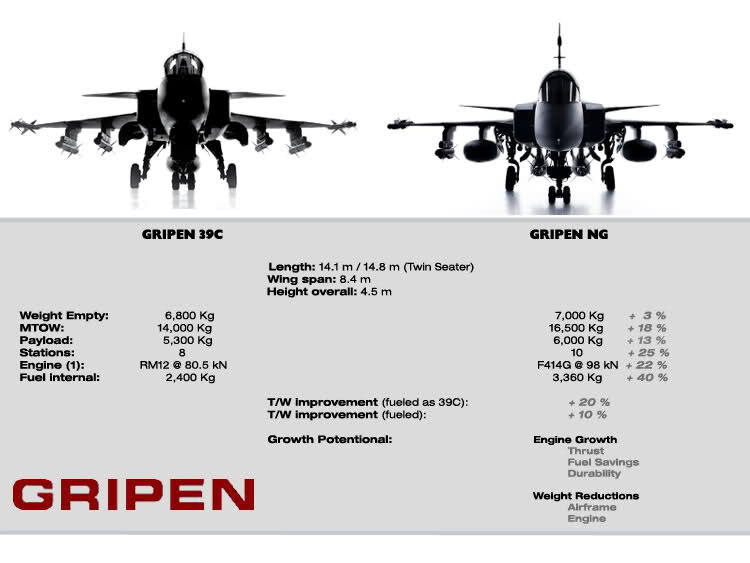
An interesting aspect where the Gripen is better than the JF-17 is the number of hardpoints particularly the heavy hardpoints. I think that was an ingenious bit of Swedish engineering. (I mean the NG’s new stations)
PLA-MKIIA picture of the OV-10 gun
http://www.aero-web.org/database/aircraft/showimage.php?id=10052
Some thoughts:
1. the mid mounting seems a more stable location than further forward.
2. does the gun turret turn 360 degrees? Or is it just vertically adjustable?
3. A 20mm gun in that configuration would be devastating for close in work
PLA-MKIIThe moment infantry goes fighting at night and/or adverse weather the aerial support platforms have to have that capability too.
During maneuvering the low mounted wing obscures a large part of the sensor field of view. Having the sensor on the centreline requires extra hardening since it will be in the dirt and spray of the nose wheel. And putting the sensors on the wing is not a good idea because of wing flexing and vibrations.
The sensor also occupies the best weapon station on a single prop. If you look at that USMC Bronco NOS with the belly turret you’ll see the beauty of it, as it enables off-flight vector suppression gun fire.
Brilliant post! Thanks for reminding how CAS/COIN is different today from the past. I am curious though, does low mounted wings really get in the way of a plane whose sensors are mounted in the nose?
PLA-MKIIExcept the technology of the J-20 itself is suspect so unless we know the level of advancement in the J-20 we will never know.
And also Stealthy Airframe = F-414 class Engines is a hilarious statement.
Actually the hilarious bit is how much conceit it takes to deny China’s industrial and technological leap forward.
PLA-MKIIThe key element here is “remains to be seen” until then all such claims of the abject inferiority of Chinese technology is suspect. China can build the J-20, it certainly can build something approximately in the class of the F-414.
____
Another common element between the JFT and Gripen is that the next block of both planes will be called “NG”
PLA-MKIIThis is an image of the JF-17 HMD:
and this is the Denel system:
PLA-MKIIHere’s an interesting video of JF-17. Does anyone know if the HMDS at 7:54 is the same one on Gripen?
There is some speculation it is the Denel Archer for the JF-17s
PLA-MKIIOne commonality will be that they will both have a swashplate AESA.
The Gripen NG will have a considerably more powerful engine. I don’t think the WS-13 (if it is ready by Block II) will have that range of power. However, presently the RD-93 gets 98 kN (see here)
while the RM-12 only gets 80.5 kN (?)
PLA-MKIIGood question. I can’t seem to find anywhere that it does!! But it states that the NG will have one, and the NG demo also has one.
PLA-MKIII give Gripen’s HUD the edge over JF-17’s, though this year JF-17 gets the new F-22 style HUD this is being fitted to J-10 and J-20.
Gripen HUD http://desmond.imageshack.us/Himg229/scaled.php?server=229&filename=cockpitgripen.jpg&res=medium
JF-17 HUD http://pafwallpapers.com/blog/wp-content/uploads/2012/03/jf-17_thunder_understanding-_cockpit.jpg
Nice cockpit pictures! I must say the Gripen HUD definitely looks cooler.
PLA-MKIIWould it not be fairer to compare the Gripen with the J-10 ?
No, actually it wouldn’t, they are in different weight classes (kg):
JFT: 6586
Gripen: 6800
J-10: 9750
3.1% difference in empty weight for the JFT/Gripen versus 43.4% for the J-10/Gripen
However, do feel free to start a separate thread about J-10 in comparison to Gripen.
Again, to all those who don’t like the plane(s) or the comparison please feel free to not look at the thread. No need to come and tell everyone how useless you think it is.
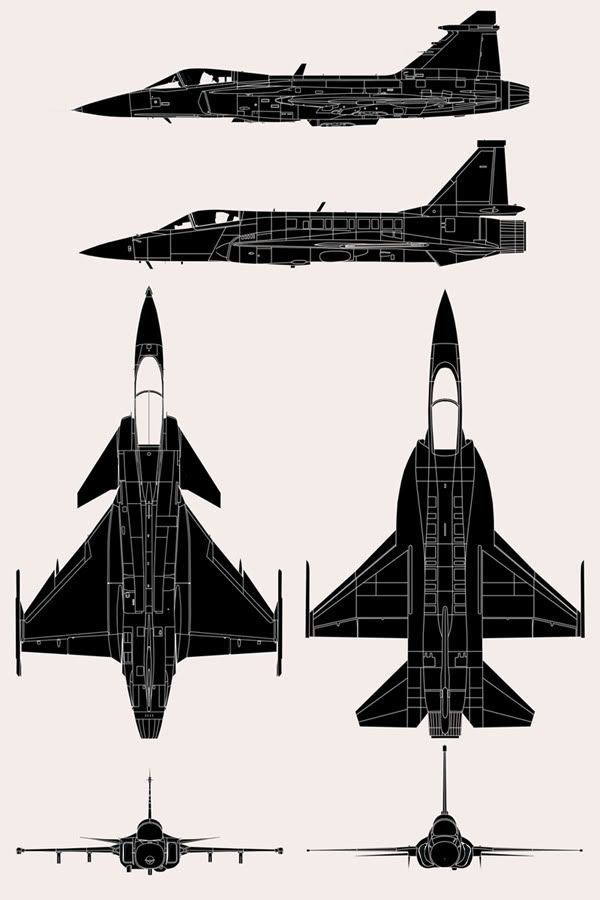
PLA-MKIIA basic comparison of the two aircraft in question:
Thunder:
Length: 14.93 m (49 ft])
Wingspan: 9.45 m (31 ft, including 2 wingtip missiles)
Height: 4.72 m (15 ft 6 inches)
Wing area: 24.4 m² (263 ft²)
Empty weight: 6,586 kg (14,520 lb)
Maximum speed: Mach 1.8
Gripen:
Length: 14.1 m (46 ft 3 in)
Wingspan: 8.4 m (27 ft 7 in)
Height: 4.5 m (14 ft 9 in)
Wing area: 30.0 m² (323 ft²)
Empty weight: 6,800 kg (12,600 lb)
Maximum Speed: Mach 2


 Sign In