http://www.centennialofflight.gov/essay/Evolution_of_Technology/VSTOL_aircraft/Tech30G6.htm
Thats awesome! its so cool!! Its run by ONE turboshaft engine! Those wings are also the type I have in mind – low cord thick wings. My design also has a tilt in fact, but but a very small fixed tilt and does not aim to be a VTOL but a very conventional STOL. I think I’m going to get started with this new design, I’m just beginning to, well almost beginning to believe in a single engined twin prop.
hehe… well, I think it could be as benign as just that the mayor was a free mason and decided to leave an imprint for the world to know him by..
as long as its not the super adventure club..
hehe… well, I think it could be as benign as just that the mayor was a free mason and decided to leave an imprint for the world to know him by..
as long as its not the super adventure club..
Excuse my ignorance here, but, what exactly would be the benefits of having 2 props on one engine ?
Contrarotative props can be useful to absorb the power of large engine (and negate the torque), but as for 2 separate props ?
You add complexity without eliminating the engine failure risk.
Hi Frank,
well, I am brainstorming some of my ideas. I am looking to design a single engined CAS platform that has great endurance and STOL capabilities. Now here are the possibilities:
1. Conventional single prop engine layout. with this pilot visibility is sacrificed and the nose cannot carry required sensors and other items like radar, IRST & nose mounted gun (well the last is possible of course, but can be a problem, particularly if you want a gun like that on an attack helo).
2. A twin engined plane with the twin props on the wings. This is an excellent design but twin engines means higher costs per plane, not suited for the swarm tactics I have in mind. Further, twin engines on the wings tend to make planes less agile and the required armoring for the plane’s vital areas has to be increased, given the greater area that would now need armoring. If WWII is anything to go by, its the single engines that really cut the cheese, so to speak. Further, in my plans, the larger single engine as opposed to the smaller twin engines would provide a commonality for other plane projects – with a larger single prop engine in production for the CAS aircraft, a complementary transport can be built with two of the CAS aircraft engines.
3. A design where th props are positioned in the rear – like many UAVs. This is the design that I have settled on for the past 3 years. This seems to get the best of both worlds – nose free for various items while single engined. However, because of the reduced wash over the wings, this increases the distance needed for take offs and landings as well as the minimum stall speeds and really low speed agility. These are all extremely vital for the CAS type I have in mind. I want my planes to have no need for airbases and be based along with my mobile armored divisions, as fully integrated units.
4. Of course one could just move to a turbofan engine, but I believe that a prop engine has its advantages over turbofans for the type of aircraft I’m designing; prop wash, efficiency, low speed flight and shorter take offs all favor props..

thanks, 25deg south!!!
hehe. well, I am not trying to validate any conspiracy theories, just trying to see if anyone has been there (I haven’t) and if it really has all this stuff at the airport. 🙂
there has to be something more than the Wright flyer! 🙂
come on guys, rack your brains and the vast source of collective aviation knowlege, one last time.
Crobato & plawolf, I think what you’re facing is a classic example of the H0 and H1 hypothesis problem.
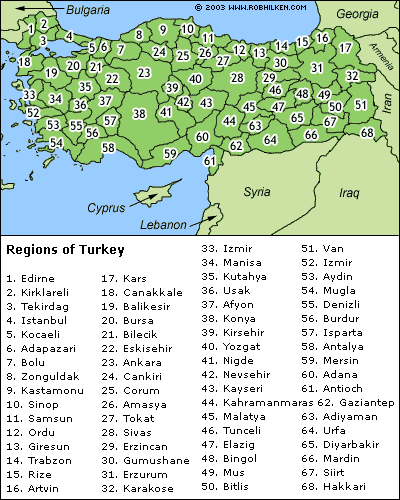
The externals were found in Number 61 – Antioch (Hatay) and number 62 – Gaziantep regions.
Why not make use of skirting the Turkish border and then zip over the Hatay province on final egress. It seems very logical to me! Why egress further south into a potential hornets nest? Maybe the strike package on ingress followed this route too and the externals were dropped on ingress?
I think UAZ and vikasrehman have ably poked enough holes into this theory to make it suspect. I do not claim to know anything more than anyone here but just a few points that bother me with this “planned turkish egress route” theory:
on the one hand proponents claim that the IDF has no problems with Syrian AD. Then why need to anger Turkey, Israel’s closest Muslim Ally?
What’s so important that it was built on the only part not properly covered by the Syrian AD?
Why would anyone think that a nuclear program can be built in one building complex?
Why would one need to make a media campaign out of this as a “great achievement” and one which somehow acts as a “come back” from the Lebanon affair?
Thats another find, but its sort of different from the way I’m looking at it.. the pretty much together..
Here are some pics:
http://scalemodel.net/pictures/WrightFlyer/WrightFlyer.jpg
http://www.flickr.com/photos/6element/26171339/in/set-40463/
hehehe, cheers mate!
well, thats the idea but – its not how it works apparently, perhaps it does with the Eurofighter and the Rafale.
Go and look up a map of the supposed flight route. The aircraft basically flew round Syria via the med and into turkey so they only passed through Syria only on the return flight when they were at their lightest. Which further suggests that the dropping of the fuel tanks is a standard practice before entering hostile airspace in order to improve performance.
that sounds plausible but don’t think its as surely the case as you make it out to be 😀
thats a good point but it still doesn’t explain why the IDF had to fly over Turkey, something that surely was not part of the plan.