 Chox
ChoxKen’s a name from my distant past. I can vaguely remember us spending an afternoon in the back of a Dominie, bumbling round the old V-Bomber low level route… let’s see, that must be about 25-30 years ago? Eek!
ChoxIt’s a sad business when such a well-known title effectively folds and more-so when the much-respected Editor leaves too. I hope the new publisher of Aeroplane maintains standards but from the minute I heard of this news I got a feeling that perhaps we were about to witness another retrograde step…
As for Flypast, I guess Key will ensure that there are no significant changes even with the arrival of a new Editor.
ChoxAnyone know if a decent-quality image of the Harrier at St.Pancras can be found anywhere? I’ve only managed to find a couple of rather dodgy website pictures…
ChoxThanks for the info. I hadn’t looked into the history of that aircraft as yet so that’s certainly interesting to know!
ChoxSorry, maybe I wasn’t as clear as I could have been, I did mean the test aircraft. The preserved examples are fairly well-documented but pictures of them in-service are surprisingly rare. Even the Nasa ones seem surprisingly absent from their own databases. Thanks for the pointers though guys.
Choxpic in Tim McLelland’s book on the Lightning (p78)
There is indeed. I didn’t find much information about the markings other than the much-repeated belief that they were applied for the air show. I have my doubts though as it would seem a tad pointless. I suspect the markings were actually applied for an ACM exercise and were simply still there when the air show came around. The WS10 markings though are far simpler to explain – they’re simply zaps as has been said. I assume the reference regarding decals must mean these markings as I’ve never seen any evidence of anything more spectacular in terms of German markings on Lightnings – much as I’d like to!
ChoxIt rather depends what you mean by “great aircraft” I suppose. As you say, the aircraft’s systems weren’t spectacular. They were good for 1965 but distinctly low-tech by later standards, and the TSR2’s systems were certainly ambitious – maybe unrealistically so. I don’t doubt for a minute that getting the aircraft’s “kit” up to a good standard for service use would probably have been the project’s biggest problem – but we never got to that stage.
But as an actual aircraft it was outstanding, there’s no doubt about that. It’s the stuff inside the aircraft that might have been the difficulty.
ChoxYep, maybe you misunderstood what I said. That’s the point – Tornado wouldn’t have happened if TSR2 had survived.
As for names, well yes you’re quite right, the term TSR2 was little more than slang in effect but it eventually became adopted as an easy all-embracing name for the aircraft and project, even though the actual aeroplane was the Vicker-Supermarine Type 571. The “T” stood for “Tactical”. The term “TSR” came from Julian Amery, although when he first used it he even managed to mis-quote his own department’s slang, substituting the term “Support” for “Strike” by mistake. The “2” is an even bigger mystery. Some have suggested it was because in some departments the Canberra had been regarded as “TSR1” but I think this is a specious theory. It probably simply referred to the projected Mach 2 performance of the aircraft.
Names? Well anybody’s guess. Various names have been thrown around but no names were ever suggested or adopted. Maybe the only possible straw to clutch at is the name “Merlin” which would probably have been applied to the F-111K. The name “Eagle” keeps getting thrown about but it’s just one of many that have been mentioned (“Claymore” was another). I suppose it’s more likely than an alliterative name to suit Vickers might actually have been chosen, given the way that Vickers (within BAC) were at the time.
ChoxQuestions which can never be answered really. Lots of theories of course so it’s a case of picking the one you think is most likely. I suppose that if the Government hadn’t had the presence of mind to abandon TSR2 when they did, it would have only been affordable in fairly small numbers – maybe fifty, especially if the abortive AFVG project had also continued. The most reliable guess on longevity would be to look at how the Buccaneer was used, and this gives you a fair guess at when TSR2 might have been retired. But then you also have to take into account the non-appearance of Tornado which would presumably have had a lot of influence on TSR2’s future (ie, it’s difficult to guess what might have replaced it).
In simple terms you could make an estimate based on an initial entry into service around 1970, take into account that Tornado was planned to remain in service until 2025, and apply the same figures to TSR2, which suggests that it could have had an OSD of maybe 2012-13 in which case it would still have been in service. But as we know, Tornado is now unlikely to be around until 2025 and if TSR2 had still been in service, last week’s SDR might well have called for its retirement. But much depends on what would have ultimately replaced TSR2.
Again, it can only be a guess, but if the RAF had received TSR2 (and maybe AFVG too) then the development of what eventually became Tornado would have been of far less interest to Britain and it would doubtless have been a very different aircraft (without so much British input) which entered service rather later. Consequently, I wouldn’t discount the notion that Britain would have opted for a purchase of F-15Es at some stage as a replacement, in which case TSR2 would have no doubt been retired many years ago.
You also can speculate on how TSR2’s systems might have been developed, as this would have had an important effect on the aircraft’s usefulness and projected service life. Lots of variable all of which depend on available cash, military requirements, other design projects, and so on.
In short, it all depends on what criteria you factor-in to your projected future. But I think it fair to say that no matter what scenario you prefer, TSR2 would have either been long gone, or about to retire within the next few weeks.
ChoxI suppose the only real mystery is why Northrop would spend money and waste so much time on building a model for no reason. Surely they don’t need the money (whatever the TV folks paid them), nor do they need the publicity. Wonder what their true motivation was?
ChoxEntertaining claptrap were words that came to my mind after I’d finished watching it 😀
ChoxThe Avro Vulcan – A History by Peter Dancey. Absolutely dreadful but entertaining:p
ChoxYes, all of the squadron’s aircraft were similarly painted:-
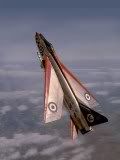
Their twin-seater T.Mk.4 was also painted in the same scheme. The actual display team was a nine-ship (as far as I can recall) mostly split into two component formations. Most (if not all) of the squadron’s aircraft were also fitted with two vent pipes linked to one of the wing flap fuel tanks. This housed diesel fuel which was pumped into the jet exhaust to provide white smoke, similar to the system now used by the Red Arrows.
As for Hunters, yes, there were two teams, these being 111 Squadron’s “Black Arrows” (from where the Red Arrows acquired their name – combined with the Red Pelicans’ title) with black-painted aircraft, and the “Blue Diamonds” of No.92 Squadron, their aircraft being blue. The large formation you refer to is presumably the famous (and record-breaking) 22-aircraft which looped at the Farnborough show. I would imagine that larger formations of Hunters were assembled but not for aerobatics. I guess some of the experts on this forum might be able to recall those better than I can though!
ChoxHard to say but from what I can recall (and heaven-knows where I read it now), the official instruction was that all the UK Lighting squadrons had to subsequently adhere to a standard insignia with tail markings that were within a defined size (and a small one at that) and position. This was why we went through a period when the markings were all applied to a small circle (56, 5, 11, 23, etc.) and it was only some years later that the tail markings slowly expanded again – but not very much!
ChoxWell things were slightly different with the F1A as at that stage the squadron was performing in public as the “Firebirds” display team. Consequently, the paint scheme you refer-to was essentially an air display scheme. The check design applied when the F3s were delivered was intended as the squadron’s standard colours, so a different view evidently prevailed. It was in effect a culmination of the increasingly-colourful schemes which had been applied to aircraft with almost every Lightning squadron and one suspects that the miserable officials simply felt that the trend had gone too far.
There was no logic or reason behind the decision, it was simply a case of those with the authority having no interest in artistic flair. Presumably they felt that Her Majesty’s aircraft should be maintained in as miserable a condition as possible. The same depressing attitude still seems to be around even now although it’s usually dressed-up in some unconvincing notion of camouflage effectiveness. It’s a pity that common sense cannot prevail, enabling the RAF to return to the pre-war days when each squadron’s air and ground crews were encouraged to take pride in their aircraft. In many ways the check-tailed F3s were the end of a great tradition.


 Sign In







