 Chox
ChoxBrings back fond memories of joining-in with the flypast a few years back, in one of the whip Hawks :-
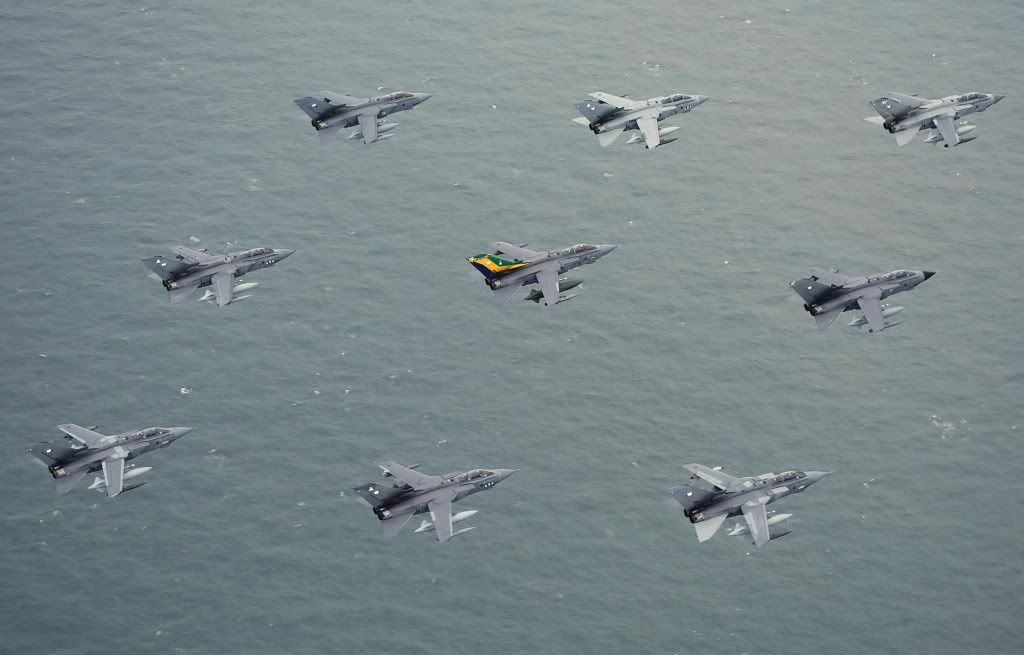
Sitting in the VAS room at Marham, watching Her Maj in Horse Guards Parade on the telly, somebody says “hey we’d better get going or she’ll have nothing to watch!” Great fun parked at the runway threshold watching the Tornado formation get airborne in groups, going round the circuit and adding a few more aircraft each time until all nine plus spares are all aboard. Then it’s off to the North Sea to cruise around in ever decreasing circles until all the other formations slot in. Then a few rolls over the top of each group with a layout chart on your lap, commenting on the various aircraft that need to nudge in or out a little bit to get the formations perfect. Then finally it’s off over Southwold and along the traditional route to London.
We tagged along as far as Chelmsford while I tried to grab some photos of a C-17, but the fuel reserves dictated that this was as far as we could go, so it was “bon voyage” to the rest of the guys, followed by a sprightly climb to clear an airway before heading back to Leeming. Some careful flying managed to get us home with a trickle of fuel to spare but our colleagues in the second Hawk couldn’t quite make it, and diverted to Coninsgby.
Ahh, the effort these guys make to entertain Her Maj. I don’t think she has any idea – bless!
ChoxAs Bruce rightly says, arrangements between authors and publishers do vary quite considerably. Unless the situation has changed since I last had any dealings with Crowood, they work on a pretty standard publishing basis which gives the author an advance fee, and then further royalties are paid depending on how many books or sold. In practise (particularly with aviation books and smaller publishers like Crowood) the royalties will never be greater than the advance paid, so in effect you simply get paid once and that’s it.
My arrangement with Ian Allan is slightly different in that I get paid once for the book on completion, regardless of how many copies are sold. It’s my choice but these days I prefer to work that way as relying on a trickle of advances coming-in over a number of years is tedious and unrewarding. I’d rather complete a book, move on and forget about it. Of course this kind of arrangement runs a very real risk in that the book could sell like proverbial hot cakes but I wouldn’t make so much as one more penny. This happened to me once before with a book I did – it sold far in excess of the predicted figure but I didn’t get paid any more. That’s the gamble you take!
So I never have any burning desire to promote my books as I have no financial motive for doing so. I’m always happy to discuss them or bring them to people’s attention (in case they’re of interest) but it’s funny how lots of people often assume that I have some evil money-driven motive to “sell” my books to people. Actually I don’t, as it’s of no interest to me if a book sells or not. My only concern is my reputation as a writer and the need to satisfy myself that what I write is as good as it can be.
PS – I would supply you with a cover illustration from my book if I could, but I haven’t seen it yet! It seems that a large poster of the cover was on display at the Book Fair some weeks back, but so far nothing has emerged for on-line promotion I’m afraid. The illustration is of XR219 as seen during flight trials. We took a conscious decision not to get involved with any speculative colour schemes either for the cover or inside the book, as we wanted the book to concentrate on factual information rather than the usual speculative stuff which has been published many times before.
It’s very odd that Crowood have decided to publish a book on the same subject at precisely the same time as Ian Allan (although I do know why) but from what I can determine, it looks as if both books will be markedly different from each other, so readers will have the luxury of buying the book that suits their interests.
ChoxTim, how would alerting your potential buyers of a saving be a snipe?
Perhaps I placed too much emphasis on the “rolling eyes” at the end of your comment? I’ve become somewhat accustomed to gratuitous sarcasm and probably see it where it isn’t even intended these days!:p
Incidentally, they’re not “my” potential buyers. My work on that project is done so it’s down to the publisher to worry about selling what is now their product! I’ve already moved on to the next project and much as I enjoyed investigating TSR2’s story, it’s nice not to have to think about it any longer! Although the story of TSR2 is very long and quite fascinating, it’s quite a task to weed-out all the nonsense which has been written about this project. But enough is enough. Now I just want to return to my dark fantasies of a big colour book on the Varsity… the stuff of dreams!
ChoxJust to clarify your confusion Robbo, my book is being published by Ian Allan and as a mainstream publisher they always discount new books. It’s standard practise for commercial publishers. Crowood also sell their books at discount but as a small specialist publisher, they only do this at a later stage to sell-off the unsold copies.
Incidentally, just to update this post, you’ll note that the Crowood book is already discounted on Amazon too. It’s common practise.
ChoxI’m already in contact with AIX but thanks for the pointer. You’d probably be surprised how difficult it is to find old pictures of airfields, particularly in that sort of region (Wales and the adjacent counties). There are a few well-known shots of course but the vast majority of airfields (most of which have long since been abandoned) just don’t seem to have been captured on film in their heyday.
It’s just a general request really, nothing in particular. A nice shot of Brawdy which shows the hangars and tower would be brilliant, or a decent shot of Castle Bromwich, RNAS Dale, Lichfield, Mona, Tern Hill, Condover, Hawarden and so on. And then there are the even more obscure sites like Penrhos, Hinstock, Cranage and so on. It’s amazing how many there are and yet pictures of any of them back in the days when they were in use, are incredibly rare. Of those that do survive, most seem to have been gobbled-up by the major libraries, but I don’t think many pictures were ever taken in the first place. Guess the locals were busy fighting a war!
Anyway, if anyone has the odd snapshot anywhere do please message me!
ChoxIndeed, we got the follow-on to the Hunter – it was called Harrier. It was a project which Healey pushed-for oddly enough!
ChoxEr, well if you read what I said I didn’t “wash-away” his account at all – I said it was doubtless true. What isn’t true (in terms of much-published material) is the reason why.
But if you’re suggesting that my assertion isn’t true, rest assured that the reality of the documentation is on record, as stated by a senior member of the design team. It’s not invention.
ChoxWell some of it, although I finally decided not to devote much space to the subject of what units might or might not have equipped with TSR2, as there was virtually nothing documented, and I didn’t want to waste space on supposition. The basic story takes up more than enough space – I ended-up with precisely twice as much text as I’d been commissioned to write.
Company archives? Virtually nothing actually other than photographs, and most of those have now gone (and some are damaged). Having looked for myself, there isn’t all that much to access. But material was lurking around through other sources thankfully.
ChoxSgt Austin it’s true that an awful lot of effort was put into destroying all traces of the project – some of the BAC people have commented that more attention seemed to be devoted to this than the actual project! The reason for this absurdity is because there were very stringent requirements laid-down in advance, and by this stage the spectre of non-compliance penalties was starting to appear, so BAC were keen to do everything to the letter.
As for public records, as far as I know there is nothing else expected to emerge which would be relevant to TSR2. Pretty-much everything that relates to the project has now been released. Of course, like most of the stuff you can find at Kew, the greater proportion doesn’t tell you anything of direct relevance as most papers inevitably refer to proposals and plans that became dead-ends. As far as I can determine, only one mystery it still classified, and that concerns a Government decision on the permitted yield of the aircraft’s nuclear bombs which was (for reasons yet unclear) limited for some time.
As for being a “pretty” aeroplane, well yes, I agree that it certainly was. Guess that’s a symptom of its sustained supersonic capability. Of course its graceful looks were hindered by the ghastly undercarriage that was created in response to the Air Staff’s slightly bonkers obsession with STOL operations. It was over-engineered and caused the whole flight test programme to be held back.
Bruggen, I don’t know how I could explain more clearly? You’re asserting that there was some dark Government plot to destroy everything and I’ve illustrated that there patently wasn’t. BAC could have kept two aircraft flying if they’d wanted to. You can’t really get any clearer than that. As for shifting to the wider issues of cancellation (which wasn’t what I referred-to as “nonsense”), you seem to think that Wilson was the culprit? In actual fact it was he who proposed that the project be kept alive for six months, when everybody else wanted to scrap it.
ChoxOh I quite agree – things are never entirely black and white. But I wanted to try and put things straight as best I could in my book, as I think the story has been allowed to run out of control for far too long (a bit like the actual TSR2 project in fact!).
Whilst it will always be possible to cast doubt on various aspects of the story, I think it is now possible to clarify some of the key points which have been misinterpreted for years. We all know why this has been done – it’s human nature. The “conspiracy theory” was very exciting and gave the aircraft an added touch of glamour (the “Elvis/James Dean” syndrome), and of course there’s nothing us Brits like more than obsessing over what might have been. But I think it’s unfair for serious historians/enthusiasts to be fooled by this kind of stuff forever, and I wanted to try and set the story straight for once.
All the books and magazine features that obsess over what brilliant weapons TSR2 might have carried, what fancy colour schemes it might have worn, or where it might have operated, etc., are all very nice, but they fail to address the key points of the project’s history. I didn’t want to devote space to more of this “what if” stuff, and I’ve opted for a more straightforward account of what did happen, not what might have happened. Okay, I know I’ll get plenty of criticism, especially from those who still want to convince themselves of dark conspiracies, but that’s okay, I have broad shoulders!
ChoxWell, I guess it depends on how you interpret any assertion from Healey that the East of Suez role would have disappeared. Naturally, he believed that it would not disappear, or perhaps to be more accurate, he didn’t want it to, but others within the Government were pretty clear that it would go, and one advisor had identified this prospect years previously but nobody seemed prepared to address the issue at the time. But regardless of how you look at Healey’s view, the point is that the role did go, and it was gone by the time that TSR2 (or F-111) was to have settled into service. That’s why the need for an equivalent aircraft was never pursued and Tornado was developed for the role that was required – within Europe.
Okay, it’s still an interpretation of history but not one which is based on supposition, it’s a simple statement of facts as they turned-out. No matter how you look at it, TSR2 was designed for two roles – East of Suez and Europe, but the former role was gone by the 1970’s, therefore an aircraft with TSR2’s capabilities simply wasn’t necessary. Buccaneer was more than suitable – as it had been all along.
ChoxI notice that there’s a merchandise page on the T5 web site. Maybe it would be worth someone from the group contacting Ian Allan Publishing to see if they could arrange some sort of a deal for you to sell the Lightning book that I did some time back? The book features a first-hand account of flying in XS458 and includes various photos of the aircraft, so I would have thought it would be something appropriate to sell and raise money? I don’t know what Ian Allan would say but I would think they’d be happy to help and the idea would certainly have my blessing.
ChoxOkay, well the question of keeping the two aircraft as research airframes isn’t a “hole” in my “theory” as you put it. There wasn’t any question as to the wisdom of the idea, it was just that the Government hadn’t got the money/will to do it, and BAC didn’t want to pay for it themselves. Nobody has questioned the validity of the idea though.
As for the assertion that the aircraft’s role would vanish after the end of our East of Suez commitments, well again it’s not an assertion, it’s a fact borne out by statements from the people concerned. The aircraft was designed for long-legged strike missions specifically for this role. It was over-engineered for the Nato role. That’s why Tornado is the way it is – designed specifically for European operations, a pint-sized TSR2 in effect.
As for your comments Bruggen, I know you’ve explained before what your father saw, and I’m quite sure his recollections are accurate. But the idea that this was a manifestation of a Government plot is indeed nonsense, which people have been peddling for decades. It has to be, otherwise how do you explain Jenkins’ and Healey’s agreement to keep two aircraft flying? That’s a complete reversal of the “destroy everything” myth. Besides, key members of the BAC staff are on record stating that very detailed and specific documentation had already been laid-down for the dismantlement of the project even before it happened, and when the project was cancelled they merely implemented the procedures which they’d already been given. Either way, it demonstrates that the age-old conspiracy theory just doesn’t bear any scrutiny.
ChoxIf you believe so, perhaps you could explain precisely what these “holes” are?
ChoxI think the key benefits of flying the two aircraft would have been to enable the Olympus engines to be tested and developed – ultimately for Concorde, and to gather more general research data on sustained supersonic flight. I think the systems would have been a secondary consideration as they could be tested (and were tested) in other aircraft in any case, eventually leading to developed systems that were used in Nimrod, Jaguar, and ultimately Tornado, but it would obviously have made good sense to use the aircraft, thereby getting something back from the programme. Just dumping the aircraft at P&EE (and using the other for equally pointless ground trials) was silly.


 Sign In







