dark light

robban

Forum Replies Created

Viewing 15 posts - 31 through 45 (of 360 total)
  • Author
    Posts
  • in reply to: Compare/Contrast: JAS-39 and JF-17 #2374670
    robban
    Participant

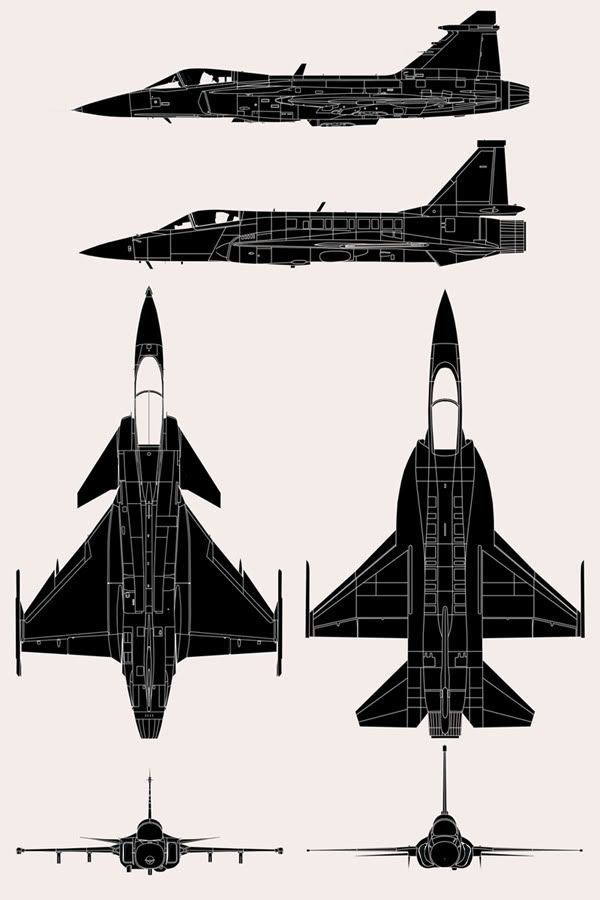
    beautiful! did you do that? Can I use it?

    Yeah, I made it. And, sure, you can use it. 🙂

    in reply to: Compare/Contrast: JAS-39 and JF-17 #2375223
    robban
    Participant

    A size comparison…

    http://img.photobucket.com/albums/v486/robban75/comp3.jpg

    in reply to: Saab 37 Viggen Questions #2347729
    robban
    Participant

    If you claim that data you have give the source of that. The clean JA-37 empty equipped is 12,2 tons. Empty equipped is a flight ready fighter with pilot/crew minus payload. The payload is is the sum of JP*, ordenance and the related pylons.

    According to the book “System 37 Viggen” by Ulf Edlund & Hans Kampf, the empty weight of a JA 37 is 11,790kg. To this figure the weight of the electronics, ammunition and pilot is added, which is roughly 200 kg.
    However, looking at the weight plates in real JA 37’s(fitted behind the ejection seat) the true empty weight is 1000kg lower than this figure. The weight also differs alot between different aircraft “individuals”. Some JA 37’s had parts, like for example their vertical tails made out of composite material.
    Fuel weight for the JA 37 is 4500kg, plus 800-1000kg for the external fuel tank.

    in reply to: Saab 37 Viggen Questions #2348932
    robban
    Participant

    Viggen (JA37) had 88% of F-4 thust =125/(71*2)
    the PS-46/A vs. AN/APQ-72 was as i recall 85% 48/56

    by weight 12 200 kg(JA37) vs 13,757 kg (E version) is 89%

    The JA 37 empty weight is around 10,500-11,000 kg. Normal take off weight for a JA 37 was around 16,500 kg – full internal fuel and an external fuel tank.

    in reply to: Cheetah C #2354766
    robban
    Participant
    in reply to: Indian AF News and Discussion Part 16. #2340182
    robban
    Participant

    aren’t folk always telling us that C/D is just A/B in NATO standard, why should the specs be different ?

    While the C/D is externally similar to the A/B they are quite different underneath the skin. The most obvious difference is the cockpit displays.

    in reply to: Indian Air Force- News & D iscussion #15 #2343479
    robban
    Participant

    robban and scorpion, the canard delta config was well known and a drawing of it was even provided to the press. what I said comes from the statements of program designers and leaders, they didn’t have any reason to lie that I know of. moreover now that the FBW has definitely matured they could have gone for canards in Mk2 if they needed, that they didn’t speaks of their conviction in the original configuration.
    the sukhoi flanker dropped canards from MKI to su-35, kindly remember that too. 😉
    at the end of the day you are free to form your personal opinions.
    I know which I would rather believe.

    It’s not as simple as “adding” a pair of canards to increase performance. The Flanker wasn’t designed to optimise the use of canards. While they improve landing performance slightly their position imediately ahead of the main wing decreases the total lift on the wing as well. The weren’t used used for pitch either. That job was still done by the huge tailerons.

    Deleting the canards on the LCA certainly lessened the risks and costs. Allowing the program to progress faster. The way the LCA is configured there is no place for a canard. The wing is probably mounted too high on the fuselage for that.

    in reply to: Indian Air Force- News & D iscussion #15 #2343508
    robban
    Participant

    the original LCA design did have canards and looked like the gripen. they later dropped the canards and adopted the twisted cranked delta config.
    diff paths to same ends.

    Deleting the canards would lessen the risks to the program, and no doubt reduce costs. Which I’m sure is the real reason for dropping the canards on the LCA. A cranked delta cannot give the same advantages as a canard controlled configuration.

    The Gripen and Eurofighter uses their canards for pitch, and elevons for roll and trim, whereas the LCA uses its elevons for pitch/roll/trim. Big difference in the way the aircrafts utilise avaliable lift.

    in reply to: What Makes Euro-canards better than Russian fighters? #2344818
    robban
    Participant

    Su-35S official data:

    Acceleration time at H=1,000 m and fuel bingo 50% of the standard capacity, sec:
    from 600 km/h to 1,100 km/h 13.8
    from 1,100 km/h to 1,300 km/h 8.0

    So, the Su-35S gains 700km/h in 22 seconds.

    An improvement over the Su-27SMK, which needs 27 seconds to do the same. 600 km/h to 1,100 km/h 15.0 sec,
    from 1,100 km/h to 1,300 km/h 12.0 sec. Strange though that the biggest improvement is in the transonic region. The Su-35S certainly isn´t improved aerodynamically over the SMK. Could the TVC be the magic behind this?

    It is interesting to note that a RM12 powered Gripen gains 700km/h in 30 seconds. Just 3 seconds slower than the Su-27SMK. If we compare their respective TWR´s it´s quite spectacular.
    The F414 powered Gripen should be much better. I think this speakes volumes about the superior low drag aerodynamics of the Gripen vs the Flanker.

    in reply to: F-35 News Thread III #2348424
    robban
    Participant

    Most aircombat happens at speeds below Mach 1.2! Which, really makes speeds above of Mach 1.6 moot.

    The new “generation” of fighters can take aircombat well above M 1.2. Contrary to the older generation, the new fighters can actually turn quite well at supersonic speeds and maintain their E.

    in reply to: F-35 News Thread III #2350375
    robban
    Participant

    Yes any day, and Gripen may well be the most aerodynamic fighter ever built.
    The fact that it supercruise M1.2+ with a single F-414 only reinforce that assumption.

    Even an RM12 powered Gripen can supercruise, even when fully loaded with A2A missiles. See link 🙂

    http://img243.imageshack.us/i/gripensupercruisetempja8.jpg

    in reply to: F-35 News Thread III #2350379
    robban
    Participant

    Do you happen to have any source ?
    I havn’t actually checked them all, i just took what was presented in wiki

    I did a quick comparison on Wiki as well, but not for all the aircraft.

    Taking the empty weight of a Gripen C, 6800kg + fuel weight 2500kg = 9300kg, divided by wing area 30.7, I got 302.93.

    If we add an external 1100 liter(833kg) drop tank to that, we get 330. I don´t know the weight of an empty drop tank, but if it weighs around 200kg, we should end up closer to 336. The Gripen flies with an external drop tank 80% of the time, so perhaps the wiki number isn´t too far off?

    In comparison, an F-35 even with 50% fuel has a wing loading of 410 kg/m^2! That´s higher than a JAS 39A at max weight(12500kg).

    Remember, as the Gripen is unstable the canards adds to total lift, so they are accounted for in the total wing area, contrary to tailplanes.


    in reply to: F-35 News Thread III #2350488
    robban
    Participant

    Just a quick note. The wing loading for a Gripen C, loaded weight, is actually 303 kg/m^2, not 336 kg/m^2.

    in reply to: F-35 News Thread III #2351096
    robban
    Participant

    It just seems that some people just don’t get that the F-35 will be clean (A-A) and the others types will be loaded with extenal stores. Which, will greatly effect there performance.

    The F-35 has a huge frontal area, and very high drag even when in clean config. It is also very short and stubby, hardly an indicator for low drag. I doubt it to be less slippery than a SH.
    It will be a good bomber at low altitude with those tiny highly loaded wings, but an A2A fighter it is not.

    in reply to: Rafales for Brasil #3, Cachorro-quente! #2375809
    robban
    Participant

    If it was on pure performance/capability the rafale would be the winner:D

    Depends on what performance/capabilities you want/prefer. Or are you saying the Rafale is better at everything? If so, then your lying to yourself.

Viewing 15 posts - 31 through 45 (of 360 total)