 Erkokite
For bombing undefended nations it sure is great.
Good luck striking anything when you can’t fly into a well defended airspace.
Having air dominance wins wars, and from there having superior strike jets matters little.
Somebody missed the old adage that you can’t win a war on airpower alone…
Erkokite@Spudman
I was referring to Mildave’s quote from the House Armed Services Committee:
Development testing of the common mission system and flight sciences for CTOL and CV is now scheduled to complete in the first quarter of 2016
Per standardized DoD practices, there is an operational test period following development testing. I was extrapolating based on the completion of the DT phase that the program could finish the OT and finally reach IOC in 2018 (for the C and B variants). This also coincides with the A variant timeline expected by USAF.
On a separate note, the APG-81 seems quite impressive- It would be fascinating to look through their R&D stuff to see what techniques they are using to jam the F-22 (in itself an LPI/J radar). 😀
ErkokiteIf Development Test finishes in 2016, then they still have to perform Operational Test, which could easily push things into 2018.
ErkokiteErkokiteAn insightful find, Deino. 🙂
One can see variations in the element spacing particularly around the middle vertical section. Also there is a horizontal division at the IFF dipoles. So the radar is divided into 4 quadrants. I believe this has to do with monopulse detection.
http://www.radartutorial.eu/06.antennas/an17.en.html
On an AESA (at least those capable of multiple beam emission), you have reconfigurable subarrays which can either act as one single monopulse quadrant each or in some cases possess 4 quadrants per subelement (I’m not sure about the latter- though it is theoretically possible).
Compare this with the EL/2052 (a good example having similar geometry and very clearly defined elements):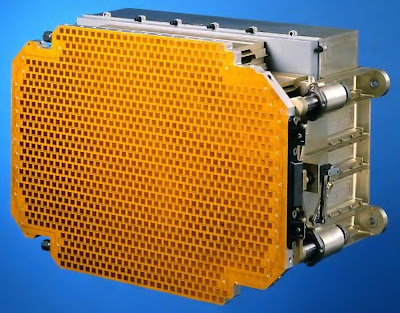
Note that the element distribution is constant across the face.
The fact that the radar is divided up into 4 quadrants like this suggests a conventional monopulse phased array. Not an AESA with reconfigurable subarrays (although I guess it could still be done).
Another thing that is interesting are the elements themselves. It resembles the Irbis radar(and AESA for PAK-FA) in some ways.
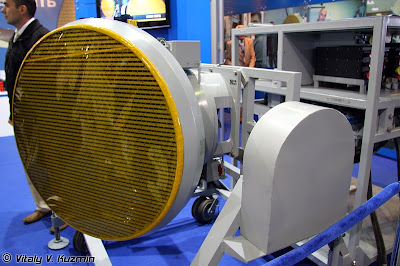
I think that each element is a hole or tiny waveguide (similar to a slotted array but used as a phased array). This resembles the Irbis. I think the yellow plastic covering is to keep out debris and moisture.
ErkokiteI would think that the J-10b would use a PESA as it is supposed to be an inexpensive aircraft. I could see an AESA on the J-11 and J-20 though.
ErkokiteThe customers would be upset about problems too, don’t you think? Military pilots have spoken highly too.
It’s not that it’s a bad aircraft- radar, situational awareness, etc… are very good. But kinematics may not be any better than the teen series aircraft. If we were to believe some people, the aircraft could go 100-1 against J-20’s or T-50’s or advanced 4.5 gen designs, all while making your dinner and changing your oil.
I think it is important to be skeptical and try to examine each claim as well as its source. When I hear navy test pilots (reliable source) state that the aircraft is similar in performance to an F-18, and given what we know about wing loading, thrust, weight and wing shape, and design points for the aircraft that about lines up.
ErkokiteYour model is wrong
Gripen diameter 60 cm
A=pi*30^2=2826 cm^2Rafale diameter 55 cm
A=pi*27.5^2 2374 cm^2With 1000 modules on Gripen NG as reference, Typhoon will carry 1360 modules
Rafale 16% smaller -> 840 modules
http://rafalenews.blogspot.com/2011/02/thales-aesa-rbe-2-modules-pattern.html
Math and images agree it is ~840 T/R
That’s a prototype image.
ErkokiteYou have an uncanny ability to continuously provide the most pessimistic assessments, based upon anecdotes that have been provided to show positive information. If there’s a way to spin something negatively, you’ll find it. There have been numerous claims by both test pilots, and military pilots which contradict your views. Your response is that you don’t trust them. There have been numerous links given, in many posts, where hints to what the F-35 is capable of were alluded to-
i.e. better turn performance, acceleration, nose pointing ability, than either the F-16 or F-18(and this is clean F-16/18s vs F-35 with 5000lbs of internal weapons), and similar to the F-22 in the subsonic regime. The bottom line here is that the Typhoon, Rafale, Gripen, Flanker, Fulcrum aren’t going to enjoy large margins of performance advantages(if any) across the full envelope. In most of the envelope, the F-35 should be pretty close or even superior, but with better avionics.
I’ve heard the statements from JB to be:
…subsonic acceleration is about as good as a clean Block 50 F-16 or a Raptor- which is about as good as you can get.
However, it seems a little surprising (but not too surprising) to me that a clean Block 50 F-16 and F-22 have comparable acceleration. Is this true (honest question)? Wouldn’t something like the Typhoon (with a light load) also have similar performance (or at least as much) as a clean Block 50? And this says nothing of supersonic performance, where the Rafale and Typhoon’s lower bypass engines may even give them an advantage.
Another statement:
“The F-35 chief test pilot further noted that the F-35 can fly at angles of attack that are just as steep as those of the F-18 or the F-22. “It’s a fully maneuverable 50-degree airplane,” he said. He invited those who had witnessed the F-22’s startling agility at airshows recently to ponder the fact that “the same people also designed the flight control system for the F-35.”
Being able to fly high AoA doesn’t necessarily translate to good turning performance- high AoA causes energy loss, and when you have a high wing loading (like the F-35) you must compensate by increasing AoA. Rafale pilots noticed this issue when flying against Super Hornets, stating that the aircraft has a tendency to sink when turning.
It seems incredibly misleading to me to draw the comparison between the F-35 and F-22’s airshow performance due to a similar FCS. The F-22’s supermaneuverability comes from TVC, something that the F-35 lacks.
While I’ve no doubt that there is at least some truth the claims, you have to remember that Beesley works for Lockheed Martin. That alone should give pause when taking the claims at face value. Another test pilot (Norwegian Air Force) stated the F-35 “is not an airshow plane.” That should make you question things a bit.
ErkokiteSure. I actually made those containers for the “Silent Hornet” model, but just fooling around with a Rafale I made, I thought I could throw them in. The whole idea is to produce very low drag, and lift creating fuel tanks and external weapons bays, just as in the suppossed F-18E Blk III.
A Rafale equiped with 3x FT and 2x weapons bays, could carry 8x AAM for very long air defense missions, or a couple of heavy ASM in stealthy anti ship interdiction. Each external weapon bay fits as much as 8x SDB, so there is a lot of different configurations possible.
I also broke down the main rudder into 2 smaller canted ones, that despite their smaller size, actualy increase the area due to being fully movable. The SPECTRA gear from the rudder had to be split in two, and moved to the wingtips to give 360º cover.
Another thing (that’s not represented in the model) was a pair of CFT. I’m not certain if they make sense, for the ridge on the fuselaje is quite low, and a clean dessigned, very low drag CFT would only carry around 900 kg of extra fuel.
The F5 iteraction of the Rafale, could surely use extra power. Maybe those ~90kN M-88 for the F4 are enough, but given the similarity in weight and size, I would consider switching to F-414-400 EPE, but that’s only a personal choice and nothing else. Maybe with engines in the 120kN range, true SC performance could become a reality. I kept the inlets as they are right now, but I am sure they will need to be changed a bit.
Saludos
Dassault originally proposed fitting the Rafale with the Kaveri engine for the Indian competition. Given that SNECMA is now involved in the program, I think the Kaveri + M88 HPT/Burner/HPC engine that they are working on would be a good fit- I’ve heard 90-100 kN for thrust, and it is a variable cycle engine rated for flat thrust at all altitudes. This would surely give prodigious supercruise ability.
ErkokiteWhich I didn’t said, I just pointed out that the F35 will be available at the same time, possibly even before the EF might be ready to have real A2G capabilities, so why should they pay twice for the same capabilties if the F35 will be deploy in these roles, either alongside Tornados, or later as a replacement?
There is simply no need for it in the RAF with Tornado now and F35 later. In an recent flightglobal article they confirmed that the US and French shows interest in integrating Brimstone to their fighters, while RAF has not. Which means, they are happy with it in use from Tornados and has no need to integrate it on EF anytime soon. Especially when there are only a few EFs A2G capable so far, let alone enough trained pilots.
I wouldn’t be surprised to see Brimstone on Rafale earlier then on EF, but it might depend on what Dassaults plans are about the rocket pod they wanted to integrate as well.you also note that the inference of the highlighted section is that the F35 will not be available to be the A2G aircraft of choice by 2018.
Actually it makes clear that the 2018 date has nothing to do with electronic attack capabilities, but that the EF will be fully A2G capable only by then. EA might come in addition, depending on the AESA development itself, but the integration of weapons is the point here and as I pointed out, Storm Shadow makes only sense with CFTs which for sure will need time for development and testing.
In the mean time they will add some more LGBs and possibly JDAM, but any A2G missile is questionable until they officially agrees to the integration.Again F35 planed for 2016/17, EF fully A2G capable only by 2018.
F-35 IOC for USAF has been moved to 2018.
ErkokiteI’ve never heard of these types of radars, having an ISAR capability, or accuracy of the type, you speak of.
Saab was talking about something along these lines. I don’t know at which frequency it operates- they referred to it as ultra-wideband, which usually implies something much lower than X-band (UWB is difficult at higher frequencies I think).
There is a good paper on stealth imaging using ISAR at http://ieeexplore.ieee.org/xpl/freeabs_all.jsp?arnumber=1391235.
I wasn’t necessarily implying that such a system exists today- but it could very well exist in the near future.
ErkokiteThe processors may be advancing, but the RF energy is still limited by physics. This means that there will be improvements in the maximum range that a stealthy aircraft can be detected. It doesn’t mean that all of a sudden VLO aircraft are visible out to the max radar range. The radars in the <2 GHz range don’t have the fidelity, to provide more than a trip wire capability. Fire control radars will still be very limited.
I believe that low frequency radars operating in ISAR mode are capable of detecting and imaging stealth aircraft with quite a bit of accuracy- I imagine if such a method can perform imaging, then it should provide an unambiguous range. The downside of this is that the radar has to illuminate the target something on the order of 100 times- with a quick PRF this is no issue, but it still makes you vulnerable to passive detection.
ErkokiteAssuming that approximations for Typhoon and SH RCSs are correct to within an order of magnitude, and for the statements to cohere, then Rafale + (external, non-LO) load has an RCS < the (external, non-LO) load alone, were that load simply hovering without pylons and plane, forward facing, in mid air: Rafale has an enormous negative-RCS! that extends out over its load.
So, at this point, it’s not worth being too concerned with passive-LO (shaping, materials and Emcon), since that can only take you down to zero RCS (if even that’s theoretically possible), and Rafale’s RCS-reduction is much, much better than a mere zero RCS (though the passive stuff supplements).
[All genuine questions, not being snide – I’ve been a bit out of touch re aerospace for a while….]
*So a full load SH has 10x the RCS of an AtA loaded Typhoon, and a Rafale with AtA load has a total RCS of about the same as, or less than, one of the smaller AAMs it’s carrying….:confused:
Negative RCS refers to a value in dB. Negative value in dB refers to a m^2 RCS of less than 1.0. The formula is 10*log(RCS in m^2). This has nothing to do with external stores.
ErkokiteI think the Eurofighter and Rafale AESA’s use the same UMS T/R modules.


 Sign In







