 robban
The Gripen is a bit boring while the Tejas at least try to explore new solutions
Well, opinions differ no doubt. I fail to see how a Gripen can be boring, but, oh’well.
robbanIf the SR-71 pilot knew it was coming, perhaps. The Viggen pilot could fly radar silent and get real time info from ground controllers through its fighter link.
This is straying off topic though.
robbanBeing scrambled to intercept an aircraft that you don’t know is comming beforehand, that is flying at >20000 meters at Mach 3 is no mean feat IMO. Especially since the aircraft doing the intercept was originally designed to be an attack aircraft and not an interceptor. The Viggens radar always locked at max distance and refused to break the lock even though the SR-71 pilot tried his hardest to jam it. Closing speeds during the intercepts were Mach 5! This didn’t leave alot of time for the Viggen pilot to accelerate to speed and reach the altitude necessary to make the intercept. Yet, the Viggen did it routinely. I don’t think there were many fighters capable of doing it as “easily” as the Viggen did.
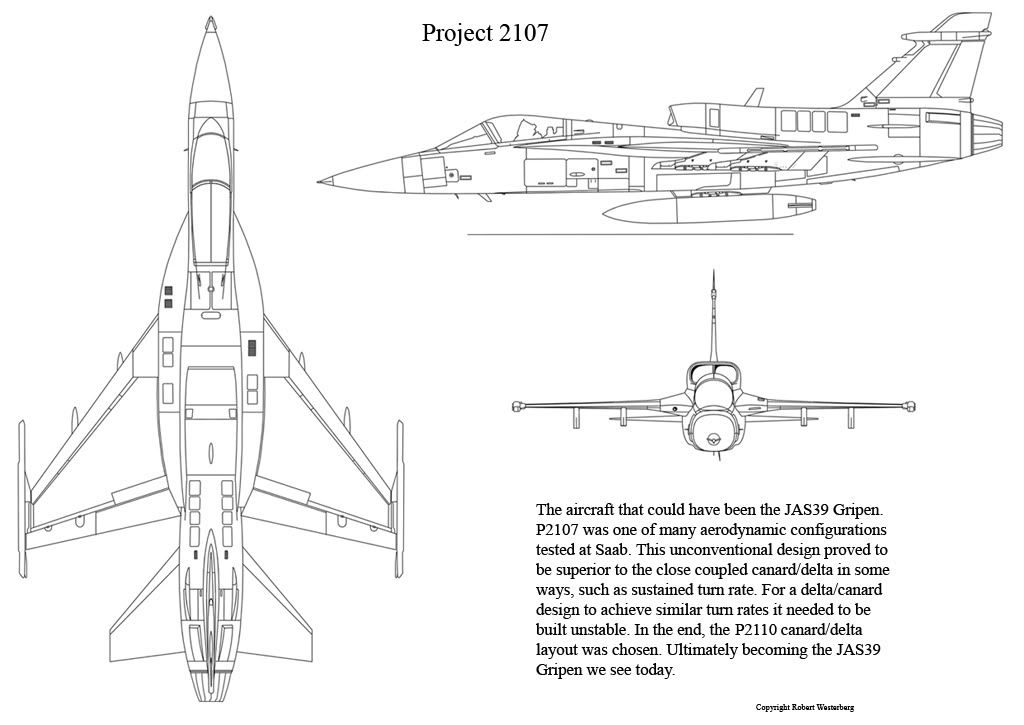
robbanAlso, just as a reference, anyone who has studied the Gripen knows that what appeared to be the best design was the conventionally tailed model 2107, but they thought the dorsal inlet was too risky. They said it actually had lower weight than the canard configuration, which I “think” is due to how they were able to greatly simplify the airframe/engine integration issues by minimizing the weight penalty of the inlet.
With the 2107 the desired STR was achievable with a stable platform. However its drag at supersonic speeds were too high, and as you say the dorsal intake was too risky. As the delta/canard, when bulit unstable offerded good sustained turn rates, as well as low supersonic drag it was (amongst many other reasons)chosen instead of 2107.
robbanI like the look of the JF-17. Sleek and sharp. I read somewhere that one will participate at this years Farnborough. I hope it’s true!:)


robbanfew will say the F-15 and Viggen belong to the same generation.
Strange, because there’s no way around it. They are quite clearly of the same generation. Technology wise the AJ 37 is comparable to the F-15A, and the JA37 is comparable with the F-15C. The JA37 was taken out of service because of budget cuts, not because it wasn’t still effective in its role.
But I agree, the generation issue is indeed mostly subjective and up to a degree a commercial ploy
robbanThe difference is not as great, both are third generation aircraft, the difference in turn rate is substantial of around 2.6deg/s at Mach 0.6, the MiG-23 will be similar with 14.1deg/s sustained turn at 780km/h and 16.7 deg/s instantaneous, however see the early Harrier variants could not pull more than 15 deg/s instantaneous but once LERXes were added it pulled 20deg/s instantaneosu and 17-18 deg/s sustained much superior to the Viggen which shows you using tailplanes is as good as Canards and in stealth tailplanes are easier to adapt to planforming.
See that the Kfir wont go beyond 10deg/s sustained and 18 deg/s instantaneous turn rates so canards are not the inherently superior to tailplanes
The F-4 was concieved at the same time as the Draken, which is a 2nd gen aircraft, according to how SAAB devides the generations. That is, aircraft with integrated weapons and avionics systems. Viggen is a 3rd gen, meaning its infrastructure is based on separate digital systems which rely on computers to achieve functionality.
It is true that in terms of sustained maneuvering capability the stable delta/canard are at a disadvantage(drag), in comparison to an aircraft with a tail.
Before SAAB had decided upon which configuration to use, they saw that a good STR was possible even with a stable tail design, however the delta/canard needed to be unstable.
robbanLet us say it, the Viggen can not pull more tha 6Gs in a turn, the F-4 can pull a little bit more 6.4 and the MiG-23 around 7Gs.
The JA37 Viggen can pull 7G’s, and fly at close to 30 deg AoA before the engine starts to complain.
Also, the F-4 and Viggen does not belong to the same generation. The F-4 is more comparable to the Draken here.
If the youtube vid I posted is anything to go by the Viggen makes a sustained 360 in 22 seconds. The average turn rate would then be 16.36 deg/sec.
robbanOf course , the Mirage 2000, Eurofighter and Rafale have been optimized for some flight regimes, same is any other aircraft.
The Mirage 2000 does exhibit some degree of parity with the F-16 at some flight regimes, but in others is the other way around the F-16 is superior.
As a fighter the Mirage 2000 is preferable, and as an attack aircraft the F-16 is preferable. The high instantaneous turn rate of the Mirage 2000 allows it to get its nose onto the F-16 first. AFAIK, when Greek Mirage’s mix it with Greek F-16’s the Mirage is the victor 9 times out of 10. The F-16 has more power, and because of this a higher sustained turn rate. If the Mirage 2000 had the same TWR as the F-16 how much would their STR differ?
Is it safe to assume that instability offers more for a delta than it does for an aircraft with a tail?
The F-15 and Viggen only show how a design does not exhibit inherent superiority just because it has taiplanes or canards.
Not a fair comparison. The F-15 was designed to be an air superiority fighter, while the Viggen was built to be an attack aircaft. The Viggen was later modified to become a fighter, and The F-15 was later modified to be able to drop bombs. However, it is always better to start out with a fighter and modify it to be an attack aircraft than vice versa.
Had the Viggen arrived just a few years later it might have been fitted with FBW and relaxed stability. This could have completely transformed it into a much more agile and maneuverable aircraft.
The Russians and Americans have created aircraft with compound wings and tailplanes and have fighters with very high thrust to weight ratios in the F-22 is far far higher than a Gripen and the Su-35BM alone is more powerful than even the Eurofighter in terms of thrust.
So, perhaps the combination of instability and canards allows for similar or better sustained turn rates with a lower TWR? It does seem to be the case.
robbanRobban
Having a canard is not a guarantee of being better than a tailplane, a fighter is a product of thrust and lift plus control surfaces.
The Viggen and Kfir for example were completly outmatched by fighters like the F-4 and MiG-23, the sustained turn radius of a Viggen is below of what a F-4 and MiG-23 can achieve and way below what an F-15 does.
The MiG-29 also has better sustained turn rate than the Gripen.Now the F-22 has an excess of power and a huge wing, the F-22 versus the Gripen is quit similar to an F-15 versus Viggen comparation
That’s not an accurate description.
In reality an F-4 pilot would be unwise to mix it with a Viggen. Tornado pilots avoided close combat against the Viggen if they could. And Viggen pilots have told me they found it quite easy to outmaneuver the large F-4.
The big delta and canard produced plenty of lift, but as the canards were fixed and the aircraft was aerodynamically stable it couldn’t get the most out of the configuration like the newer Gripen, Rafale and Eurofighter could.
Nevertheless, the Viggen had a very powerful engine that offered tremendeous acceleration and climb rate. ITR was very good, and at certain altitudes the Viggen could sustain a 6G turn rate until it ran out of fuel.
Video of an AJS 37 airshow display. http://www.youtube.com/watch?v=-JK3Vx_G2k0
The Gripen has in comparison with the F-16, Eurofighter, F-22, MiG-29 etc, a rather poor thrust to weight ratio. But even so, it can still sustain a 20 deg/sec turn rate. And it can fly at supersonic airspeeds with a full A2A load out using dry thrust only.
This should give us an idea that todays modern canard/deltas has come quite a long way in comparison to the stable Viggen, which barely scraped the surface of the delta/canards potential.
Gripen video. From 3:32 – 3:48 Showing a sustained 360 turn in 16 seconds, average turn rate 22.5 deg/sec. http://www.youtube.com/watch?v=ACDGkNa77Rs
robbanForgive me if I’m way off here, but if there’s visible condensation on top of the canard, isn’t that clear proof that the there’s a low pressure area on the top, meaning positive lift?


No condensation on the pic below, but the canards clearly provide positive lift here.

robbanActually a more accurate statement might be is that a clean EF/Rafale might be less draggy than a clean F-22. There’s no way the Raptor is draggier than when they’re fully loaded.
Maybe, maybe not. The reason the F-22 has internal weapons is not to achieve lower drag. it’s just an added bonus.
However, AAM’s aren’t too draggy. Anti-ship missiles, LGB’s and other large heavy A2G weapons have more noticable effects on drag, for obvious reasons.
robbanOkay, so the F-16, which has a soft 25° AoA limit, must be a better, “smarter” performer than all of them. Hell, a fighter with a 10° AoA limit must be downright BRILLIANT. :rolleyes:
***removed by moderator***
:confused: They are precisely the same thing!!
If you really wanted to understand what I meant I wouldn’t have to respond to this, but oh’well. There’s a difference in how the FCS commands the control surfaces when in landing/take off mode in comparison to in flight mode.
Question: Are the canards themselves contributing to lift when/if they’re busy holding the nose down? If they aren’t, then just how relevant is any alledged “positive” effect they might have on the wings?
The stabs on unstable wing-tails LIFT the butt of the plane to keep the nose down. LERXs and slats contribute to airflow management (LERXs also add to overall lift area). It’s a win-win in terms of lift.
And what are the elevons on a canard/delta for? Contrary to tailpushers the canard/delta has more control surfaces to help achieve the best lift/drag possible. The canards work in conjuction with the elevons. You are focusing way to much on the canards.
First of all, “drag management” takes a back seat during subsonic ACM, especially if your’re a 4th gen. fighter carrying a draggy combat load. Second, if you accept the fact that unstable canard-deltas are DOWNFORCE-lift platforms, then it’s in the lift efficiency department where canard-deltas fall short compared to unstable wing-tails. The entire F-22 basically acts as a big wing. It doesn’t rely on downforce to keep its nose in check.
Drag management will always be prio, and that includes subsonic ACM. For all we know the F-22 could be a more draggy design in comparison to, for example a fully loaded Typhoon or Gripen. The F-22 has sacrificed aerodynamics to achieve a higher level of stealth than the Eurocanards. I think it’s safe to say that just like the Eurocanards falls short in the stealth department, the F-22 falls short in aerodynamics department. But, naturally you can’t believe that. The F-22 is infallible after all. :rolleyes:
And please show us the facts you have that canards provide downforce during maneuvers.
If “efficient drag management” is the goal, and if canards are so effective at controlling airflow over the wings, then why use slats at all, seeing as slats are awfully draggy when they’re extended.
If LERX’s are so effective at controlling the airflow over the wings, why use slats at all?
robbanAs long as dassault takes care of the looks :diablo:
Hmmm, is it really necessary? :confused: But alright, just let SAAB take care of build quality.:D
robbanTo say that the reason was lack of experience, fear, etc… is just BS though(not saying that’s what you’re trying to say).
You are right of course, but it’s not just black and white. As there’s quite alot of money involved in designing and producing a fighter jet, any country would prefer to go the safe route. That is, you go with what you know best. It’s undeniably so that the US are far more experienced with conventional designs than with canard/delta ones.


 Sign In







